

118
6 Nanomaterials for Batteries
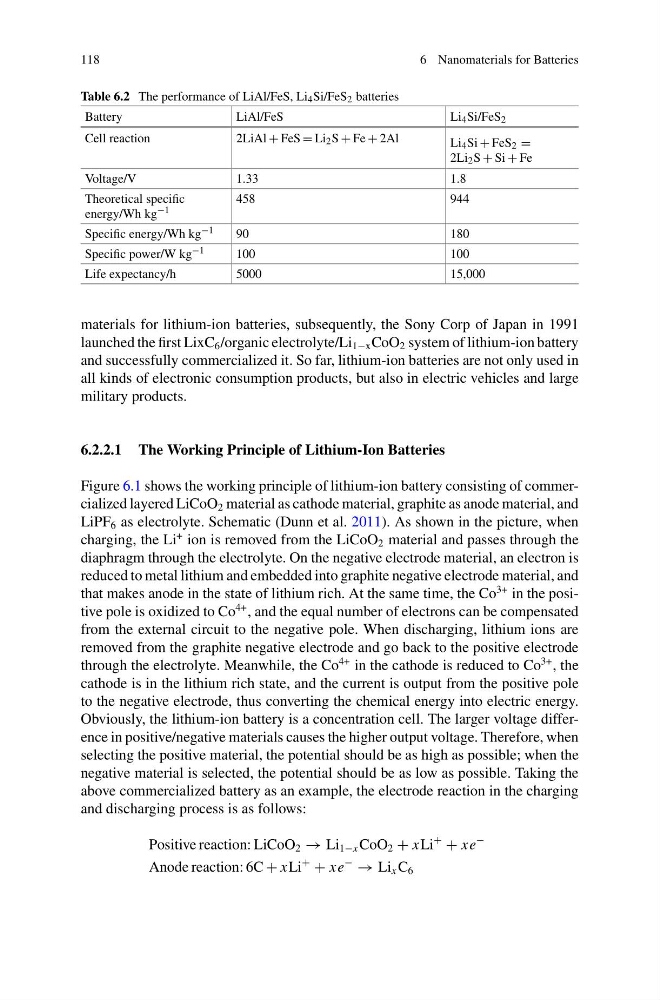
Table 6.2 The performance of LiAl/FeS, Li 4 Si/FeS 2 batteries
Battery
LiAl/FeS
Li 4 Si/FeS 2
Cell reaction
2LiAl + FeS = Li 2 S + Fe + 2Al
Li 4 Si + FeS 2 =
2Li 2 S + Si + Fe
Voltage/V
1.33
1.8
Theoretical specific
energy/Wh kg −1
458
944
Specific energy/Wh kg −1
90
180
Specific power/W kg −1
100
100
Life expectancy/h
5000
15,000
materials for lithium-ion batteries, subsequently, the Sony Corp of Japan in 1991
launched the first LixC 6 /organic electrolyte/Li 1−x CoO 2 system of lithium-ion battery
and successfully commercialized it. So far, lithium-ion batteries are not only used in
all kinds of electronic consumption products, but also in electric vehicles and large
military products.
6.2.2.1 The Working Principle of Lithium-Ion Batteries
Figure 6.1 shows the working principle of lithium-ion battery consisting of commercialized layered LiCoO 2 material as cathode material, graphite as anode material, and
LiPF 6 as electrolyte. Schematic (Dunn et al. 2011). As shown in the picture, when
charging, the Li
+ ion is removed from the LiCoO 2 material and passes through the
diaphragm through the electrolyte. On the negative electrode material, an electron is
reduced to metal lithium and embedded into graphite negative electrode material, and
that makes anode in the state of lithium rich. At the same time, the Co
3+ in the positive pole is oxidized to Co
4+ , and the equal number of electrons can be compensated
from the external circuit to the negative pole. When discharging, lithium ions are
removed from the graphite negative electrode and go back to the positive electrode
through the electrolyte. Meanwhile, the Co
4+ in the cathode is reduced to Co
3+ , the
cathode is in the lithium rich state, and the current is output from the positive pole
to the negative electrode, thus converting the chemical energy into electric energy.
Obviously, the lithium-ion battery is a concentration cell. The larger voltage difference in positive/negative materials causes the higher output voltage. Therefore, when
selecting the positive material, the potential should be as high as possible; when the
negative material is selected, the potential should be as low as possible. Taking the
above commercialized battery as an example, the electrode reaction in the charging
and discharging process is as follows:
Positive reaction: LiCoO 2 → Li 1−x CoO 2 + xLi
+
+ xe
−
Anode reaction: 6C + xLi
+
+ xe
−
→ Li x C 6
6 Nanomaterials for Batteries
Table 6.2 The performance of LiAl/FeS, Li 4 Si/FeS 2 batteries
Battery
LiAl/FeS
Li 4 Si/FeS 2
Cell reaction
2LiAl + FeS = Li 2 S + Fe + 2Al
Li 4 Si + FeS 2 =
2Li 2 S + Si + Fe
Voltage/V
1.33
1.8
Theoretical specific
energy/Wh kg −1
458
944
Specific energy/Wh kg −1
90
180
Specific power/W kg −1
100
100
Life expectancy/h
5000
15,000
materials for lithium-ion batteries, subsequently, the Sony Corp of Japan in 1991
launched the first LixC 6 /organic electrolyte/Li 1−x CoO 2 system of lithium-ion battery
and successfully commercialized it. So far, lithium-ion batteries are not only used in
all kinds of electronic consumption products, but also in electric vehicles and large
military products.
6.2.2.1 The Working Principle of Lithium-Ion Batteries
Figure 6.1 shows the working principle of lithium-ion battery consisting of commercialized layered LiCoO 2 material as cathode material, graphite as anode material, and
LiPF 6 as electrolyte. Schematic (Dunn et al. 2011). As shown in the picture, when
charging, the Li
+ ion is removed from the LiCoO 2 material and passes through the
diaphragm through the electrolyte. On the negative electrode material, an electron is
reduced to metal lithium and embedded into graphite negative electrode material, and
that makes anode in the state of lithium rich. At the same time, the Co
3+ in the positive pole is oxidized to Co
4+ , and the equal number of electrons can be compensated
from the external circuit to the negative pole. When discharging, lithium ions are
removed from the graphite negative electrode and go back to the positive electrode
through the electrolyte. Meanwhile, the Co
4+ in the cathode is reduced to Co
3+ , the
cathode is in the lithium rich state, and the current is output from the positive pole
to the negative electrode, thus converting the chemical energy into electric energy.
Obviously, the lithium-ion battery is a concentration cell. The larger voltage difference in positive/negative materials causes the higher output voltage. Therefore, when
selecting the positive material, the potential should be as high as possible; when the
negative material is selected, the potential should be as low as possible. Taking the
above commercialized battery as an example, the electrode reaction in the charging
and discharging process is as follows:
Positive reaction: LiCoO 2 → Li 1−x CoO 2 + xLi
+
+ xe
−
Anode reaction: 6C + xLi
+
+ xe
−
→ Li x C 6