

102
5 Synthesis of Three-Dimensional Nanomaterials
graphene composites initially (Rengaraj et al. 2015). Graphene was grown on 25mm-thick copper foil by a CVD technique using a mixture of methane and hydrogen.
The copper foil was first annealed in hydrogen at ~1000 °C for 20 min. Graphene
was then grown over methane and hydrogen at the same temperature for 10 min.
A thin poly(methylmethacrylate) (PMMA) film was subsequently spin-coated on a
graphene/copper substrate at 2000 rpm. After drying overnight at room temperature,
the graphene on backside of Cu foil was divided through plasma etching for 2 min.
Cu was then dissolved in ammonium persulfate aqueous solution, after which it was
washed with DI water. The floating graphene/PMMA was scooped onto the SiO 2 /Si
substrate (1 × 1 cm), dried under vacuum overnight and baked at the environment
of 150 °C for 10 min. Eventually, PMMA was dissolved in acetone. The one-step
electrochemical synthesis of the NiO/graphene nanocomposite was carried out by
scanning the potential of the graphene/GCE between −1.2 and 0 V versus SCE at a
scan rate of 50 mV s
−1 for 30 cycles in the environment of 0.1 M acetate buffer solution (ABS, pH 4.0) containing 10 mM Ni(NO 3 ) 2 as an electrolyte. After deposition,
the electrode was flushed with distilled water, then kept annealed at the environment
of 270 °C for 3 h in air.
Furthermore, Xia et al. attempted to meet requirements of universal design for
high-performance supercapacitor electrodes through combining with strategies of
lightweight substrate, porous nanostructure design, and conductivity modification.
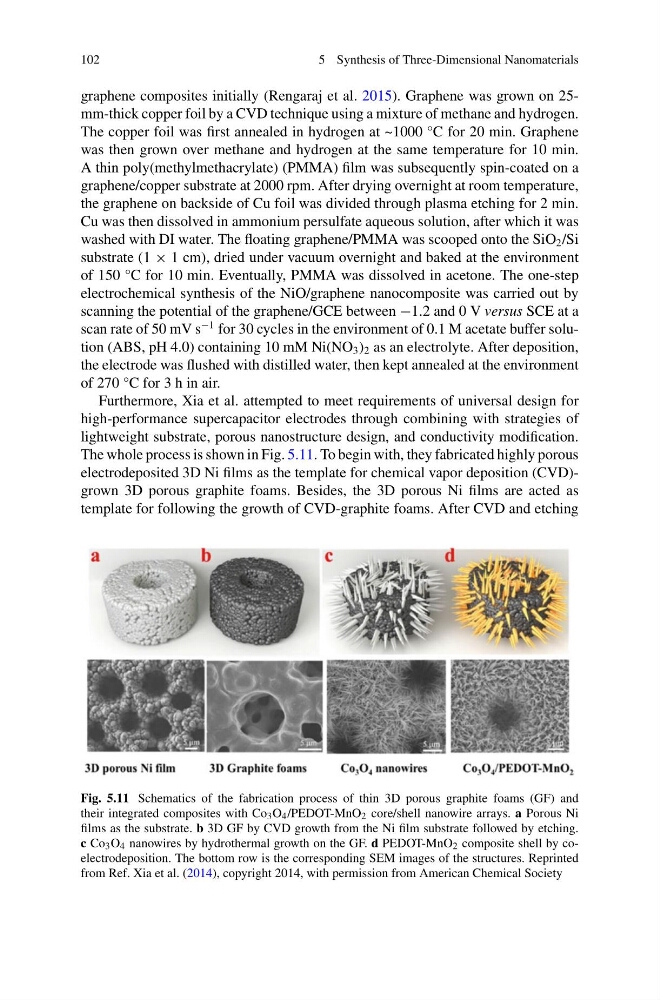
The whole process is shown in Fig. 5.11. To begin with, they fabricated highly porous
electrodeposited 3D Ni films as the template for chemical vapor deposition (CVD)grown 3D porous graphite foams. Besides, the 3D porous Ni films are acted as
template for following the growth of CVD-graphite foams. After CVD and etching
Fig. 5.11 Schematics of the fabrication process of thin 3D porous graphite foams (GF) and
their integrated composites with Co 3 O 4 /PEDOT-MnO 2 core/shell nanowire arrays. a Porous Ni
films as the substrate. b 3D GF by CVD growth from the Ni film substrate followed by etching.
c Co 3 O 4 nanowires by hydrothermal growth on the GF. d PEDOT-MnO 2 composite shell by coelectrodeposition. The bottom row is the corresponding SEM images of the structures. Reprinted
from Ref. Xia et al. (2014), copyright 2014, with permission from American Chemical Society
5 Synthesis of Three-Dimensional Nanomaterials
graphene composites initially (Rengaraj et al. 2015). Graphene was grown on 25mm-thick copper foil by a CVD technique using a mixture of methane and hydrogen.
The copper foil was first annealed in hydrogen at ~1000 °C for 20 min. Graphene
was then grown over methane and hydrogen at the same temperature for 10 min.
A thin poly(methylmethacrylate) (PMMA) film was subsequently spin-coated on a
graphene/copper substrate at 2000 rpm. After drying overnight at room temperature,
the graphene on backside of Cu foil was divided through plasma etching for 2 min.
Cu was then dissolved in ammonium persulfate aqueous solution, after which it was
washed with DI water. The floating graphene/PMMA was scooped onto the SiO 2 /Si
substrate (1 × 1 cm), dried under vacuum overnight and baked at the environment
of 150 °C for 10 min. Eventually, PMMA was dissolved in acetone. The one-step
electrochemical synthesis of the NiO/graphene nanocomposite was carried out by
scanning the potential of the graphene/GCE between −1.2 and 0 V versus SCE at a
scan rate of 50 mV s
−1 for 30 cycles in the environment of 0.1 M acetate buffer solution (ABS, pH 4.0) containing 10 mM Ni(NO 3 ) 2 as an electrolyte. After deposition,
the electrode was flushed with distilled water, then kept annealed at the environment
of 270 °C for 3 h in air.
Furthermore, Xia et al. attempted to meet requirements of universal design for
high-performance supercapacitor electrodes through combining with strategies of
lightweight substrate, porous nanostructure design, and conductivity modification.
The whole process is shown in Fig. 5.11. To begin with, they fabricated highly porous
electrodeposited 3D Ni films as the template for chemical vapor deposition (CVD)grown 3D porous graphite foams. Besides, the 3D porous Ni films are acted as
template for following the growth of CVD-graphite foams. After CVD and etching
Fig. 5.11 Schematics of the fabrication process of thin 3D porous graphite foams (GF) and
their integrated composites with Co 3 O 4 /PEDOT-MnO 2 core/shell nanowire arrays. a Porous Ni
films as the substrate. b 3D GF by CVD growth from the Ni film substrate followed by etching.
c Co 3 O 4 nanowires by hydrothermal growth on the GF. d PEDOT-MnO 2 composite shell by coelectrodeposition. The bottom row is the corresponding SEM images of the structures. Reprinted
from Ref. Xia et al. (2014), copyright 2014, with permission from American Chemical Society