

100
5 Synthesis of Three-Dimensional Nanomaterials
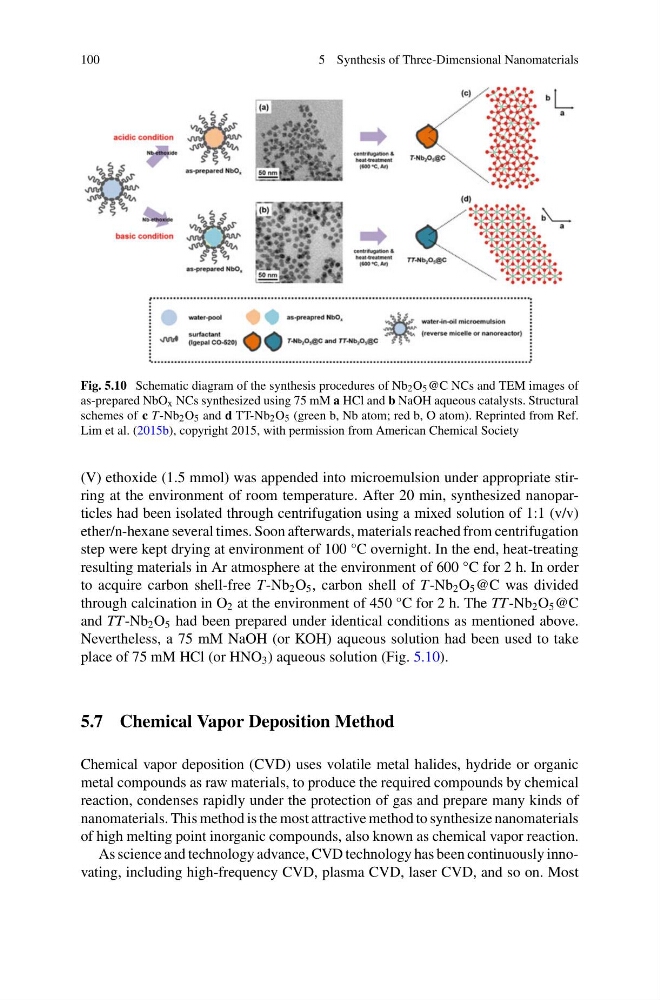
Fig. 5.10 Schematic diagram of the synthesis procedures of Nb 2 O 5 @C NCs and TEM images of
as-prepared NbO x NCs synthesized using 75 mM a HCl and b NaOH aqueous catalysts. Structural
schemes of c T-Nb 2 O 5 and d TT-Nb 2 O 5 (green b, Nb atom; red b, O atom). Reprinted from Ref.
Lim et al. (2015b), copyright 2015, with permission from American Chemical Society
(V) ethoxide (1.5 mmol) was appended into microemulsion under appropriate stirring at the environment of room temperature. After 20 min, synthesized nanoparticles had been isolated through centrifugation using a mixed solution of 1:1 (v/v)
ether/n-hexane several times. Soon afterwards, materials reached from centrifugation
step were kept drying at environment of 100 °C overnight. In the end, heat-treating
resulting materials in Ar atmosphere at the environment of 600 °C for 2 h. In order
to acquire carbon shell-free T-Nb 2 O 5 , carbon shell of T-Nb 2 O 5 @C was divided
through calcination in O 2 at the environment of 450 °C for 2 h. The TT-Nb 2 O 5 @C
and TT-Nb 2 O 5 had been prepared under identical conditions as mentioned above.
Nevertheless, a 75 mM NaOH (or KOH) aqueous solution had been used to take
place of 75 mM HCl (or HNO 3 ) aqueous solution (Fig. 5.10).
5.7 Chemical Vapor Deposition Method
Chemical vapor deposition (CVD) uses volatile metal halides, hydride or organic
metal compounds as raw materials, to produce the required compounds by chemical
reaction, condenses rapidly under the protection of gas and prepare many kinds of
nanomaterials. This method is the most attractive method to synthesize nanomaterials
of high melting point inorganic compounds, also known as chemical vapor reaction.
As science and technology advance, CVD technology has been continuously innovating, including high-frequency CVD, plasma CVD, laser CVD, and so on. Most
5 Synthesis of Three-Dimensional Nanomaterials
Fig. 5.10 Schematic diagram of the synthesis procedures of Nb 2 O 5 @C NCs and TEM images of
as-prepared NbO x NCs synthesized using 75 mM a HCl and b NaOH aqueous catalysts. Structural
schemes of c T-Nb 2 O 5 and d TT-Nb 2 O 5 (green b, Nb atom; red b, O atom). Reprinted from Ref.
Lim et al. (2015b), copyright 2015, with permission from American Chemical Society
(V) ethoxide (1.5 mmol) was appended into microemulsion under appropriate stirring at the environment of room temperature. After 20 min, synthesized nanoparticles had been isolated through centrifugation using a mixed solution of 1:1 (v/v)
ether/n-hexane several times. Soon afterwards, materials reached from centrifugation
step were kept drying at environment of 100 °C overnight. In the end, heat-treating
resulting materials in Ar atmosphere at the environment of 600 °C for 2 h. In order
to acquire carbon shell-free T-Nb 2 O 5 , carbon shell of T-Nb 2 O 5 @C was divided
through calcination in O 2 at the environment of 450 °C for 2 h. The TT-Nb 2 O 5 @C
and TT-Nb 2 O 5 had been prepared under identical conditions as mentioned above.
Nevertheless, a 75 mM NaOH (or KOH) aqueous solution had been used to take
place of 75 mM HCl (or HNO 3 ) aqueous solution (Fig. 5.10).
5.7 Chemical Vapor Deposition Method
Chemical vapor deposition (CVD) uses volatile metal halides, hydride or organic
metal compounds as raw materials, to produce the required compounds by chemical
reaction, condenses rapidly under the protection of gas and prepare many kinds of
nanomaterials. This method is the most attractive method to synthesize nanomaterials
of high melting point inorganic compounds, also known as chemical vapor reaction.
As science and technology advance, CVD technology has been continuously innovating, including high-frequency CVD, plasma CVD, laser CVD, and so on. Most