

5.6 Microemulsion Method
99
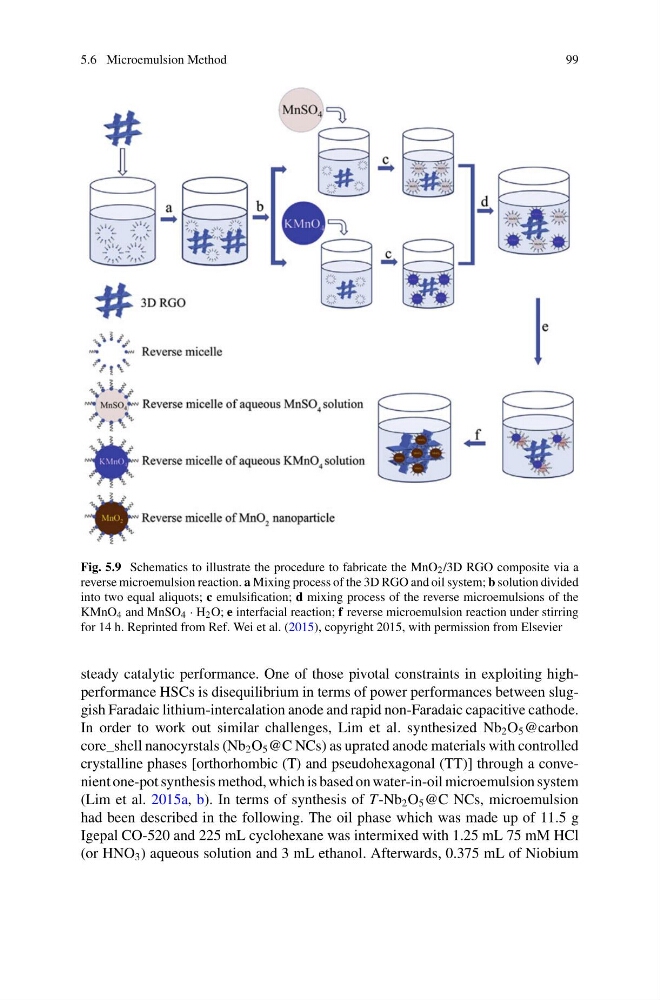
Fig. 5.9 Schematics to illustrate the procedure to fabricate the MnO 2 /3D RGO composite via a
reverse microemulsion reaction. a Mixing process of the 3D RGO and oil system; b solution divided
into two equal aliquots; c emulsification; d mixing process of the reverse microemulsions of the
KMnO 4 and MnSO 4 · H 2 O; e interfacial reaction; f reverse microemulsion reaction under stirring
for 14 h. Reprinted from Ref. Wei et al. (2015), copyright 2015, with permission from Elsevier
steady catalytic performance. One of those pivotal constraints in exploiting highperformance HSCs is disequilibrium in terms of power performances between sluggish Faradaic lithium-intercalation anode and rapid non-Faradaic capacitive cathode.
In order to work out similar challenges, Lim et al. synthesized Nb 2 O 5 @carbon
core_shell nanocyrstals (Nb 2 O 5 @C NCs) as uprated anode materials with controlled
crystalline phases [orthorhombic (T) and pseudohexagonal (TT)] through a convenient one-pot synthesis method, which is based on water-in-oil microemulsion system
(Lim et al. 2015a, b). In terms of synthesis of T-Nb 2 O 5 @C NCs, microemulsion
had been described in the following. The oil phase which was made up of 11.5 g
Igepal CO-520 and 225 mL cyclohexane was intermixed with 1.25 mL 75 mM HCl
(or HNO 3 ) aqueous solution and 3 mL ethanol. Afterwards, 0.375 mL of Niobium
99
Fig. 5.9 Schematics to illustrate the procedure to fabricate the MnO 2 /3D RGO composite via a
reverse microemulsion reaction. a Mixing process of the 3D RGO and oil system; b solution divided
into two equal aliquots; c emulsification; d mixing process of the reverse microemulsions of the
KMnO 4 and MnSO 4 · H 2 O; e interfacial reaction; f reverse microemulsion reaction under stirring
for 14 h. Reprinted from Ref. Wei et al. (2015), copyright 2015, with permission from Elsevier
steady catalytic performance. One of those pivotal constraints in exploiting highperformance HSCs is disequilibrium in terms of power performances between sluggish Faradaic lithium-intercalation anode and rapid non-Faradaic capacitive cathode.
In order to work out similar challenges, Lim et al. synthesized Nb 2 O 5 @carbon
core_shell nanocyrstals (Nb 2 O 5 @C NCs) as uprated anode materials with controlled
crystalline phases [orthorhombic (T) and pseudohexagonal (TT)] through a convenient one-pot synthesis method, which is based on water-in-oil microemulsion system
(Lim et al. 2015a, b). In terms of synthesis of T-Nb 2 O 5 @C NCs, microemulsion
had been described in the following. The oil phase which was made up of 11.5 g
Igepal CO-520 and 225 mL cyclohexane was intermixed with 1.25 mL 75 mM HCl
(or HNO 3 ) aqueous solution and 3 mL ethanol. Afterwards, 0.375 mL of Niobium