

A Look at Semantic Web Technology and the Potential Semantic …
69
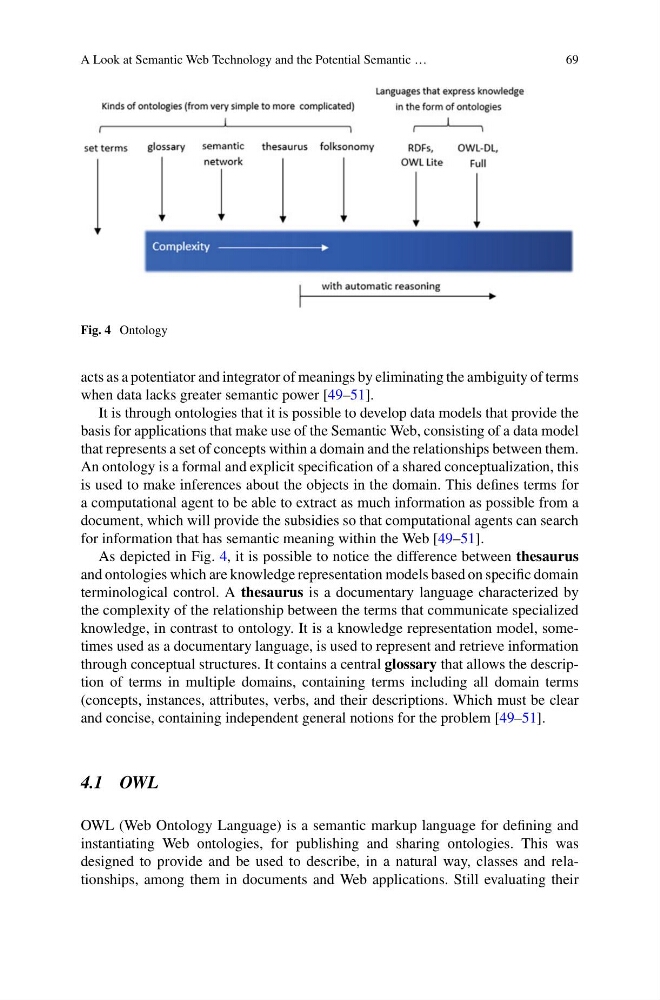
Fig. 4 Ontology
acts as a potentiator and integrator of meanings by eliminating the ambiguity of terms
when data lacks greater semantic power [49–51].
It is through ontologies that it is possible to develop data models that provide the
basis for applications that make use of the Semantic Web, consisting of a data model
that represents a set of concepts within a domain and the relationships between them.
An ontology is a formal and explicit specification of a shared conceptualization, this
is used to make inferences about the objects in the domain. This defines terms for
a computational agent to be able to extract as much information as possible from a
document, which will provide the subsidies so that computational agents can search
for information that has semantic meaning within the Web [49–51].
As depicted in Fig. 4, it is possible to notice the difference between thesaurus
and ontologies which are knowledge representation models based on specific domain
terminological control. A thesaurus is a documentary language characterized by
the complexity of the relationship between the terms that communicate specialized
knowledge, in contrast to ontology. It is a knowledge representation model, sometimes used as a documentary language, is used to represent and retrieve information
through conceptual structures. It contains a central glossary that allows the description of terms in multiple domains, containing terms including all domain terms
(concepts, instances, attributes, verbs, and their descriptions. Which must be clear
and concise, containing independent general notions for the problem [49–51].
4.1 OWL
OWL (Web Ontology Language) is a semantic markup language for defining and
instantiating Web ontologies, for publishing and sharing ontologies. This was
designed to provide and be used to describe, in a natural way, classes and relationships, among them in documents and Web applications. Still evaluating their
69
Fig. 4 Ontology
acts as a potentiator and integrator of meanings by eliminating the ambiguity of terms
when data lacks greater semantic power [49–51].
It is through ontologies that it is possible to develop data models that provide the
basis for applications that make use of the Semantic Web, consisting of a data model
that represents a set of concepts within a domain and the relationships between them.
An ontology is a formal and explicit specification of a shared conceptualization, this
is used to make inferences about the objects in the domain. This defines terms for
a computational agent to be able to extract as much information as possible from a
document, which will provide the subsidies so that computational agents can search
for information that has semantic meaning within the Web [49–51].
As depicted in Fig. 4, it is possible to notice the difference between thesaurus
and ontologies which are knowledge representation models based on specific domain
terminological control. A thesaurus is a documentary language characterized by
the complexity of the relationship between the terms that communicate specialized
knowledge, in contrast to ontology. It is a knowledge representation model, sometimes used as a documentary language, is used to represent and retrieve information
through conceptual structures. It contains a central glossary that allows the description of terms in multiple domains, containing terms including all domain terms
(concepts, instances, attributes, verbs, and their descriptions. Which must be clear
and concise, containing independent general notions for the problem [49–51].
4.1 OWL
OWL (Web Ontology Language) is a semantic markup language for defining and
instantiating Web ontologies, for publishing and sharing ontologies. This was
designed to provide and be used to describe, in a natural way, classes and relationships, among them in documents and Web applications. Still evaluating their