

68
R. P. França et al.
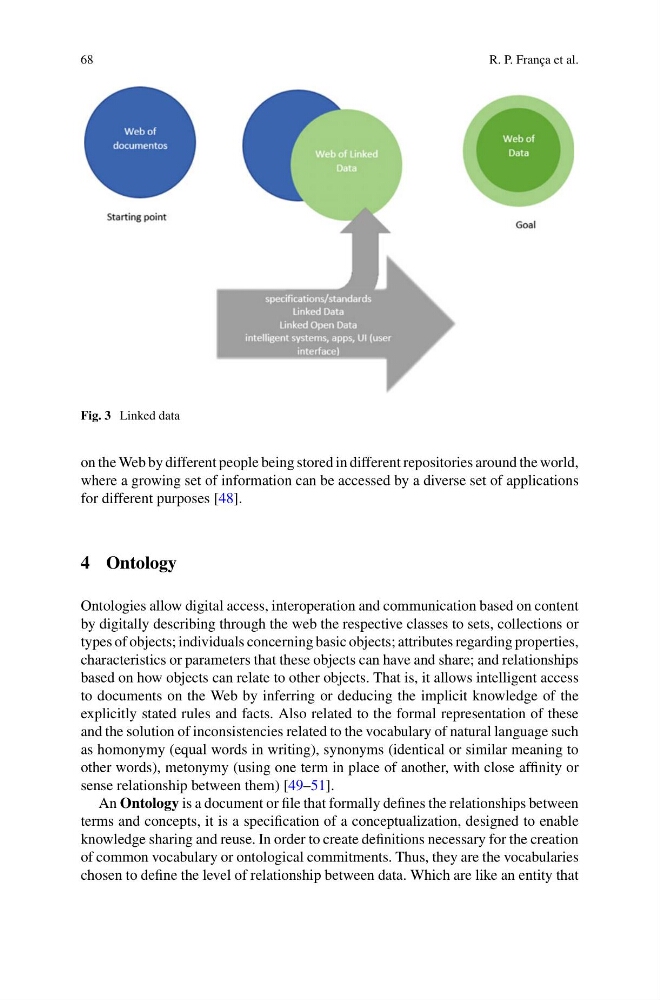
Fig. 3 Linked data
on the Web by different people being stored in different repositories around the world,
where a growing set of information can be accessed by a diverse set of applications
for different purposes [48].
4 Ontology
Ontologies allow digital access, interoperation and communication based on content
by digitally describing through the web the respective classes to sets, collections or
types of objects; individuals concerning basic objects; attributes regarding properties,
characteristics or parameters that these objects can have and share; and relationships
based on how objects can relate to other objects. That is, it allows intelligent access
to documents on the Web by inferring or deducing the implicit knowledge of the
explicitly stated rules and facts. Also related to the formal representation of these
and the solution of inconsistencies related to the vocabulary of natural language such
as homonymy (equal words in writing), synonyms (identical or similar meaning to
other words), metonymy (using one term in place of another, with close affinity or
sense relationship between them) [49–51].
An Ontology is a document or file that formally defines the relationships between
terms and concepts, it is a specification of a conceptualization, designed to enable
knowledge sharing and reuse. In order to create definitions necessary for the creation
of common vocabulary or ontological commitments. Thus, they are the vocabularies
chosen to define the level of relationship between data. Which are like an entity that
R. P. França et al.
Fig. 3 Linked data
on the Web by different people being stored in different repositories around the world,
where a growing set of information can be accessed by a diverse set of applications
for different purposes [48].
4 Ontology
Ontologies allow digital access, interoperation and communication based on content
by digitally describing through the web the respective classes to sets, collections or
types of objects; individuals concerning basic objects; attributes regarding properties,
characteristics or parameters that these objects can have and share; and relationships
based on how objects can relate to other objects. That is, it allows intelligent access
to documents on the Web by inferring or deducing the implicit knowledge of the
explicitly stated rules and facts. Also related to the formal representation of these
and the solution of inconsistencies related to the vocabulary of natural language such
as homonymy (equal words in writing), synonyms (identical or similar meaning to
other words), metonymy (using one term in place of another, with close affinity or
sense relationship between them) [49–51].
An Ontology is a document or file that formally defines the relationships between
terms and concepts, it is a specification of a conceptualization, designed to enable
knowledge sharing and reuse. In order to create definitions necessary for the creation
of common vocabulary or ontological commitments. Thus, they are the vocabularies
chosen to define the level of relationship between data. Which are like an entity that