

40
J. R. Prasad et al.
Dr. Sinha
Dr. Rajwade
Dr. Mehta
Mechanical Engineering
Computer Engineering
Electronics Engineering
Civil Engineering
Mechanical Engineering
Civil Engineering
Pune, Maharashtra, India
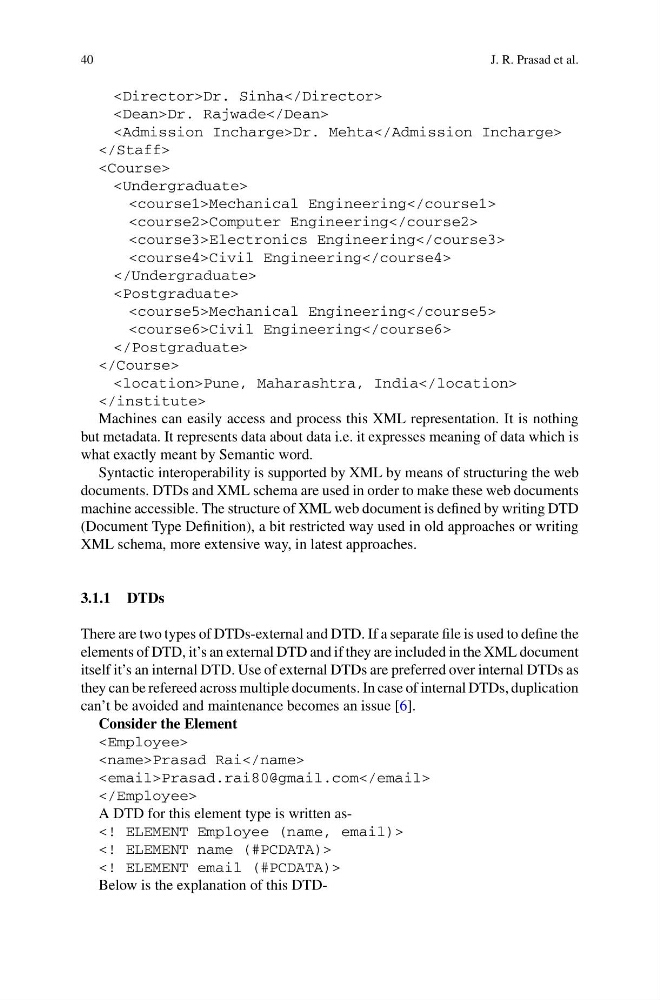
Machines can easily access and process this XML representation. It is nothing
but metadata. It represents data about data i.e. it expresses meaning of data which is
what exactly meant by Semantic word.
Syntactic interoperability is supported by XML by means of structuring the web
documents. DTDs and XML schema are used in order to make these web documents
machine accessible. The structure of XML web document is defined by writing DTD
(Document Type Definition), a bit restricted way used in old approaches or writing
XML schema, more extensive way, in latest approaches.
3.1.1 DTDs
There are two types of DTDs-external and DTD. If a separate file is used to define the
elements of DTD, it’s an external DTD and if they are included in the XML document
itself it’s an internal DTD. Use of external DTDs are preferred over internal DTDs as
they can be refereed across multiple documents. In case of internal DTDs, duplication
can’t be avoided and maintenance becomes an issue [6].
Consider the Element
Prasad Rai
Prasad.rai80@gmail.com
A DTD for this element type is written as
Below is the explanation of this DTD-
J. R. Prasad et al.
Machines can easily access and process this XML representation. It is nothing
but metadata. It represents data about data i.e. it expresses meaning of data which is
what exactly meant by Semantic word.
Syntactic interoperability is supported by XML by means of structuring the web
documents. DTDs and XML schema are used in order to make these web documents
machine accessible. The structure of XML web document is defined by writing DTD
(Document Type Definition), a bit restricted way used in old approaches or writing
XML schema, more extensive way, in latest approaches.
3.1.1 DTDs
There are two types of DTDs-external and DTD. If a separate file is used to define the
elements of DTD, it’s an external DTD and if they are included in the XML document
itself it’s an internal DTD. Use of external DTDs are preferred over internal DTDs as
they can be refereed across multiple documents. In case of internal DTDs, duplication
can’t be avoided and maintenance becomes an issue [6].
Consider the Element
A DTD for this element type is written as
Below is the explanation of this DTD-