

404
J. R. Prasad et al.
4 SDN (Software Defined Network)
The Software-defined network is very helpful because of its centralized nature and
programmable capability. It is having two separate planes, one data plane and another
control plane. In SDN, we are separating both the control and data information from
each other. So these two planes are decoupled from each other. The added advantage is we can implement a heterogeneous environment together with a centralized
control. It also reduces the CAPEX (Capital Expenditure) and OPEX (Operational
Expenditure) of the organization on a huge scale. But the disadvantage is of security
of a centralized controller is very important. We can combine various heterogeneous
IoT environments with this concept of SDN which is programmable. On top of this
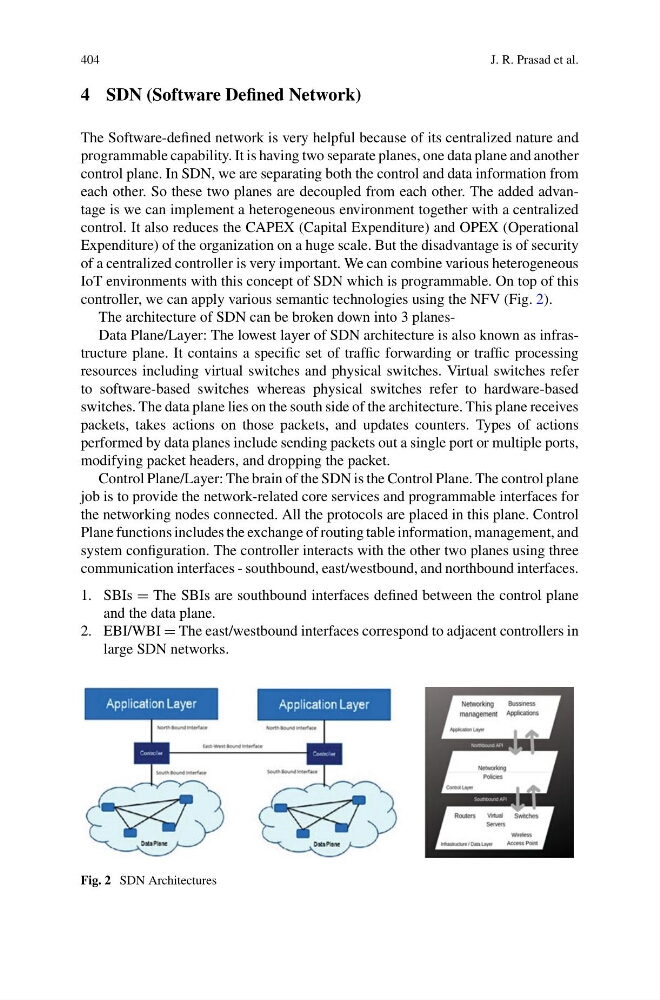
controller, we can apply various semantic technologies using the NFV (Fig. 2).
The architecture of SDN can be broken down into 3 planesData Plane/Layer: The lowest layer of SDN architecture is also known as infrastructure plane. It contains a specific set of traffic forwarding or traffic processing
resources including virtual switches and physical switches. Virtual switches refer
to software-based switches whereas physical switches refer to hardware-based
switches. The data plane lies on the south side of the architecture. This plane receives
packets, takes actions on those packets, and updates counters. Types of actions
performed by data planes include sending packets out a single port or multiple ports,
modifying packet headers, and dropping the packet.
Control Plane/Layer: The brain of the SDN is the Control Plane. The control plane
job is to provide the network-related core services and programmable interfaces for
the networking nodes connected. All the protocols are placed in this plane. Control
Plane functions includes the exchange of routing table information, management, and
system configuration. The controller interacts with the other two planes using three
communication interfaces - southbound, east/westbound, and northbound interfaces.
1. SBIs = The SBIs are southbound interfaces defined between the control plane
and the data plane.
2. EBI/WBI = The east/westbound interfaces correspond to adjacent controllers in
large SDN networks.
Fig. 2 SDN Architectures
J. R. Prasad et al.
4 SDN (Software Defined Network)
The Software-defined network is very helpful because of its centralized nature and
programmable capability. It is having two separate planes, one data plane and another
control plane. In SDN, we are separating both the control and data information from
each other. So these two planes are decoupled from each other. The added advantage is we can implement a heterogeneous environment together with a centralized
control. It also reduces the CAPEX (Capital Expenditure) and OPEX (Operational
Expenditure) of the organization on a huge scale. But the disadvantage is of security
of a centralized controller is very important. We can combine various heterogeneous
IoT environments with this concept of SDN which is programmable. On top of this
controller, we can apply various semantic technologies using the NFV (Fig. 2).
The architecture of SDN can be broken down into 3 planesData Plane/Layer: The lowest layer of SDN architecture is also known as infrastructure plane. It contains a specific set of traffic forwarding or traffic processing
resources including virtual switches and physical switches. Virtual switches refer
to software-based switches whereas physical switches refer to hardware-based
switches. The data plane lies on the south side of the architecture. This plane receives
packets, takes actions on those packets, and updates counters. Types of actions
performed by data planes include sending packets out a single port or multiple ports,
modifying packet headers, and dropping the packet.
Control Plane/Layer: The brain of the SDN is the Control Plane. The control plane
job is to provide the network-related core services and programmable interfaces for
the networking nodes connected. All the protocols are placed in this plane. Control
Plane functions includes the exchange of routing table information, management, and
system configuration. The controller interacts with the other two planes using three
communication interfaces - southbound, east/westbound, and northbound interfaces.
1. SBIs = The SBIs are southbound interfaces defined between the control plane
and the data plane.
2. EBI/WBI = The east/westbound interfaces correspond to adjacent controllers in
large SDN networks.
Fig. 2 SDN Architectures