

394
A. Kumar and S. Sharma
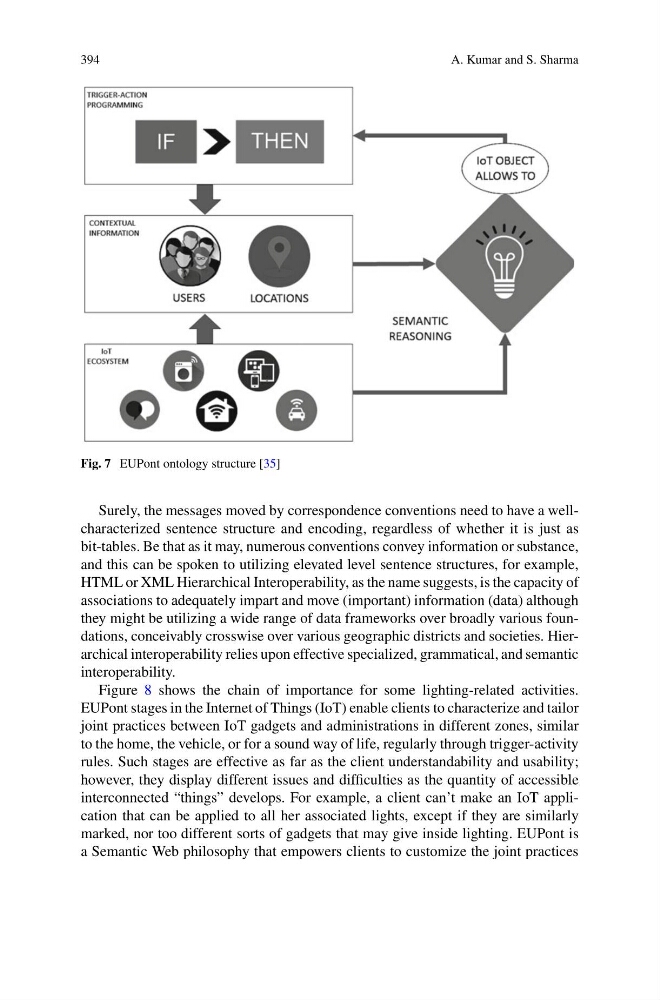
Fig. 7 EUPont ontology structure [35]
Surely, the messages moved by correspondence conventions need to have a wellcharacterized sentence structure and encoding, regardless of whether it is just as
bit-tables. Be that as it may, numerous conventions convey information or substance,
and this can be spoken to utilizing elevated level sentence structures, for example,
HTML or XML Hierarchical Interoperability, as the name suggests, is the capacity of
associations to adequately impart and move (important) information (data) although
they might be utilizing a wide range of data frameworks over broadly various foundations, conceivably crosswise over various geographic districts and societies. Hierarchical interoperability relies upon effective specialized, grammatical, and semantic
interoperability.
Figure 8 shows the chain of importance for some lighting-related activities.
EUPont stages in the Internet of Things (IoT) enable clients to characterize and tailor
joint practices between IoT gadgets and administrations in different zones, similar
to the home, the vehicle, or for a sound way of life, regularly through trigger-activity
rules. Such stages are effective as far as the client understandability and usability;
however, they display different issues and difficulties as the quantity of accessible
interconnected “things” develops. For example, a client can’t make an IoT application that can be applied to all her associated lights, except if they are similarly
marked, nor too different sorts of gadgets that may give inside lighting. EUPont is
a Semantic Web philosophy that empowers clients to customize the joint practices
A. Kumar and S. Sharma
Fig. 7 EUPont ontology structure [35]
Surely, the messages moved by correspondence conventions need to have a wellcharacterized sentence structure and encoding, regardless of whether it is just as
bit-tables. Be that as it may, numerous conventions convey information or substance,
and this can be spoken to utilizing elevated level sentence structures, for example,
HTML or XML Hierarchical Interoperability, as the name suggests, is the capacity of
associations to adequately impart and move (important) information (data) although
they might be utilizing a wide range of data frameworks over broadly various foundations, conceivably crosswise over various geographic districts and societies. Hierarchical interoperability relies upon effective specialized, grammatical, and semantic
interoperability.
Figure 8 shows the chain of importance for some lighting-related activities.
EUPont stages in the Internet of Things (IoT) enable clients to characterize and tailor
joint practices between IoT gadgets and administrations in different zones, similar
to the home, the vehicle, or for a sound way of life, regularly through trigger-activity
rules. Such stages are effective as far as the client understandability and usability;
however, they display different issues and difficulties as the quantity of accessible
interconnected “things” develops. For example, a client can’t make an IoT application that can be applied to all her associated lights, except if they are similarly
marked, nor too different sorts of gadgets that may give inside lighting. EUPont is
a Semantic Web philosophy that empowers clients to customize the joint practices