

Semantic Localization for IoT
375
space (e.g. containment, path, proximity, angle, etc.), and functions define other
structural aspects of the space (such as distance for a metric space) as appropriate.
The values of constants, relations and functions are potentially time varying as the
structure evolves. For instance, a topological ontology of an indoor space with doors
opening and closing has a dynamic “path” relation. The quality and nature of the
sensor data may constrain the level at which these ontologies may be constructed.
For example, orientation information may simply not be available.
2.3 Physical and Relational Ontologies
In the previous section, a spatial ontology is a mathematical structure which can be
used to evaluate a logical sentence that makes reference to spatial relationships. This
notion of a spatial ontology is considerably more general than the usual notion of a
printed paper map with a 2D representation of the road network of a city, for example.
We will use the term “relational ontology” when we want to emphasize the abstracted
nature of the spatial relationships that the map represents, but in this research, a spatial
ontology is a mathematical object at any of these levels of abstraction, as long as it
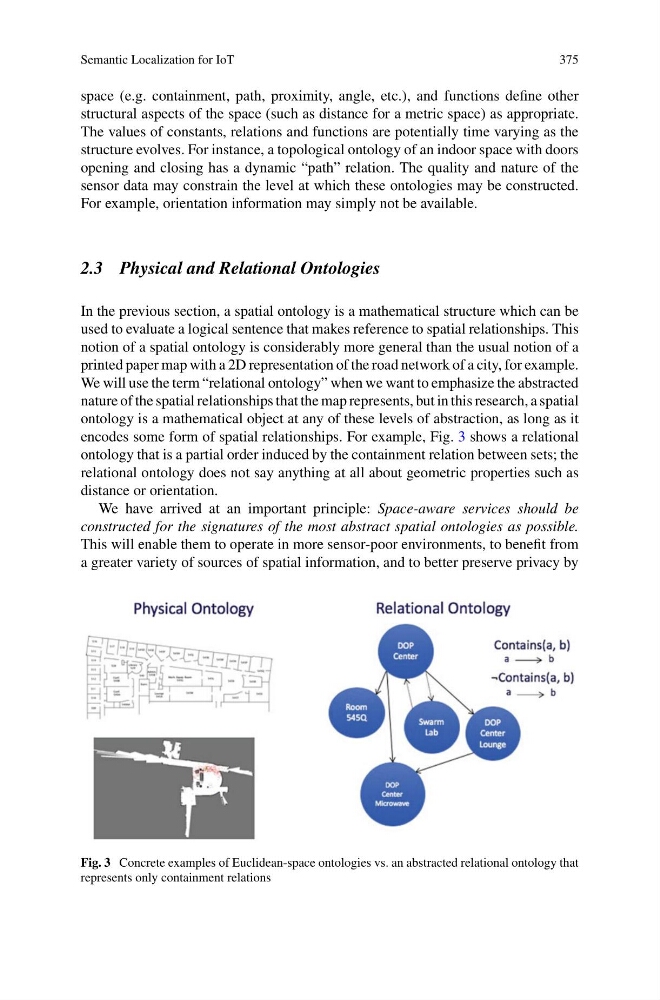
encodes some form of spatial relationships. For example, Fig. 3 shows a relational
ontology that is a partial order induced by the containment relation between sets; the
relational ontology does not say anything at all about geometric properties such as
distance or orientation.
We have arrived at an important principle: Space-aware services should be
constructed for the signatures of the most abstract spatial ontologies as possible.
This will enable them to operate in more sensor-poor environments, to benefit from
a greater variety of sources of spatial information, and to better preserve privacy by
Fig. 3 Concrete examples of Euclidean-space ontologies vs. an abstracted relational ontology that
represents only containment relations
375
space (e.g. containment, path, proximity, angle, etc.), and functions define other
structural aspects of the space (such as distance for a metric space) as appropriate.
The values of constants, relations and functions are potentially time varying as the
structure evolves. For instance, a topological ontology of an indoor space with doors
opening and closing has a dynamic “path” relation. The quality and nature of the
sensor data may constrain the level at which these ontologies may be constructed.
For example, orientation information may simply not be available.
2.3 Physical and Relational Ontologies
In the previous section, a spatial ontology is a mathematical structure which can be
used to evaluate a logical sentence that makes reference to spatial relationships. This
notion of a spatial ontology is considerably more general than the usual notion of a
printed paper map with a 2D representation of the road network of a city, for example.
We will use the term “relational ontology” when we want to emphasize the abstracted
nature of the spatial relationships that the map represents, but in this research, a spatial
ontology is a mathematical object at any of these levels of abstraction, as long as it
encodes some form of spatial relationships. For example, Fig. 3 shows a relational
ontology that is a partial order induced by the containment relation between sets; the
relational ontology does not say anything at all about geometric properties such as
distance or orientation.
We have arrived at an important principle: Space-aware services should be
constructed for the signatures of the most abstract spatial ontologies as possible.
This will enable them to operate in more sensor-poor environments, to benefit from
a greater variety of sources of spatial information, and to better preserve privacy by
Fig. 3 Concrete examples of Euclidean-space ontologies vs. an abstracted relational ontology that
represents only containment relations