

374
M. Weber and E. A. Lee
particular spatial ontology. Just as the formula ∃n 0 < n < 1 may be evaluated within
different structures, so too might a semantic localization formula be evaluated within
heterogeneous spatial ontologies. For example, let contains (a, b) be a binary relation
which is true when room a contains person b, let user1 and user2 be constants for
people, and let the variable room range over a set of rooms. The formula ∃ room
contains(room, user1) ∧ contains(room, user2) expresses the spatial arrangement in
which user1 and user2 are both within the same room, independently of a particular
spatial ontology. We propose using semantic localization as a conceptual interface
between location programming and location models in the IoT.
A semantic localization formula can be interpreted in one of two ways: either
as an event condition or as a query into some spatial database. In the first case, the
sentence acts as a predicate that triggers an event when it evaluates to true. In the
second case, the formula can be evaluated against database entries to signify that the
entries to return are those that cause the formula to evaluate to true when plugged
into unbound variables. However, in either case a statement can only be evaluated in
an ontology with a compatible signature.
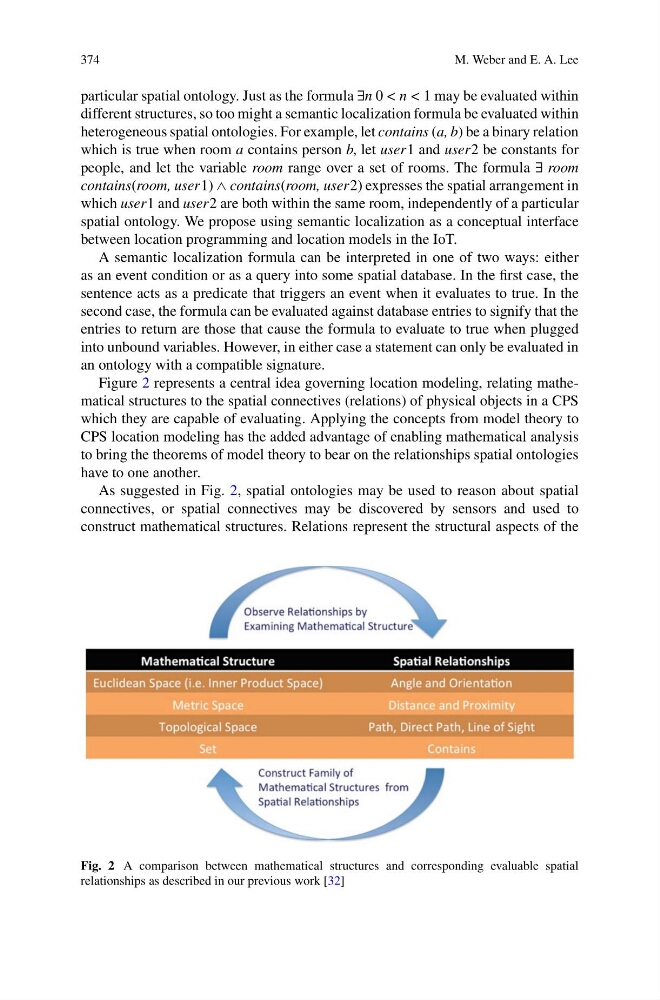
Figure 2 represents a central idea governing location modeling, relating mathematical structures to the spatial connectives (relations) of physical objects in a CPS
which they are capable of evaluating. Applying the concepts from model theory to
CPS location modeling has the added advantage of enabling mathematical analysis
to bring the theorems of model theory to bear on the relationships spatial ontologies
have to one another.
As suggested in Fig. 2, spatial ontologies may be used to reason about spatial
connectives, or spatial connectives may be discovered by sensors and used to
construct mathematical structures. Relations represent the structural aspects of the
Fig. 2 A comparison between mathematical structures and corresponding evaluable spatial
relationships as described in our previous work [32]
M. Weber and E. A. Lee
particular spatial ontology. Just as the formula ∃n 0 < n < 1 may be evaluated within
different structures, so too might a semantic localization formula be evaluated within
heterogeneous spatial ontologies. For example, let contains (a, b) be a binary relation
which is true when room a contains person b, let user1 and user2 be constants for
people, and let the variable room range over a set of rooms. The formula ∃ room
contains(room, user1) ∧ contains(room, user2) expresses the spatial arrangement in
which user1 and user2 are both within the same room, independently of a particular
spatial ontology. We propose using semantic localization as a conceptual interface
between location programming and location models in the IoT.
A semantic localization formula can be interpreted in one of two ways: either
as an event condition or as a query into some spatial database. In the first case, the
sentence acts as a predicate that triggers an event when it evaluates to true. In the
second case, the formula can be evaluated against database entries to signify that the
entries to return are those that cause the formula to evaluate to true when plugged
into unbound variables. However, in either case a statement can only be evaluated in
an ontology with a compatible signature.
Figure 2 represents a central idea governing location modeling, relating mathematical structures to the spatial connectives (relations) of physical objects in a CPS
which they are capable of evaluating. Applying the concepts from model theory to
CPS location modeling has the added advantage of enabling mathematical analysis
to bring the theorems of model theory to bear on the relationships spatial ontologies
have to one another.
As suggested in Fig. 2, spatial ontologies may be used to reason about spatial
connectives, or spatial connectives may be discovered by sensors and used to
construct mathematical structures. Relations represent the structural aspects of the
Fig. 2 A comparison between mathematical structures and corresponding evaluable spatial
relationships as described in our previous work [32]