

360
G. Chuiko et al.
Table 1 Hill’s parameters
Method
A
B
c
d
Data source
ELISA
1.3
100.7
30.9
−0.96
[24–27, 33]
ELISA
3.7
99.7
5.1
−1.17
[28]
RIA
−0.5
100.7
5.2
−0.89
[31]
ELISA 2019
2.7
99.7
5.2
−1.03
[29]
RIA
−1.1
99.5
6.5
−0.98
[32]
Mean
2.3
100.1
10.6
−1.00
Standard deviation
4.1
0.6
11.4
0.10
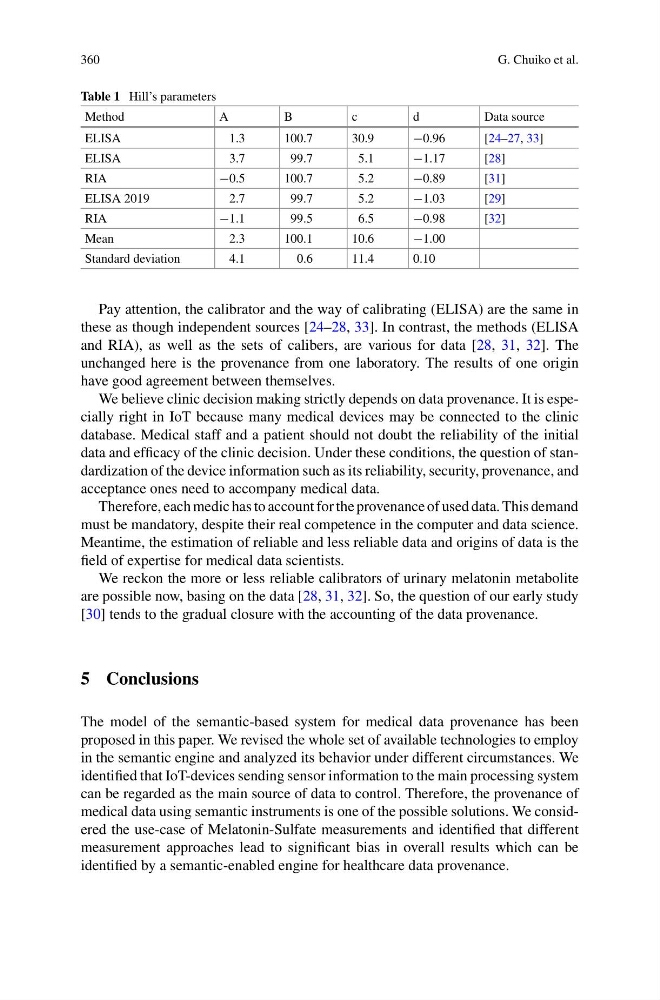
Pay attention, the calibrator and the way of calibrating (ELISA) are the same in
these as though independent sources [24–28, 33]. In contrast, the methods (ELISA
and RIA), as well as the sets of calibers, are various for data [28, 31, 32]. The
unchanged here is the provenance from one laboratory. The results of one origin
have good agreement between themselves.
We believe clinic decision making strictly depends on data provenance. It is especially right in IoT because many medical devices may be connected to the clinic
database. Medical staff and a patient should not doubt the reliability of the initial
data and efficacy of the clinic decision. Under these conditions, the question of standardization of the device information such as its reliability, security, provenance, and
acceptance ones need to accompany medical data.
Therefore, each medic has to account for the provenance of used data. This demand
must be mandatory, despite their real competence in the computer and data science.
Meantime, the estimation of reliable and less reliable data and origins of data is the
field of expertise for medical data scientists.
We reckon the more or less reliable calibrators of urinary melatonin metabolite
are possible now, basing on the data [28, 31, 32]. So, the question of our early study
[30] tends to the gradual closure with the accounting of the data provenance.
5 Conclusions
The model of the semantic-based system for medical data provenance has been
proposed in this paper. We revised the whole set of available technologies to employ
in the semantic engine and analyzed its behavior under different circumstances. We
identified that IoT-devices sending sensor information to the main processing system
can be regarded as the main source of data to control. Therefore, the provenance of
medical data using semantic instruments is one of the possible solutions. We considered the use-case of Melatonin-Sulfate measurements and identified that different
measurement approaches lead to significant bias in overall results which can be
identified by a semantic-enabled engine for healthcare data provenance.
G. Chuiko et al.
Table 1 Hill’s parameters
Method
A
B
c
d
Data source
ELISA
1.3
100.7
30.9
−0.96
[24–27, 33]
ELISA
3.7
99.7
5.1
−1.17
[28]
RIA
−0.5
100.7
5.2
−0.89
[31]
ELISA 2019
2.7
99.7
5.2
−1.03
[29]
RIA
−1.1
99.5
6.5
−0.98
[32]
Mean
2.3
100.1
10.6
−1.00
Standard deviation
4.1
0.6
11.4
0.10
Pay attention, the calibrator and the way of calibrating (ELISA) are the same in
these as though independent sources [24–28, 33]. In contrast, the methods (ELISA
and RIA), as well as the sets of calibers, are various for data [28, 31, 32]. The
unchanged here is the provenance from one laboratory. The results of one origin
have good agreement between themselves.
We believe clinic decision making strictly depends on data provenance. It is especially right in IoT because many medical devices may be connected to the clinic
database. Medical staff and a patient should not doubt the reliability of the initial
data and efficacy of the clinic decision. Under these conditions, the question of standardization of the device information such as its reliability, security, provenance, and
acceptance ones need to accompany medical data.
Therefore, each medic has to account for the provenance of used data. This demand
must be mandatory, despite their real competence in the computer and data science.
Meantime, the estimation of reliable and less reliable data and origins of data is the
field of expertise for medical data scientists.
We reckon the more or less reliable calibrators of urinary melatonin metabolite
are possible now, basing on the data [28, 31, 32]. So, the question of our early study
[30] tends to the gradual closure with the accounting of the data provenance.
5 Conclusions
The model of the semantic-based system for medical data provenance has been
proposed in this paper. We revised the whole set of available technologies to employ
in the semantic engine and analyzed its behavior under different circumstances. We
identified that IoT-devices sending sensor information to the main processing system
can be regarded as the main source of data to control. Therefore, the provenance of
medical data using semantic instruments is one of the possible solutions. We considered the use-case of Melatonin-Sulfate measurements and identified that different
measurement approaches lead to significant bias in overall results which can be
identified by a semantic-enabled engine for healthcare data provenance.