

Semantic Web and IoT
17
knowledge graph construction [103] to question-answering systems [104] and information retrieval [105]. Traditional NEL approaches relied on text-based models
which leveraged linguistic hand-engineered features [106] and machine learning
classifiers (SVM) [107]. Modern systems exploit large knowledge bases (DBpedia,
Wikipedia, WordNet) to create knowledge graphs [108] and deep learning techniques
[109] which leverage both global and local features to achieve document level disambiguation; character and word embeddings, an attention mechanism and a CRF
layer. Local and global features are combined to tackle disambiguation in [110],
which proposes a Personalised PageRank-based approach, a popular Random Walk
(RW) algorithm. Lastly, in [111] a RW variant (random walk with restart—RWR)
and a high-coherence densest subgraph algorithm are combined to create Babelfy,
an integrated approach to EL and Word Sense Disambiguation (WSD).
3.2.5 Modelling Domain—Context
The primacy in cultural heritage domain is owned by CIDOC Conceptual Reference
Model (CRM) [112] which is responsible as both a theoretical and a practical tool
to integrate information in the field of cultural heritage. It provides definitions and
structures depicting concepts in the domain enabling querying and investigation of
such data. It is the nurture of over 20 years of development and maintenance by
the CIDOC Documentation Standards Working Group and more recently by the
CIDOC GRM SG. Since 2006 it has been recognized as an official ISO standard
(ISO 21127:2014).
Ontologies in health domain can capture information like patient profile, including
physiological information, personal information, activities and information specific
to the health status of the patient. An abundance of ontologies have been developed
for this scope, to support smart home capabilities, provide smart assisting living
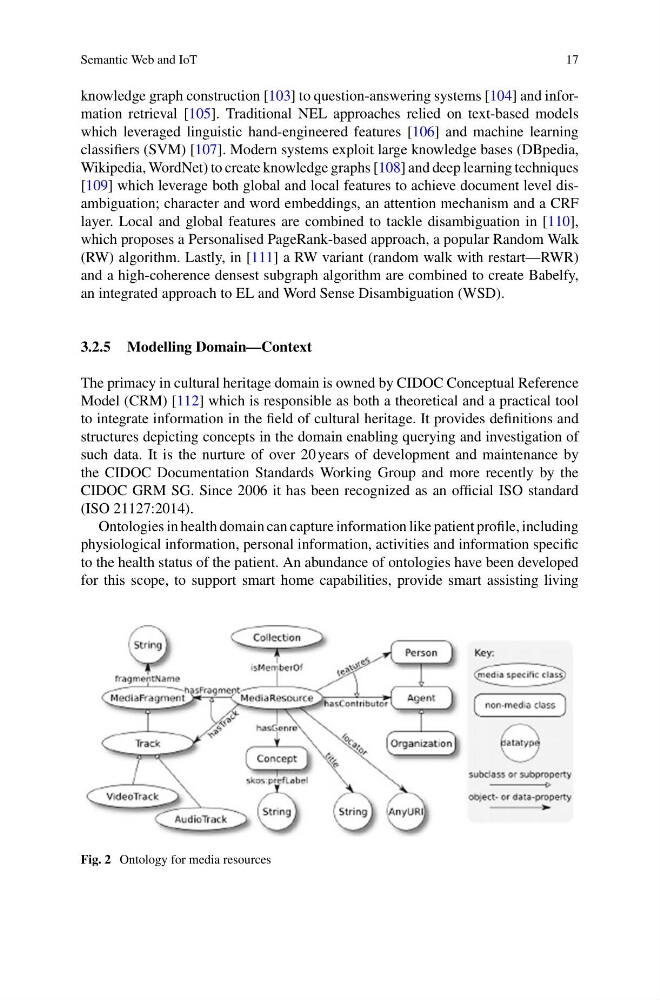
Fig. 2 Ontology for media resources
17
knowledge graph construction [103] to question-answering systems [104] and information retrieval [105]. Traditional NEL approaches relied on text-based models
which leveraged linguistic hand-engineered features [106] and machine learning
classifiers (SVM) [107]. Modern systems exploit large knowledge bases (DBpedia,
Wikipedia, WordNet) to create knowledge graphs [108] and deep learning techniques
[109] which leverage both global and local features to achieve document level disambiguation; character and word embeddings, an attention mechanism and a CRF
layer. Local and global features are combined to tackle disambiguation in [110],
which proposes a Personalised PageRank-based approach, a popular Random Walk
(RW) algorithm. Lastly, in [111] a RW variant (random walk with restart—RWR)
and a high-coherence densest subgraph algorithm are combined to create Babelfy,
an integrated approach to EL and Word Sense Disambiguation (WSD).
3.2.5 Modelling Domain—Context
The primacy in cultural heritage domain is owned by CIDOC Conceptual Reference
Model (CRM) [112] which is responsible as both a theoretical and a practical tool
to integrate information in the field of cultural heritage. It provides definitions and
structures depicting concepts in the domain enabling querying and investigation of
such data. It is the nurture of over 20 years of development and maintenance by
the CIDOC Documentation Standards Working Group and more recently by the
CIDOC GRM SG. Since 2006 it has been recognized as an official ISO standard
(ISO 21127:2014).
Ontologies in health domain can capture information like patient profile, including
physiological information, personal information, activities and information specific
to the health status of the patient. An abundance of ontologies have been developed
for this scope, to support smart home capabilities, provide smart assisting living
Fig. 2 Ontology for media resources