

258
P. Guleria and M. Sood
Table 4 bagOfNgrams on
input dataset
ans = 5 × 1 tokenizedDocument
5 tokens
chill due fever sore throat
7 tokens
cold symptom running nose
cough sneeze bodyache
headache
6 tokens
fatigue cause due symptom
common cold
6 tokens
bodyache tiredness due common
cold
2 tokens
prolong illness
bag = bagOfNgrams with properties
Counts
Vocabulary
Ngrams NgramLengths
NumNgrams
NumDocuments
[13 × 41 double]
[1 × 37 string]
[41 × 2 string]
2
41
13
Initial topic assignments sampled in 0.111156 s.
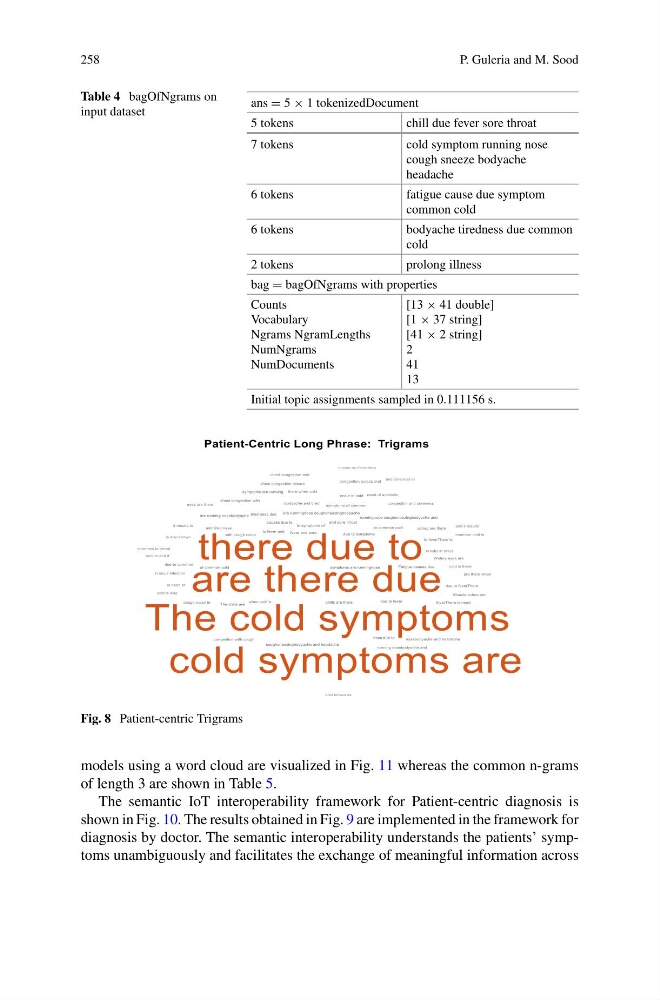
Fig. 8 Patient-centric Trigrams
models using a word cloud are visualized in Fig. 11 whereas the common n-grams
of length 3 are shown in Table 5.
The semantic IoT interoperability framework for Patient-centric diagnosis is
shown in Fig. 10. The results obtained in Fig. 9 are implemented in the framework for
diagnosis by doctor. The semantic interoperability understands the patients’ symptoms unambiguously and facilitates the exchange of meaningful information across
P. Guleria and M. Sood
Table 4 bagOfNgrams on
input dataset
ans = 5 × 1 tokenizedDocument
5 tokens
chill due fever sore throat
7 tokens
cold symptom running nose
cough sneeze bodyache
headache
6 tokens
fatigue cause due symptom
common cold
6 tokens
bodyache tiredness due common
cold
2 tokens
prolong illness
bag = bagOfNgrams with properties
Counts
Vocabulary
Ngrams NgramLengths
NumNgrams
NumDocuments
[13 × 41 double]
[1 × 37 string]
[41 × 2 string]
2
41
13
Initial topic assignments sampled in 0.111156 s.
Fig. 8 Patient-centric Trigrams
models using a word cloud are visualized in Fig. 11 whereas the common n-grams
of length 3 are shown in Table 5.
The semantic IoT interoperability framework for Patient-centric diagnosis is
shown in Fig. 10. The results obtained in Fig. 9 are implemented in the framework for
diagnosis by doctor. The semantic interoperability understands the patients’ symptoms unambiguously and facilitates the exchange of meaningful information across