

Creation of Ontological Knowledge Bases in the Semantic Web …
221
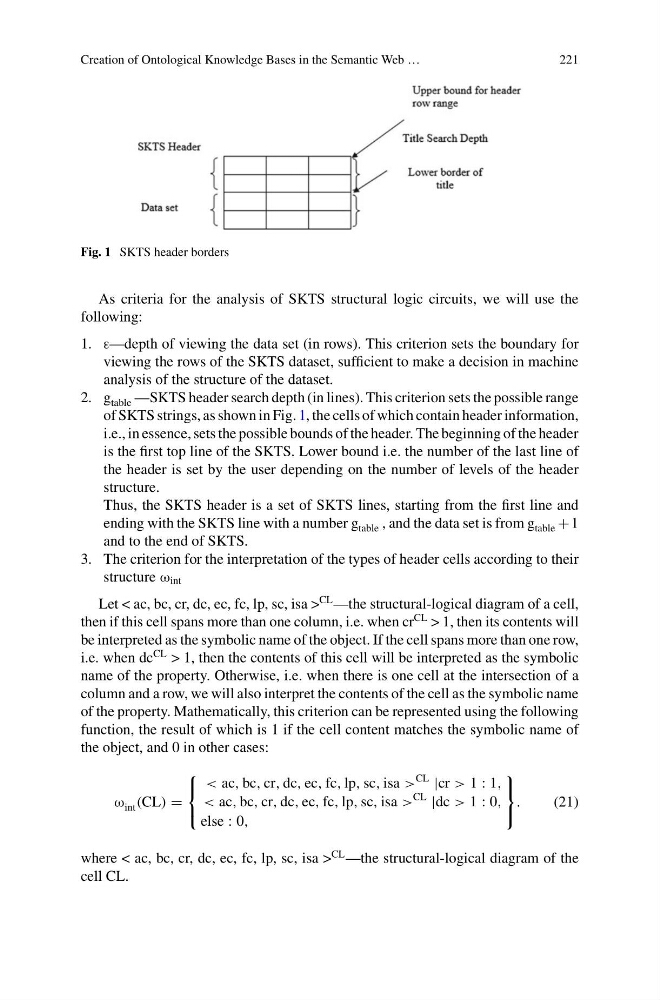
Fig. 1 SKTS header borders
As criteria for the analysis of SKTS structural logic circuits, we will use the
following:
1. ε—depth of viewing the data set (in rows). This criterion sets the boundary for
viewing the rows of the SKTS dataset, sufficient to make a decision in machine
analysis of the structure of the dataset.
2. g table —SKTS header search depth (in lines). This criterion sets the possible range
of SKTS strings, as shown in Fig. 1, the cells of which contain header information,
i.e., in essence, sets the possible bounds of the header. The beginning of the header
is the first top line of the SKTS. Lower bound i.e. the number of the last line of
the header is set by the user depending on the number of levels of the header
structure.
Thus, the SKTS header is a set of SKTS lines, starting from the first line and
ending with the SKTS line with a number g table , and the data set is from g table + 1
and to the end of SKTS.
3. The criterion for the interpretation of the types of header cells according to their
structure ω int
Let < ac, bc, cr, dc, ec, fc, lp, sc, isa >
CL —the structural-logical diagram of a cell,
then if this cell spans more than one column, i.e. when cr
CL > 1, then its contents will
be interpreted as the symbolic name of the object. If the cell spans more than one row,
i.e. when dc
CL > 1, then the contents of this cell will be interpreted as the symbolic
name of the property. Otherwise, i.e. when there is one cell at the intersection of a
column and a row, we will also interpret the contents of the cell as the symbolic name
of the property. Mathematically, this criterion can be represented using the following
function, the result of which is 1 if the cell content matches the symbolic name of
the object, and 0 in other cases:
ω int (CL) =
⎧
⎨
⎩
< ac, bc, cr, dc, ec, fc, lp, sc, isa >
CL
|cr > 1 : 1,
< ac, bc, cr, dc, ec, fc, lp, sc, isa >
CL
|dc > 1 : 0,
else : 0,
⎫
⎬
⎭
.
(21)
where < ac, bc, cr, dc, ec, fc, lp, sc, isa >
CL —the structural-logical diagram of the
cell CL.
221
Fig. 1 SKTS header borders
As criteria for the analysis of SKTS structural logic circuits, we will use the
following:
1. ε—depth of viewing the data set (in rows). This criterion sets the boundary for
viewing the rows of the SKTS dataset, sufficient to make a decision in machine
analysis of the structure of the dataset.
2. g table —SKTS header search depth (in lines). This criterion sets the possible range
of SKTS strings, as shown in Fig. 1, the cells of which contain header information,
i.e., in essence, sets the possible bounds of the header. The beginning of the header
is the first top line of the SKTS. Lower bound i.e. the number of the last line of
the header is set by the user depending on the number of levels of the header
structure.
Thus, the SKTS header is a set of SKTS lines, starting from the first line and
ending with the SKTS line with a number g table , and the data set is from g table + 1
and to the end of SKTS.
3. The criterion for the interpretation of the types of header cells according to their
structure ω int
Let < ac, bc, cr, dc, ec, fc, lp, sc, isa >
CL —the structural-logical diagram of a cell,
then if this cell spans more than one column, i.e. when cr
CL > 1, then its contents will
be interpreted as the symbolic name of the object. If the cell spans more than one row,
i.e. when dc
CL > 1, then the contents of this cell will be interpreted as the symbolic
name of the property. Otherwise, i.e. when there is one cell at the intersection of a
column and a row, we will also interpret the contents of the cell as the symbolic name
of the property. Mathematically, this criterion can be represented using the following
function, the result of which is 1 if the cell content matches the symbolic name of
the object, and 0 in other cases:
ω int (CL) =
⎧
⎨
⎩
< ac, bc, cr, dc, ec, fc, lp, sc, isa >
CL
|cr > 1 : 1,
< ac, bc, cr, dc, ec, fc, lp, sc, isa >
CL
|dc > 1 : 0,
else : 0,
⎫
⎬
⎭
.
(21)
where < ac, bc, cr, dc, ec, fc, lp, sc, isa >
CL —the structural-logical diagram of the
cell CL.