

104
R. Pandey and M. Pande
major aspects that these ontologies or semantically generated datasets of connected
devices and agents lack is the semantic interoperability of the provenance annotations
and assertions.
Sharing ontologies with inbuilt provenance will to some degree ensure interoperability. Interoperability in semantic ecosystems is a concern and can also
be achieved by embedding metadata in an accepted universal format to various
agents and machines. It is further needed to implement an interface/agent that can
comprehend and respond to semantic interoperable definitions. In case different
data models are used, interoperability can be achieved by applying semantic translation. One such proposed architecture to achieve semantic interoperability is IoT
PlatformSemanticMediator(IPSM) tool [1].
The next important aspect that an ontology lacks is provenance related metadata.
Provenance [2] being a history of a part of data allows for the easy replication of
data in an organization. Provenance is data or workflow trail that provides for easy
traceability of the lineage of a given data item. Provenance related metadata in an
ontology will ensure trustability. Most ontologies that exist do not have the feature of
trustability associated with them. Though they allow for effective semantic searching,
by specifically establishing a relationship between the subject and the object, yet
they do not provide for mechanisms that facilitate the users to ensure or rely on
the trustworthiness of data items. For example, an object book can be related to the
author using a property isAuthoredBy, it may enhance semantic searchability but
will not ensure provenance. It is thus required that we implement these using some
procedures or data models that provide for effective search procedures across the IoE
ecosystems. PROV-DM [3] data model is one such kind of data model that allows
the users to effectively search for data present on the web and ensure that the same
is trustworthy. This is a standard data model that has been suggested by the World
Wide Web Consortium (W3C) and provides for constructs that can be incorporated
into the ontology thereby facilitating for effective search results.
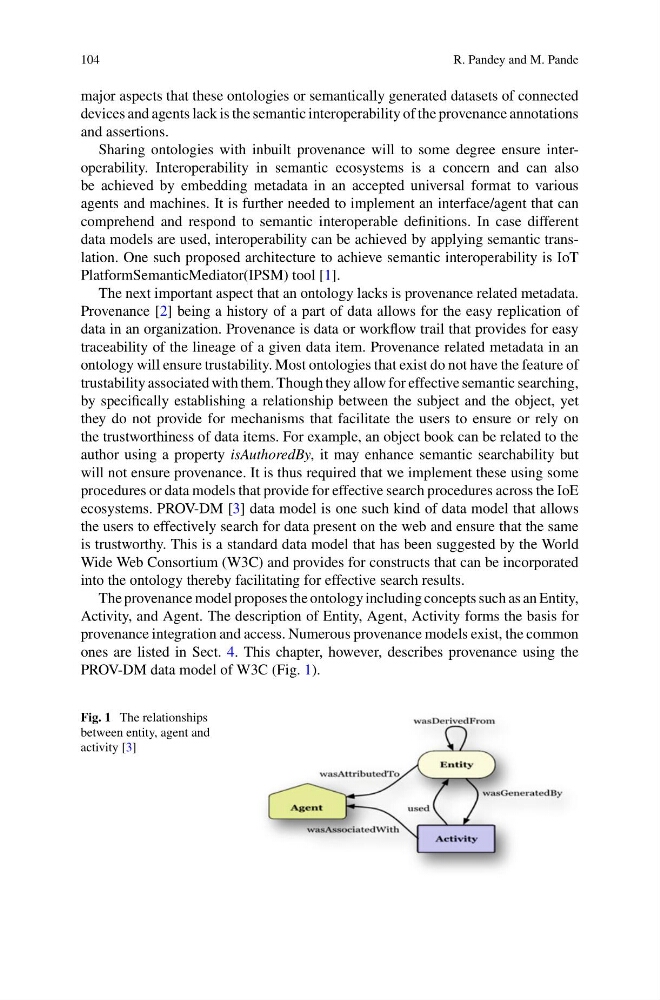
The provenance model proposes the ontology including concepts such as an Entity,
Activity, and Agent. The description of Entity, Agent, Activity forms the basis for
provenance integration and access. Numerous provenance models exist, the common
ones are listed in Sect. 4. This chapter, however, describes provenance using the
PROV-DM data model of W3C (Fig. 1).
Fig. 1 The relationships
between entity, agent and
activity [3]
R. Pandey and M. Pande
major aspects that these ontologies or semantically generated datasets of connected
devices and agents lack is the semantic interoperability of the provenance annotations
and assertions.
Sharing ontologies with inbuilt provenance will to some degree ensure interoperability. Interoperability in semantic ecosystems is a concern and can also
be achieved by embedding metadata in an accepted universal format to various
agents and machines. It is further needed to implement an interface/agent that can
comprehend and respond to semantic interoperable definitions. In case different
data models are used, interoperability can be achieved by applying semantic translation. One such proposed architecture to achieve semantic interoperability is IoT
PlatformSemanticMediator(IPSM) tool [1].
The next important aspect that an ontology lacks is provenance related metadata.
Provenance [2] being a history of a part of data allows for the easy replication of
data in an organization. Provenance is data or workflow trail that provides for easy
traceability of the lineage of a given data item. Provenance related metadata in an
ontology will ensure trustability. Most ontologies that exist do not have the feature of
trustability associated with them. Though they allow for effective semantic searching,
by specifically establishing a relationship between the subject and the object, yet
they do not provide for mechanisms that facilitate the users to ensure or rely on
the trustworthiness of data items. For example, an object book can be related to the
author using a property isAuthoredBy, it may enhance semantic searchability but
will not ensure provenance. It is thus required that we implement these using some
procedures or data models that provide for effective search procedures across the IoE
ecosystems. PROV-DM [3] data model is one such kind of data model that allows
the users to effectively search for data present on the web and ensure that the same
is trustworthy. This is a standard data model that has been suggested by the World
Wide Web Consortium (W3C) and provides for constructs that can be incorporated
into the ontology thereby facilitating for effective search results.
The provenance model proposes the ontology including concepts such as an Entity,
Activity, and Agent. The description of Entity, Agent, Activity forms the basis for
provenance integration and access. Numerous provenance models exist, the common
ones are listed in Sect. 4. This chapter, however, describes provenance using the
PROV-DM data model of W3C (Fig. 1).
Fig. 1 The relationships
between entity, agent and
activity [3]