

Semantic IoT: The Key to Realizing IoT Value
99
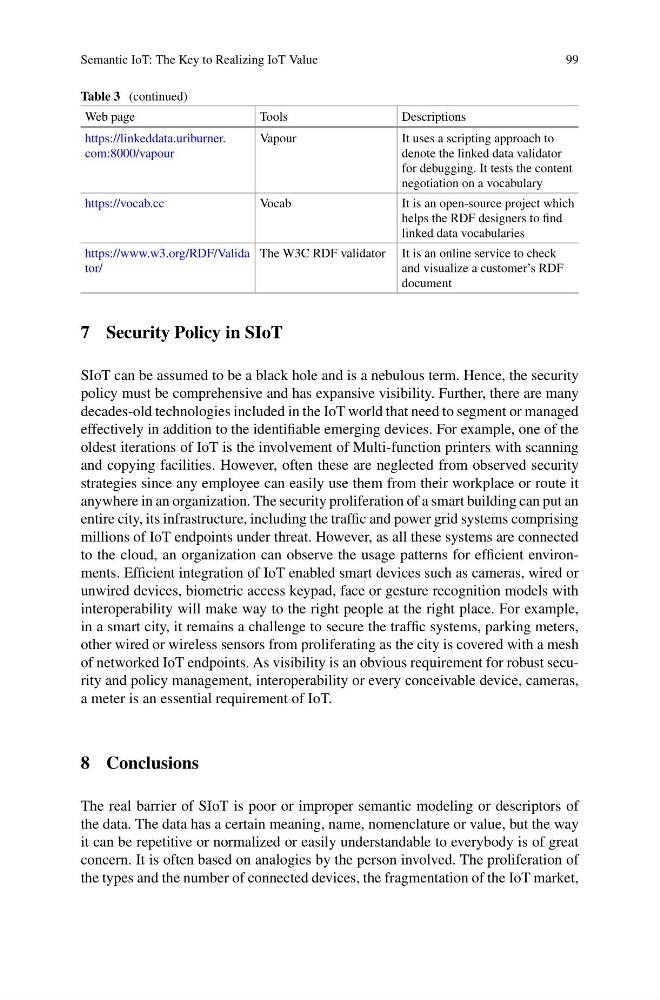
Table 3 (continued)
Web page
Tools
Descriptions
https://linkeddata.uriburner.
com:8000/vapour
Vapour
It uses a scripting approach to
denote the linked data validator
for debugging. It tests the content
negotiation on a vocabulary
https://vocab.cc
Vocab
It is an open-source project which
helps the RDF designers to find
linked data vocabularies
https://www.w3.org/RDF/Valida
tor/
The W3C RDF validator It is an online service to check
and visualize a customer’s RDF
document
7 Security Policy in SIoT
SIoT can be assumed to be a black hole and is a nebulous term. Hence, the security
policy must be comprehensive and has expansive visibility. Further, there are many
decades-old technologies included in the IoT world that need to segment or managed
effectively in addition to the identifiable emerging devices. For example, one of the
oldest iterations of IoT is the involvement of Multi-function printers with scanning
and copying facilities. However, often these are neglected from observed security
strategies since any employee can easily use them from their workplace or route it
anywhere in an organization. The security proliferation of a smart building can put an
entire city, its infrastructure, including the traffic and power grid systems comprising
millions of IoT endpoints under threat. However, as all these systems are connected
to the cloud, an organization can observe the usage patterns for efficient environments. Efficient integration of IoT enabled smart devices such as cameras, wired or
unwired devices, biometric access keypad, face or gesture recognition models with
interoperability will make way to the right people at the right place. For example,
in a smart city, it remains a challenge to secure the traffic systems, parking meters,
other wired or wireless sensors from proliferating as the city is covered with a mesh
of networked IoT endpoints. As visibility is an obvious requirement for robust security and policy management, interoperability or every conceivable device, cameras,
a meter is an essential requirement of IoT.
8 Conclusions
The real barrier of SIoT is poor or improper semantic modeling or descriptors of
the data. The data has a certain meaning, name, nomenclature or value, but the way
it can be repetitive or normalized or easily understandable to everybody is of great
concern. It is often based on analogies by the person involved. The proliferation of
the types and the number of connected devices, the fragmentation of the IoT market,
99
Table 3 (continued)
Web page
Tools
Descriptions
https://linkeddata.uriburner.
com:8000/vapour
Vapour
It uses a scripting approach to
denote the linked data validator
for debugging. It tests the content
negotiation on a vocabulary
https://vocab.cc
Vocab
It is an open-source project which
helps the RDF designers to find
linked data vocabularies
https://www.w3.org/RDF/Valida
tor/
The W3C RDF validator It is an online service to check
and visualize a customer’s RDF
document
7 Security Policy in SIoT
SIoT can be assumed to be a black hole and is a nebulous term. Hence, the security
policy must be comprehensive and has expansive visibility. Further, there are many
decades-old technologies included in the IoT world that need to segment or managed
effectively in addition to the identifiable emerging devices. For example, one of the
oldest iterations of IoT is the involvement of Multi-function printers with scanning
and copying facilities. However, often these are neglected from observed security
strategies since any employee can easily use them from their workplace or route it
anywhere in an organization. The security proliferation of a smart building can put an
entire city, its infrastructure, including the traffic and power grid systems comprising
millions of IoT endpoints under threat. However, as all these systems are connected
to the cloud, an organization can observe the usage patterns for efficient environments. Efficient integration of IoT enabled smart devices such as cameras, wired or
unwired devices, biometric access keypad, face or gesture recognition models with
interoperability will make way to the right people at the right place. For example,
in a smart city, it remains a challenge to secure the traffic systems, parking meters,
other wired or wireless sensors from proliferating as the city is covered with a mesh
of networked IoT endpoints. As visibility is an obvious requirement for robust security and policy management, interoperability or every conceivable device, cameras,
a meter is an essential requirement of IoT.
8 Conclusions
The real barrier of SIoT is poor or improper semantic modeling or descriptors of
the data. The data has a certain meaning, name, nomenclature or value, but the way
it can be repetitive or normalized or easily understandable to everybody is of great
concern. It is often based on analogies by the person involved. The proliferation of
the types and the number of connected devices, the fragmentation of the IoT market,