

Semantic IoT: The Key to Realizing IoT Value
87
3 Semantic Interoperability (SI)
Due to an exponential increase in heterogeneous sensors, actuators, devices, and
demand for better and smarter IoT platforms or services, it becomes essential to
distribute, support, monitor, control, coordinate, and communicate with these things
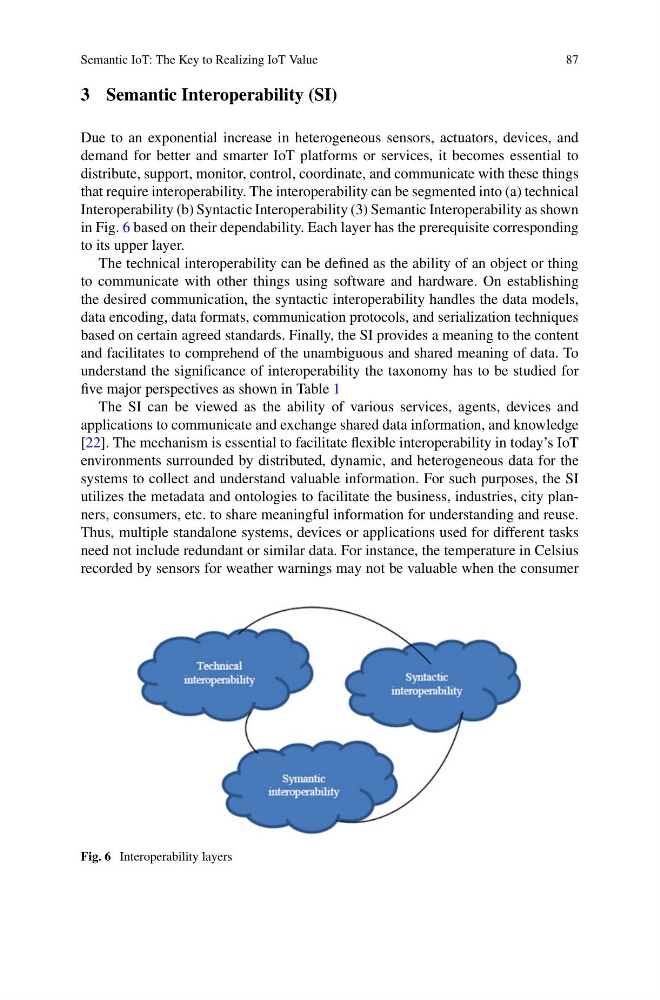
that require interoperability. The interoperability can be segmented into (a) technical
Interoperability (b) Syntactic Interoperability (3) Semantic Interoperability as shown
in Fig. 6 based on their dependability. Each layer has the prerequisite corresponding
to its upper layer.
The technical interoperability can be defined as the ability of an object or thing
to communicate with other things using software and hardware. On establishing
the desired communication, the syntactic interoperability handles the data models,
data encoding, data formats, communication protocols, and serialization techniques
based on certain agreed standards. Finally, the SI provides a meaning to the content
and facilitates to comprehend of the unambiguous and shared meaning of data. To
understand the significance of interoperability the taxonomy has to be studied for
five major perspectives as shown in Table 1
The SI can be viewed as the ability of various services, agents, devices and
applications to communicate and exchange shared data information, and knowledge
[22]. The mechanism is essential to facilitate flexible interoperability in today’s IoT
environments surrounded by distributed, dynamic, and heterogeneous data for the
systems to collect and understand valuable information. For such purposes, the SI
utilizes the metadata and ontologies to facilitate the business, industries, city planners, consumers, etc. to share meaningful information for understanding and reuse.
Thus, multiple standalone systems, devices or applications used for different tasks
need not include redundant or similar data. For instance, the temperature in Celsius
recorded by sensors for weather warnings may not be valuable when the consumer
Fig. 6 Interoperability layers
87
3 Semantic Interoperability (SI)
Due to an exponential increase in heterogeneous sensors, actuators, devices, and
demand for better and smarter IoT platforms or services, it becomes essential to
distribute, support, monitor, control, coordinate, and communicate with these things
that require interoperability. The interoperability can be segmented into (a) technical
Interoperability (b) Syntactic Interoperability (3) Semantic Interoperability as shown
in Fig. 6 based on their dependability. Each layer has the prerequisite corresponding
to its upper layer.
The technical interoperability can be defined as the ability of an object or thing
to communicate with other things using software and hardware. On establishing
the desired communication, the syntactic interoperability handles the data models,
data encoding, data formats, communication protocols, and serialization techniques
based on certain agreed standards. Finally, the SI provides a meaning to the content
and facilitates to comprehend of the unambiguous and shared meaning of data. To
understand the significance of interoperability the taxonomy has to be studied for
five major perspectives as shown in Table 1
The SI can be viewed as the ability of various services, agents, devices and
applications to communicate and exchange shared data information, and knowledge
[22]. The mechanism is essential to facilitate flexible interoperability in today’s IoT
environments surrounded by distributed, dynamic, and heterogeneous data for the
systems to collect and understand valuable information. For such purposes, the SI
utilizes the metadata and ontologies to facilitate the business, industries, city planners, consumers, etc. to share meaningful information for understanding and reuse.
Thus, multiple standalone systems, devices or applications used for different tasks
need not include redundant or similar data. For instance, the temperature in Celsius
recorded by sensors for weather warnings may not be valuable when the consumer
Fig. 6 Interoperability layers