

4 (Fig. 1b) can mostly be attributed to the limited spectral databases available for plants.
Untargeted metabolomics offers the promise of identification
and quantification of known metabolites as well as previously
unknown metabolites, which can link genetic responses (e.g., transcriptional changes) to physiological responses in the cells. Clearly,
metabolites are not direct products of genes or transcripts, they are
products or substrates of enzymes and thus can directly reflect the
cellular physiological/phenotypic states. Unfortunately, untargeted metabolomics also comes with difficulties and challenges,
e.g., chemical structure identification, and low coverage of the
metabolome (especially in single cell or single cell-types)
[6]. Here we present a method for single cell-type specific metabolomics using Arabidopsis guard cells. We have published the guard
cell preparation protocol [7]. Here we focus on a new untargeted
metabolomics method. To increase the depth and coverage of
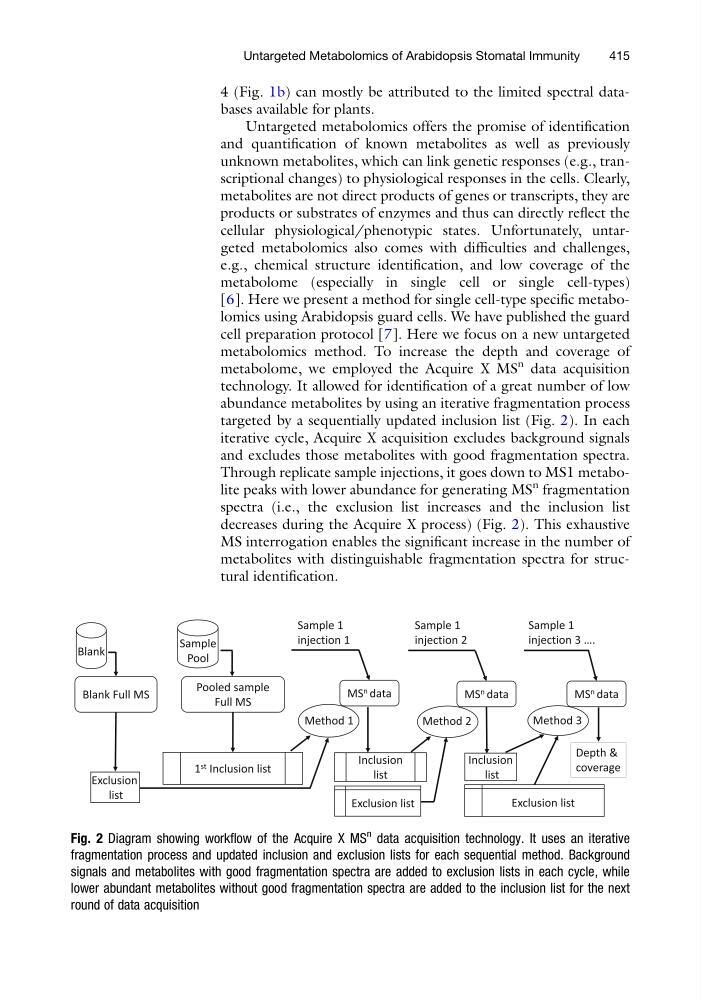
metabolome, we employed the Acquire X MS
n data acquisition
technology. It allowed for identification of a great number of low
abundance metabolites by using an iterative fragmentation process
targeted by a sequentially updated inclusion list (Fig. 2). In each
iterative cycle, Acquire X acquisition excludes background signals
and excludes those metabolites with good fragmentation spectra.
Through replicate sample injections, it goes down to MS1 metabolite peaks with lower abundance for generating MS
n fragmentation
spectra (i.e., the exclusion list increases and the inclusion list
decreases during the Acquire X process) (Fig. 2). This exhaustive
MS interrogation enables the significant increase in the number of
metabolites with distinguishable fragmentation spectra for structural identification.
Fig. 2 Diagram showing workflow of the Acquire X MS
n
data acquisition technology. It uses an iterative
fragmentation process and updated inclusion and exclusion lists for each sequential method. Background
signals and metabolites with good fragmentation spectra are added to exclusion lists in each cycle, while
lower abundant metabolites without good fragmentation spectra are added to the inclusion list for the next
round of data acquisition
Untargeted Metabolomics of Arabidopsis Stomatal Immunity
415
Untargeted metabolomics offers the promise of identification
and quantification of known metabolites as well as previously
unknown metabolites, which can link genetic responses (e.g., transcriptional changes) to physiological responses in the cells. Clearly,
metabolites are not direct products of genes or transcripts, they are
products or substrates of enzymes and thus can directly reflect the
cellular physiological/phenotypic states. Unfortunately, untargeted metabolomics also comes with difficulties and challenges,
e.g., chemical structure identification, and low coverage of the
metabolome (especially in single cell or single cell-types)
[6]. Here we present a method for single cell-type specific metabolomics using Arabidopsis guard cells. We have published the guard
cell preparation protocol [7]. Here we focus on a new untargeted
metabolomics method. To increase the depth and coverage of
metabolome, we employed the Acquire X MS
n data acquisition
technology. It allowed for identification of a great number of low
abundance metabolites by using an iterative fragmentation process
targeted by a sequentially updated inclusion list (Fig. 2). In each
iterative cycle, Acquire X acquisition excludes background signals
and excludes those metabolites with good fragmentation spectra.
Through replicate sample injections, it goes down to MS1 metabolite peaks with lower abundance for generating MS
n fragmentation
spectra (i.e., the exclusion list increases and the inclusion list
decreases during the Acquire X process) (Fig. 2). This exhaustive
MS interrogation enables the significant increase in the number of
metabolites with distinguishable fragmentation spectra for structural identification.
Fig. 2 Diagram showing workflow of the Acquire X MS
n
data acquisition technology. It uses an iterative
fragmentation process and updated inclusion and exclusion lists for each sequential method. Background
signals and metabolites with good fragmentation spectra are added to exclusion lists in each cycle, while
lower abundant metabolites without good fragmentation spectra are added to the inclusion list for the next
round of data acquisition
Untargeted Metabolomics of Arabidopsis Stomatal Immunity
415