

commercial standards. Level 2 metabolites are structurally annotated without reference standards, and their identification is based
upon physicochemical properties and fragmentation spectral similarity with public/commercial spectral libraries. Level 3 metabolites
are putatively identified compound classes based upon characteristic physicochemical properties of a chemical class of compounds, or
by spectral similarity to known compounds of a chemical class
(often using accurate precursor mass, not fragmentation profile).
Level 4 metabolites are unknown compounds. Although these
metabolite peaks (often called features) can be differentiated and
quantified based upon spectral data, they cannot be annotated.
Untargeted metabolomics often results in a large number of level
4 unknown metabolites. As one example, a recent untargeted
metabolomic analysis of lettuce varieties revealed 34,709 total
metabolite features from MS results, but only 171 of those features
were putatively identified using level 1, 2, or 3 identification criteria
[3]. Another untargeted metabolomic analysis in tomato detected a
total of 228 metabolites in the samples analyzed [4]. A recent
review summarized 109 identified metabolites in Arabidopsis
guard cell metabolome [5]. Using a new Acquire X method
described here, we were able to identify a total of 1445 metabolites
in Arabidopsis guard cell samples. From these metabolites, there
were 553 level 2 compounds with structural annotation, 299 level
3 compounds with putative compound classes, and 593 level
4 unknown compounds, according to the well-accepted minimum
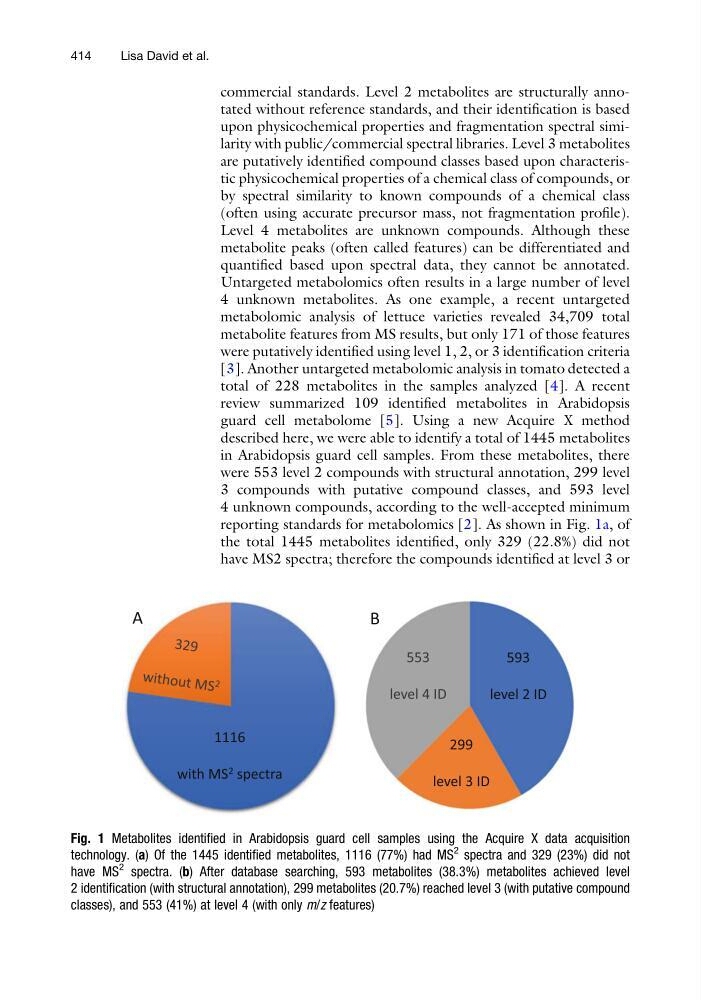
reporting standards for metabolomics [2]. As shown in Fig. 1a, of
the total 1445 metabolites identified, only 329 (22.8%) did not
have MS2 spectra; therefore the compounds identified at level 3 or
Fig. 1 Metabolites identified in Arabidopsis guard cell samples using the Acquire X data acquisition
technology. (a) Of the 1445 identified metabolites, 1116 (77%) had MS
2
spectra and 329 (23%) did not
have MS
2
spectra. (b) After database searching, 593 metabolites (38.3%) metabolites achieved level
2 identification (with structural annotation), 299 metabolites (20.7%) reached level 3 (with putative compound
classes), and 553 (41%) at level 4 (with only m/z features)
414
Lisa David et al.
upon physicochemical properties and fragmentation spectral similarity with public/commercial spectral libraries. Level 3 metabolites
are putatively identified compound classes based upon characteristic physicochemical properties of a chemical class of compounds, or
by spectral similarity to known compounds of a chemical class
(often using accurate precursor mass, not fragmentation profile).
Level 4 metabolites are unknown compounds. Although these
metabolite peaks (often called features) can be differentiated and
quantified based upon spectral data, they cannot be annotated.
Untargeted metabolomics often results in a large number of level
4 unknown metabolites. As one example, a recent untargeted
metabolomic analysis of lettuce varieties revealed 34,709 total
metabolite features from MS results, but only 171 of those features
were putatively identified using level 1, 2, or 3 identification criteria
[3]. Another untargeted metabolomic analysis in tomato detected a
total of 228 metabolites in the samples analyzed [4]. A recent
review summarized 109 identified metabolites in Arabidopsis
guard cell metabolome [5]. Using a new Acquire X method
described here, we were able to identify a total of 1445 metabolites
in Arabidopsis guard cell samples. From these metabolites, there
were 553 level 2 compounds with structural annotation, 299 level
3 compounds with putative compound classes, and 593 level
4 unknown compounds, according to the well-accepted minimum
reporting standards for metabolomics [2]. As shown in Fig. 1a, of
the total 1445 metabolites identified, only 329 (22.8%) did not
have MS2 spectra; therefore the compounds identified at level 3 or
Fig. 1 Metabolites identified in Arabidopsis guard cell samples using the Acquire X data acquisition
technology. (a) Of the 1445 identified metabolites, 1116 (77%) had MS
2
spectra and 329 (23%) did not
have MS
2
spectra. (b) After database searching, 593 metabolites (38.3%) metabolites achieved level
2 identification (with structural annotation), 299 metabolites (20.7%) reached level 3 (with putative compound
classes), and 553 (41%) at level 4 (with only m/z features)
414
Lisa David et al.