

7. Use a clean blade to cut gel and transfer gel slice to a 1.5 mL
Eppendorf tube. Use water to rinse blade and use kim wipe to
wipe it before processing next sample. After all the cutting
finished, take gel pictures to make sure that target bands are
completely covered (Fig. 4c).
8. Do gel extraction with the QiaQuick gel extraction kit or a
comparable kit according to the manufacturer’s instructions.
Recover the DNA in 30 μL of 10 mM Tris–HCl pH 8.0 buffer.
9. Use nanodrop to measure cDNA concentration. Normalize the
samples to 100 ng/μL. Run gel electrophoresis to normalize
since nanodrop analysis may be not accurate enough (Fig. 4D).
Pool cDNA libraries and the mixture is now ready for Illumina
sequencing.
3.11 Computing
Analysis Workflow
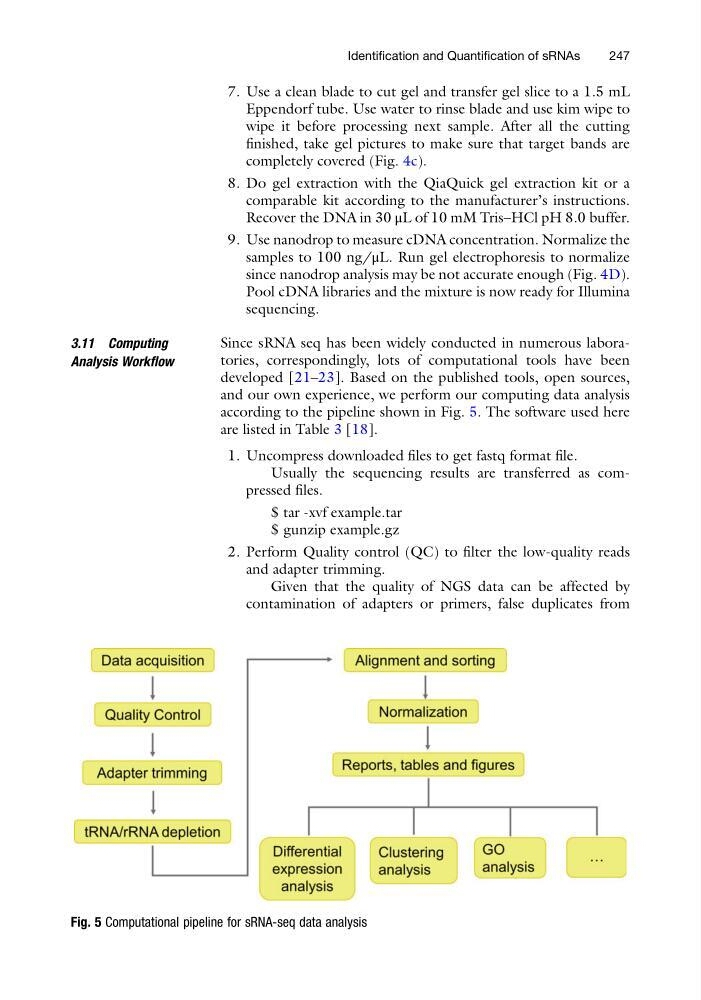
Since sRNA seq has been widely conducted in numerous laboratories, correspondingly, lots of computational tools have been
developed [21–23]. Based on the published tools, open sources,
and our own experience, we perform our computing data analysis
according to the pipeline shown in Fig. 5. The software used here
are listed in Table 3 [18].
1. Uncompress downloaded files to get fastq format file.
Usually the sequencing results are transferred as compressed files.
$ tar -xvf example.tar
$ gunzip example.gz
2. Perform Quality control (QC) to filter the low-quality reads
and adapter trimming.
Given that the quality of NGS data can be affected by
contamination of adapters or primers, false duplicates from
Fig. 5 Computational pipeline for sRNA-seq data analysis
Identification and Quantification of sRNAs
247
Eppendorf tube. Use water to rinse blade and use kim wipe to
wipe it before processing next sample. After all the cutting
finished, take gel pictures to make sure that target bands are
completely covered (Fig. 4c).
8. Do gel extraction with the QiaQuick gel extraction kit or a
comparable kit according to the manufacturer’s instructions.
Recover the DNA in 30 μL of 10 mM Tris–HCl pH 8.0 buffer.
9. Use nanodrop to measure cDNA concentration. Normalize the
samples to 100 ng/μL. Run gel electrophoresis to normalize
since nanodrop analysis may be not accurate enough (Fig. 4D).
Pool cDNA libraries and the mixture is now ready for Illumina
sequencing.
3.11 Computing
Analysis Workflow
Since sRNA seq has been widely conducted in numerous laboratories, correspondingly, lots of computational tools have been
developed [21–23]. Based on the published tools, open sources,
and our own experience, we perform our computing data analysis
according to the pipeline shown in Fig. 5. The software used here
are listed in Table 3 [18].
1. Uncompress downloaded files to get fastq format file.
Usually the sequencing results are transferred as compressed files.
$ tar -xvf example.tar
$ gunzip example.gz
2. Perform Quality control (QC) to filter the low-quality reads
and adapter trimming.
Given that the quality of NGS data can be affected by
contamination of adapters or primers, false duplicates from
Fig. 5 Computational pipeline for sRNA-seq data analysis
Identification and Quantification of sRNAs
247