

3.10 Pme I Digestion
This step is to specifically remove the PCR products amplified from
the spiked and radiolabeled markers because the marker sequence
contains a Pme I digestion site. The digestion must be complete to
avoid sequencing of RNA markers.
1. Centrifuge samples above in full speed at 4
C for 10 min.
Remove the supernatant. Air-dry DNA pellet for 3 min.
2. Resuspend DNA in Pme I reaction mix containing 5 μL
10 Â Cutsmart, 1 μl Pme I and 44 μL water for each reaction.
The volume for each reaction is 50 μL in total. Multiply the
volume for one reaction by 1.1-fold of sample numbers due to
pipetting variations. Mix well and aliquot to each sample.
3. After DNA is fully dissolved, incubate reaction at 37
C at least
4 h.
4. Add 5 μL DNA loading buffer to each sample and mix well.
5. Prepare 3% low-melting gel. Gently transfer gel to a big tank.
Load samples with empty well between different ones. Run gel
electrophoresis with 0.5Â TBE as running buffer.
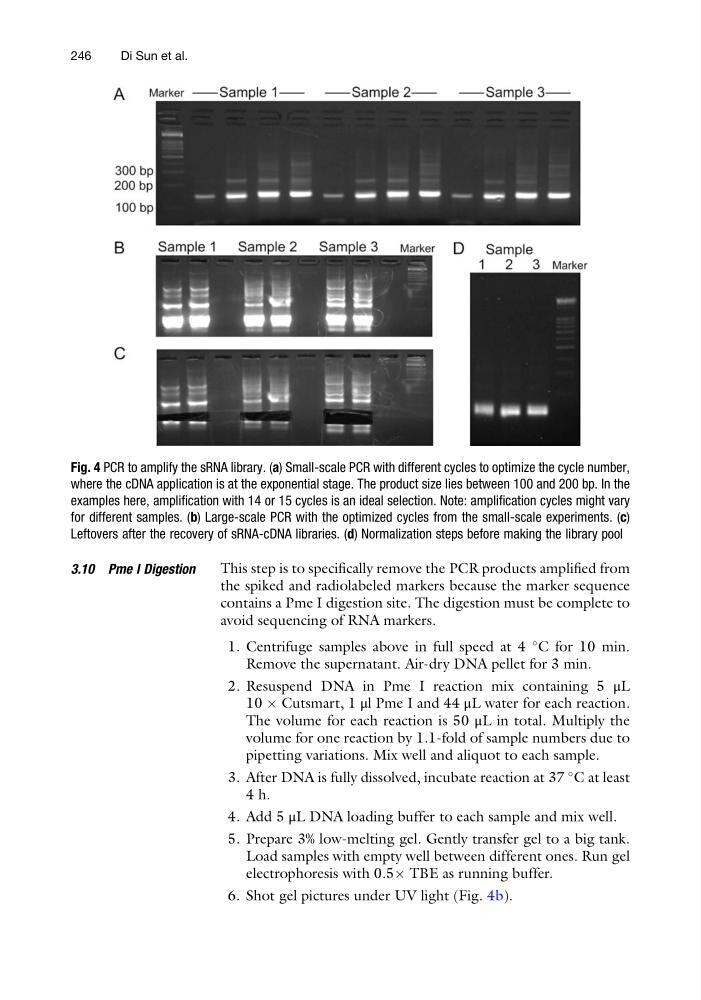
6. Shot gel pictures under UV light (Fig. 4b).
Fig. 4 PCR to amplify the sRNA library. (a) Small-scale PCR with different cycles to optimize the cycle number,
where the cDNA application is at the exponential stage. The product size lies between 100 and 200 bp. In the
examples here, amplification with 14 or 15 cycles is an ideal selection. Note: amplification cycles might vary
for different samples. (b) Large-scale PCR with the optimized cycles from the small-scale experiments. (c)
Leftovers after the recovery of sRNA-cDNA libraries. (d) Normalization steps before making the library pool
246
Di Sun et al.
This step is to specifically remove the PCR products amplified from
the spiked and radiolabeled markers because the marker sequence
contains a Pme I digestion site. The digestion must be complete to
avoid sequencing of RNA markers.
1. Centrifuge samples above in full speed at 4
C for 10 min.
Remove the supernatant. Air-dry DNA pellet for 3 min.
2. Resuspend DNA in Pme I reaction mix containing 5 μL
10 Â Cutsmart, 1 μl Pme I and 44 μL water for each reaction.
The volume for each reaction is 50 μL in total. Multiply the
volume for one reaction by 1.1-fold of sample numbers due to
pipetting variations. Mix well and aliquot to each sample.
3. After DNA is fully dissolved, incubate reaction at 37
C at least
4 h.
4. Add 5 μL DNA loading buffer to each sample and mix well.
5. Prepare 3% low-melting gel. Gently transfer gel to a big tank.
Load samples with empty well between different ones. Run gel
electrophoresis with 0.5Â TBE as running buffer.
6. Shot gel pictures under UV light (Fig. 4b).
Fig. 4 PCR to amplify the sRNA library. (a) Small-scale PCR with different cycles to optimize the cycle number,
where the cDNA application is at the exponential stage. The product size lies between 100 and 200 bp. In the
examples here, amplification with 14 or 15 cycles is an ideal selection. Note: amplification cycles might vary
for different samples. (b) Large-scale PCR with the optimized cycles from the small-scale experiments. (c)
Leftovers after the recovery of sRNA-cDNA libraries. (d) Normalization steps before making the library pool
246
Di Sun et al.