

64
T. Ashur and A. Luykx
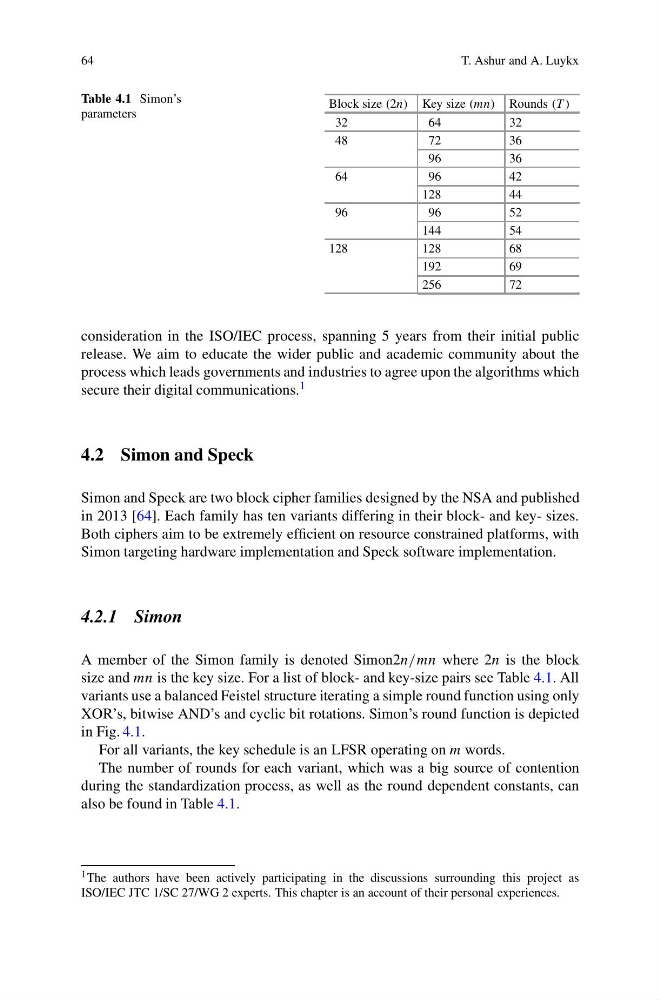
Table 4.1 Simon’s
parameters
Block size (2n) Key size (mn) Rounds (T )
32
64
32
48
72
36
96
36
64
96
42
128
44
96
96
52
144
54
128
128
68
192
69
256
72
consideration in the ISO/IEC process, spanning 5 years from their initial public
release. We aim to educate the wider public and academic community about the
process which leads governments and industries to agree upon the algorithms which
secure their digital communications. 1
4.2 Simon and Speck
Simon and Speck are two block cipher families designed by the NSA and published
in 2013 [64]. Each family has ten variants differing in their block- and key- sizes.
Both ciphers aim to be extremely efficient on resource constrained platforms, with
Simon targeting hardware implementation and Speck software implementation.
4.2.1 Simon
A member of the Simon family is denoted Simon2n/mn where 2n is the block
size and mn is the key size. For a list of block- and key-size pairs see Table 4.1. All
variants use a balanced Feistel structure iterating a simple round function using only
XOR’s, bitwise AND’s and cyclic bit rotations. Simon’s round function is depicted
in Fig. 4.1.
For all variants, the key schedule is an LFSR operating on m words.
The number of rounds for each variant, which was a big source of contention
during the standardization process, as well as the round dependent constants, can
also be found in Table 4.1.
1 The authors have been actively participating in the discussions surrounding this project as
ISO/IEC JTC 1/SC 27/WG 2 experts. This chapter is an account of their personal experiences.
T. Ashur and A. Luykx
Table 4.1 Simon’s
parameters
Block size (2n) Key size (mn) Rounds (T )
32
64
32
48
72
36
96
36
64
96
42
128
44
96
96
52
144
54
128
128
68
192
69
256
72
consideration in the ISO/IEC process, spanning 5 years from their initial public
release. We aim to educate the wider public and academic community about the
process which leads governments and industries to agree upon the algorithms which
secure their digital communications. 1
4.2 Simon and Speck
Simon and Speck are two block cipher families designed by the NSA and published
in 2013 [64]. Each family has ten variants differing in their block- and key- sizes.
Both ciphers aim to be extremely efficient on resource constrained platforms, with
Simon targeting hardware implementation and Speck software implementation.
4.2.1 Simon
A member of the Simon family is denoted Simon2n/mn where 2n is the block
size and mn is the key size. For a list of block- and key-size pairs see Table 4.1. All
variants use a balanced Feistel structure iterating a simple round function using only
XOR’s, bitwise AND’s and cyclic bit rotations. Simon’s round function is depicted
in Fig. 4.1.
For all variants, the key schedule is an LFSR operating on m words.
The number of rounds for each variant, which was a big source of contention
during the standardization process, as well as the round dependent constants, can
also be found in Table 4.1.
1 The authors have been actively participating in the discussions surrounding this project as
ISO/IEC JTC 1/SC 27/WG 2 experts. This chapter is an account of their personal experiences.