

168
7 Bioeconomy in the Oil Palm Republic of Indonesia
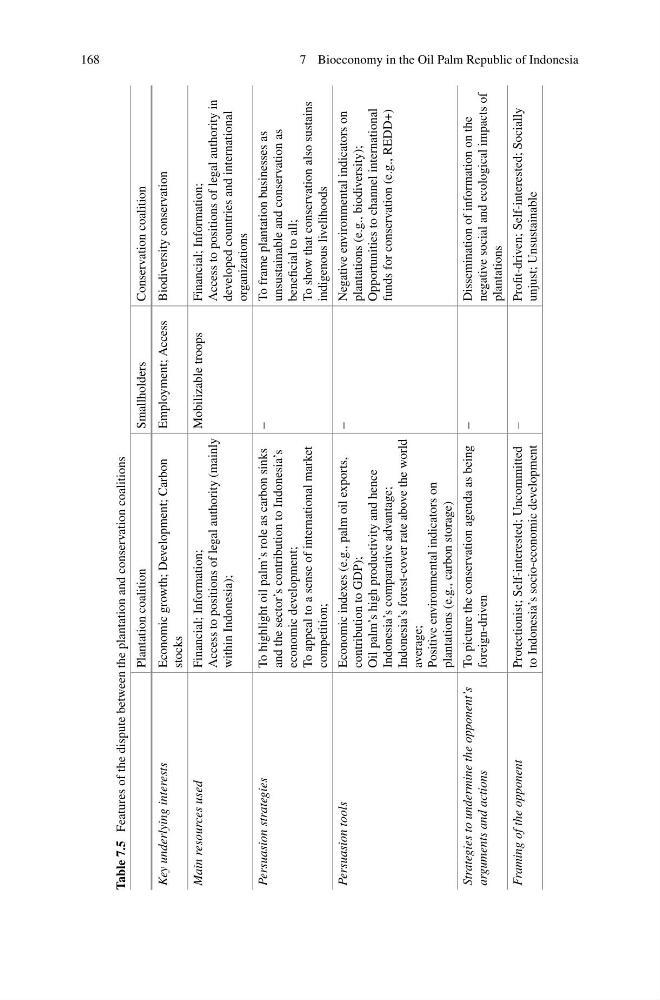
Table 7.5
Features of the dispute between the plantation and conservation coalitions
Plantation coalition
Smallholders
Conservation coalition
Key underlying interests
Economic growth; Development; Carbon
stocks
Employment; Access
Biodiversity conservation
Main resources used
Financial; Information;
Access to positions of legal authority (mainly
within Indonesia);
Mobilizable troops
Financial; Information;
Access to positions of legal authority in
developed countries and international
organizations
Persuasion strategies
To highlight oil palm’s role as carbon sinks
and the sector’s contribution to Indonesia’s
economic development;
To appeal to a sense of international market
competition;
–
To frame plantation businesses as
unsustainable and conservation as
beneficial to all;
To show that conservation also sustains
indigenous livelihoods
Persuasion tools
Economic indexes (e.g., palm oil exports,
contribution to GDP);
Oil palm’s high productivity and hence
Indonesia’s comparative advantage;
Indonesia’s forest-cover rate above the world
average;
Positive environmental indicators on
plantations (e.g., carbon storage)
–
Negative environmental indicators on
plantations (e.g., biodiversity);
Opportunities to channel international
funds for conservation (e.g., REDD+)
Strategies to undermine the opponent’s
arguments and actions
To picture the conservation agenda as being
foreign-driven
–
Dissemination of information on the
negative social and ecological impacts of
plantations
Framing of the opponent
Protectionist; Self-interested; Uncommitted
to Indonesia’s socio-economic development
–
Profit-driven; Self-interested; Socially
unjust; Unsustainable
7 Bioeconomy in the Oil Palm Republic of Indonesia
Table 7.5
Features of the dispute between the plantation and conservation coalitions
Plantation coalition
Smallholders
Conservation coalition
Key underlying interests
Economic growth; Development; Carbon
stocks
Employment; Access
Biodiversity conservation
Main resources used
Financial; Information;
Access to positions of legal authority (mainly
within Indonesia);
Mobilizable troops
Financial; Information;
Access to positions of legal authority in
developed countries and international
organizations
Persuasion strategies
To highlight oil palm’s role as carbon sinks
and the sector’s contribution to Indonesia’s
economic development;
To appeal to a sense of international market
competition;
–
To frame plantation businesses as
unsustainable and conservation as
beneficial to all;
To show that conservation also sustains
indigenous livelihoods
Persuasion tools
Economic indexes (e.g., palm oil exports,
contribution to GDP);
Oil palm’s high productivity and hence
Indonesia’s comparative advantage;
Indonesia’s forest-cover rate above the world
average;
Positive environmental indicators on
plantations (e.g., carbon storage)
–
Negative environmental indicators on
plantations (e.g., biodiversity);
Opportunities to channel international
funds for conservation (e.g., REDD+)
Strategies to undermine the opponent’s
arguments and actions
To picture the conservation agenda as being
foreign-driven
–
Dissemination of information on the
negative social and ecological impacts of
plantations
Framing of the opponent
Protectionist; Self-interested; Uncommitted
to Indonesia’s socio-economic development
–
Profit-driven; Self-interested; Socially
unjust; Unsustainable