

6.3 Agency in Biofuel Governance in India
137
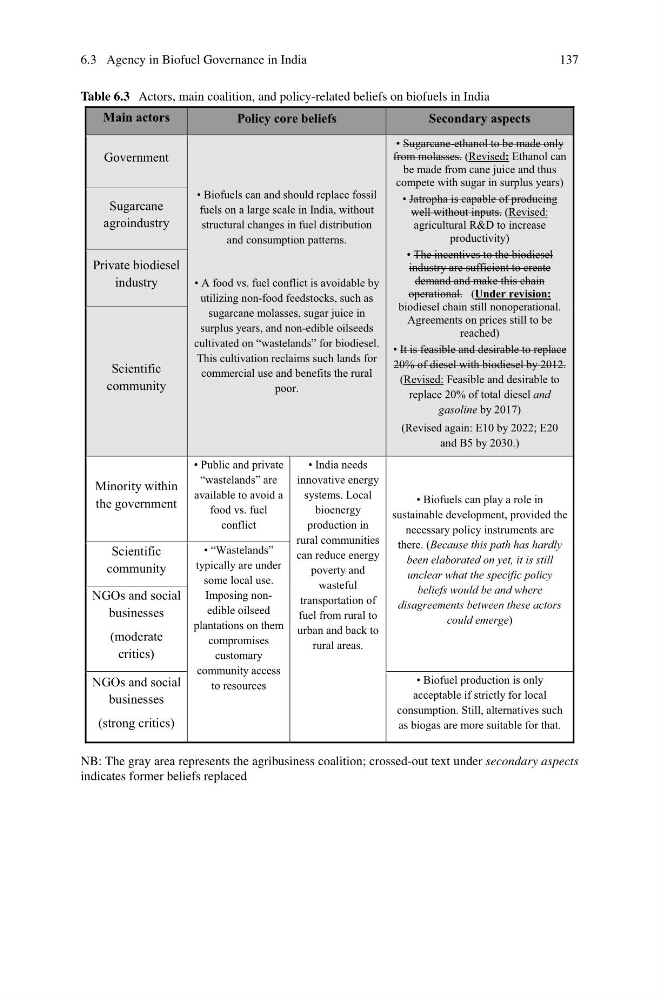
Table 6.3 Actors, main coalition, and policy-related beliefs on biofuels in India
Main actors
Policy core beliefs
Secondary aspects
Government
• Biofuels can and should replace fossil
fuels on a large scale in India, without
structural changes in fuel distribution
and consumption patterns.
• A food vs. fuel conflict is avoidable by
utilizing non-food feedstocks, such as
sugarcane molasses, sugar juice in
surplus years, and non-edible oilseeds
cultivated on “wastelands” for biodiesel.
This cultivation reclaims such lands for
commercial use and benefits the rural
poor.
• Sugarcane-ethanol to be made only
from molasses. (Revised: Ethanol can
be made from cane juice and thus
compete with sugar in surplus years)
• Jatropha is capable of producing
well without inputs. (Revised:
agricultural R&D to increase
productivity)
• The incentives to the biodiesel
industry are sufficient to create
demand and make this chain
operational. (Under revision:
biodiesel chain still nonoperational.
Agreements on prices still to be
reached)
• It is feasible and desirable to replace
20% of diesel with biodiesel by 2012.
(Revised: Feasible and desirable to
replace 20% of total diesel and
gasoline by 2017)
(Revised again: E10 by 2022; E20
and B5 by 2030.)
Sugarcane
agroindustry
Private biodiesel
industry
Scientific
community
Minority within
the government
• Public and private
“wastelands” are
available to avoid a
food vs. fuel
conflict
• India needs
innovative energy
systems. Local
bioenergy
production in
rural communities
can reduce energy
poverty and
wasteful
transportation of
fuel from rural to
urban and back to
rural areas.
• Biofuels can play a role in
sustainable development, provided the
necessary policy instruments are
there. (Because this path has hardly
been elaborated on yet, it is still
unclear what the specific policy
beliefs would be and where
disagreements between these actors
could emerge)
Scientific
community
• “Wastelands”
typically are under
some local use.
Imposing nonedible oilseed
plantations on them
compromises
customary
community access
to resources
NGOs and social
businesses
(moderate
critics)
NGOs and social
businesses
(strong critics)
• Biofuel production is only
acceptable if strictly for local
consumption. Still, alternatives such
as biogas are more suitable for that.
NB: The gray area represents the agribusiness coalition; crossed-out text under secondary aspects
indicates former beliefs replaced
137
Table 6.3 Actors, main coalition, and policy-related beliefs on biofuels in India
Main actors
Policy core beliefs
Secondary aspects
Government
• Biofuels can and should replace fossil
fuels on a large scale in India, without
structural changes in fuel distribution
and consumption patterns.
• A food vs. fuel conflict is avoidable by
utilizing non-food feedstocks, such as
sugarcane molasses, sugar juice in
surplus years, and non-edible oilseeds
cultivated on “wastelands” for biodiesel.
This cultivation reclaims such lands for
commercial use and benefits the rural
poor.
• Sugarcane-ethanol to be made only
from molasses. (Revised: Ethanol can
be made from cane juice and thus
compete with sugar in surplus years)
• Jatropha is capable of producing
well without inputs. (Revised:
agricultural R&D to increase
productivity)
• The incentives to the biodiesel
industry are sufficient to create
demand and make this chain
operational. (Under revision:
biodiesel chain still nonoperational.
Agreements on prices still to be
reached)
• It is feasible and desirable to replace
20% of diesel with biodiesel by 2012.
(Revised: Feasible and desirable to
replace 20% of total diesel and
gasoline by 2017)
(Revised again: E10 by 2022; E20
and B5 by 2030.)
Sugarcane
agroindustry
Private biodiesel
industry
Scientific
community
Minority within
the government
• Public and private
“wastelands” are
available to avoid a
food vs. fuel
conflict
• India needs
innovative energy
systems. Local
bioenergy
production in
rural communities
can reduce energy
poverty and
wasteful
transportation of
fuel from rural to
urban and back to
rural areas.
• Biofuels can play a role in
sustainable development, provided the
necessary policy instruments are
there. (Because this path has hardly
been elaborated on yet, it is still
unclear what the specific policy
beliefs would be and where
disagreements between these actors
could emerge)
Scientific
community
• “Wastelands”
typically are under
some local use.
Imposing nonedible oilseed
plantations on them
compromises
customary
community access
to resources
NGOs and social
businesses
(moderate
critics)
NGOs and social
businesses
(strong critics)
• Biofuel production is only
acceptable if strictly for local
consumption. Still, alternatives such
as biogas are more suitable for that.
NB: The gray area represents the agribusiness coalition; crossed-out text under secondary aspects
indicates former beliefs replaced