

132
6 India’s Bioeconomy and the Ambition over “Wastelands”
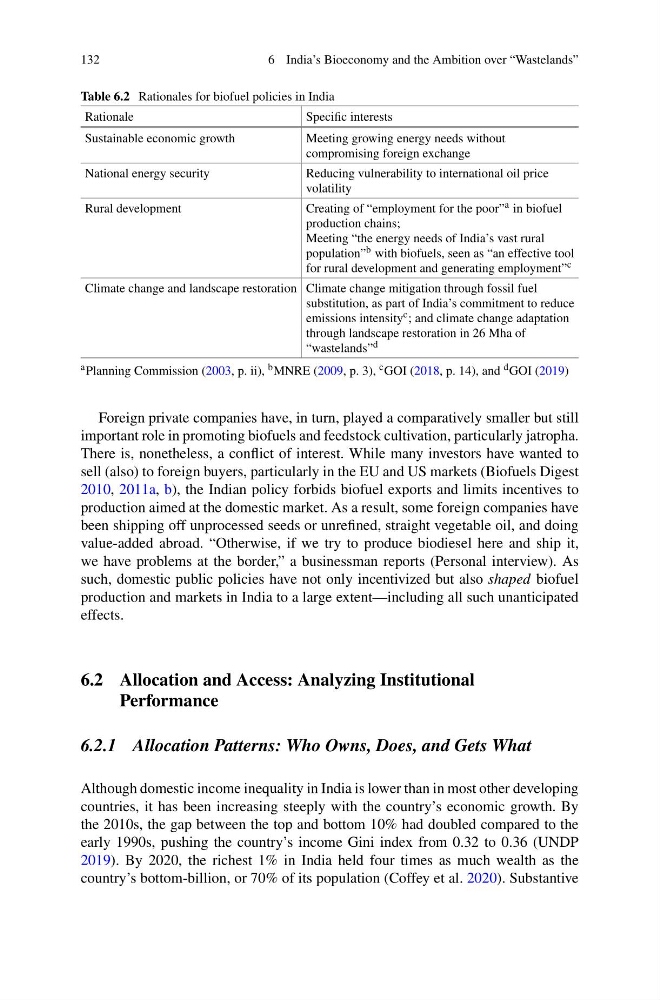
Table 6.2 Rationales for biofuel policies in India
Rationale
Specific interests
Sustainable economic growth
Meeting growing energy needs without
compromising foreign exchange
National energy security
Reducing vulnerability to international oil price
volatility
Rural development
Creating of “employment for the poor” a in biofuel
production chains;
Meeting “the energy needs of India’s vast rural
population” b with biofuels, seen as “an effective tool
for rural development and generating employment” c
Climate change and landscape restoration Climate change mitigation through fossil fuel
substitution, as part of India’s commitment to reduce
emissions intensity c ; and climate change adaptation
through landscape restoration in 26 Mha of
“wastelands” d
a Planning Commission (2003, p. ii), b MNRE (2009, p. 3), c GOI (2018, p. 14), and d GOI (2019)
Foreign private companies have, in turn, played a comparatively smaller but still
important role in promoting biofuels and feedstock cultivation, particularly jatropha.
There is, nonetheless, a conflict of interest. While many investors have wanted to
sell (also) to foreign buyers, particularly in the EU and US markets (Biofuels Digest
2010, 2011a, b), the Indian policy forbids biofuel exports and limits incentives to
production aimed at the domestic market. As a result, some foreign companies have
been shipping off unprocessed seeds or unrefined, straight vegetable oil, and doing
value-added abroad. “Otherwise, if we try to produce biodiesel here and ship it,
we have problems at the border,” a businessman reports (Personal interview). As
such, domestic public policies have not only incentivized but also shaped biofuel
production and markets in India to a large extent—including all such unanticipated
effects.
6.2 Allocation and Access: Analyzing Institutional
Performance
6.2.1 Allocation Patterns: Who Owns, Does, and Gets What
Although domestic income inequality in India is lower than in most other developing
countries, it has been increasing steeply with the country’s economic growth. By
the 2010s, the gap between the top and bottom 10% had doubled compared to the
early 1990s, pushing the country’s income Gini index from 0.32 to 0.36 (UNDP
2019). By 2020, the richest 1% in India held four times as much wealth as the
country’s bottom-billion, or 70% of its population (Coffey et al. 2020). Substantive
6 India’s Bioeconomy and the Ambition over “Wastelands”
Table 6.2 Rationales for biofuel policies in India
Rationale
Specific interests
Sustainable economic growth
Meeting growing energy needs without
compromising foreign exchange
National energy security
Reducing vulnerability to international oil price
volatility
Rural development
Creating of “employment for the poor” a in biofuel
production chains;
Meeting “the energy needs of India’s vast rural
population” b with biofuels, seen as “an effective tool
for rural development and generating employment” c
Climate change and landscape restoration Climate change mitigation through fossil fuel
substitution, as part of India’s commitment to reduce
emissions intensity c ; and climate change adaptation
through landscape restoration in 26 Mha of
“wastelands” d
a Planning Commission (2003, p. ii), b MNRE (2009, p. 3), c GOI (2018, p. 14), and d GOI (2019)
Foreign private companies have, in turn, played a comparatively smaller but still
important role in promoting biofuels and feedstock cultivation, particularly jatropha.
There is, nonetheless, a conflict of interest. While many investors have wanted to
sell (also) to foreign buyers, particularly in the EU and US markets (Biofuels Digest
2010, 2011a, b), the Indian policy forbids biofuel exports and limits incentives to
production aimed at the domestic market. As a result, some foreign companies have
been shipping off unprocessed seeds or unrefined, straight vegetable oil, and doing
value-added abroad. “Otherwise, if we try to produce biodiesel here and ship it,
we have problems at the border,” a businessman reports (Personal interview). As
such, domestic public policies have not only incentivized but also shaped biofuel
production and markets in India to a large extent—including all such unanticipated
effects.
6.2 Allocation and Access: Analyzing Institutional
Performance
6.2.1 Allocation Patterns: Who Owns, Does, and Gets What
Although domestic income inequality in India is lower than in most other developing
countries, it has been increasing steeply with the country’s economic growth. By
the 2010s, the gap between the top and bottom 10% had doubled compared to the
early 1990s, pushing the country’s income Gini index from 0.32 to 0.36 (UNDP
2019). By 2020, the richest 1% in India held four times as much wealth as the
country’s bottom-billion, or 70% of its population (Coffey et al. 2020). Substantive