

6.1 Biofuels in India: How and Why
131
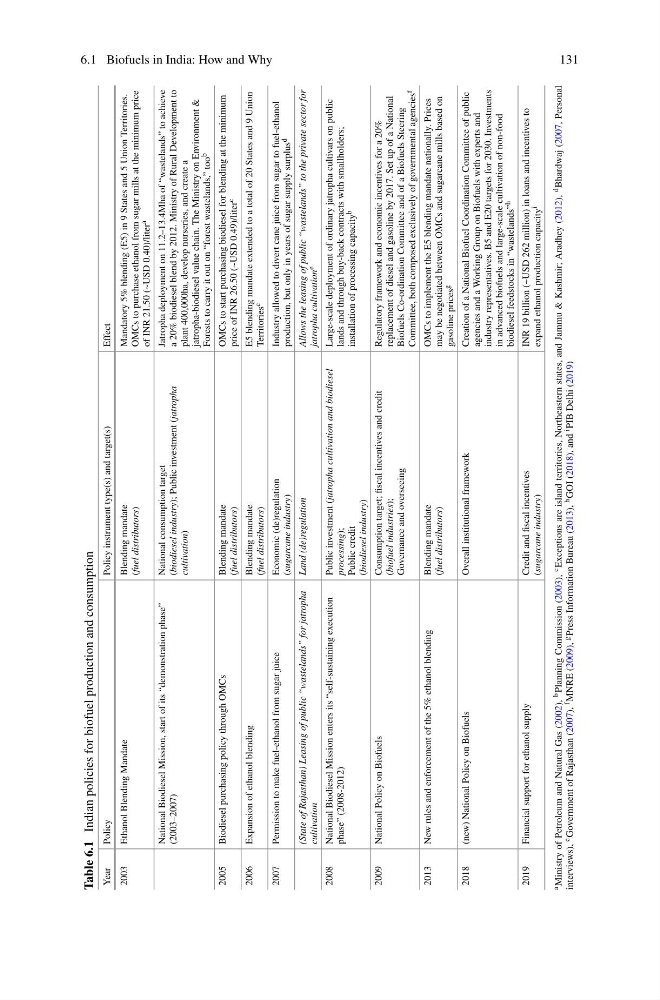
Table 6.1
Indian policies for biofuel production and consumption
Year
Policy
Policy instrument type(s) and target(s)
Effect
2003
Ethanol Blending Mandate
Blending mandate
(fuel distributors)
Mandatory 5% blending (E5) in 9 States and 5 Union Territories.
OMCs to purchase ethanol from sugar mills at the minimum price
of INR 21.50 (~USD 0.40)/liter a
National Biodiesel Mission, start of its “demonstration phase”
(2003–2007)
National consumption target
(biodiesel industry);
Public investment (jatropha
cultivation)
Jatropha deployment on 11.2–13.4Mha of “wastelands” to achieve
a 20% biodiesel blend by 2012. Ministry of Rural Development to
plant 400,000ha, develop nurseries, and create a
jatropha-biodiesel value chain. The Ministry on Environment &
Forests to carry it out on “forest wastelands,” too b
2005
Biodiesel purchasing policy through OMCs
Blending mandate
(fuel distributors)
OMCs to start purchasing biodiesel for blending at the minimum
price of INR 26.50 (~USD 0.49)/liter c
2006
Expansion of ethanol blending
Blending mandate
(fuel distributors)
E5 blending mandate extended to a total of 20 States and 9 Union
Territories c
2007
Permission to make fuel-ethanol from sugar juice
Economic (de)regulation
(sugarcane industry)
Industry allowed to divert cane juice from sugar to fuel-ethanol
production, but only in years of sugar supply surplus d
(State of Rajasthan) Leasing of public “wastelands” for jatropha
cultivation
Land (de)regulation
Allows the leasing of public “wastelands” to the private sector for
jatropha cultivation e
2008
National Biodiesel Mission enters its “self-sustaining execution
phase” (2008-2012)
Public investment (jatropha cultivation and biodiesel
processing);
Public credit
(biodiesel industry)
Large-scale deployment of ordinary jatropha cultivars on public
lands and through buy-back contracts with smallholders;
installation of processing capacity b
2009
National Policy on Biofuels
Consumption target; fiscal incentives and credit
(biofuel industries);
Governance and overseeing
Regulatory framework and economic incentives for a 20%
replacement of diesel and gasoline by 2017. Set up of a National
Biofuels Co-ordination Committee and of a Biofuels Steering
Committee, both composed exclusively of governmental agencies f
2013
New rules and enforcement of the 5% ethanol blending
Blending mandate
(fuel distributors)
OMCs to implement the E5 blending mandate nationally. Prices
may be negotiated between OMCs and sugarcane mills based on
gasoline prices g
2018
(new) National Policy on Biofuels
Overall institutional framework
Creation of a National Biofuel Coordination Committee of public
agencies and a Working Group on Biofuels with experts and
industry representatives. B5 and E20 targets for 2030. Investments
in advanced biofuels and large-scale cultivation of non-food
biodiesel feedstocks in “wastelands” h
2019
Financial support for ethanol supply
Credit and fiscal incentives
(sugarcane industry)
INR 19 billion (~USD 262 million) in loans and incentives to
expand ethanol production capacity i
a
Ministry of Petroleum and Natural Gas (2002), b
Planning Commission (2003), c
Exceptions are island territories, Northeastern states, and Jammu & Kashmir; Aradhey (2012), d
Bhardwaj (2007, Personal
interviews), e
Government of Rajasthan (2007), f
MNRE (2009), g
Press Information Bureau (2013), h
GOI (2018), and i
PIB Delhi (2019)
131
Table 6.1
Indian policies for biofuel production and consumption
Year
Policy
Policy instrument type(s) and target(s)
Effect
2003
Ethanol Blending Mandate
Blending mandate
(fuel distributors)
Mandatory 5% blending (E5) in 9 States and 5 Union Territories.
OMCs to purchase ethanol from sugar mills at the minimum price
of INR 21.50 (~USD 0.40)/liter a
National Biodiesel Mission, start of its “demonstration phase”
(2003–2007)
National consumption target
(biodiesel industry);
Public investment (jatropha
cultivation)
Jatropha deployment on 11.2–13.4Mha of “wastelands” to achieve
a 20% biodiesel blend by 2012. Ministry of Rural Development to
plant 400,000ha, develop nurseries, and create a
jatropha-biodiesel value chain. The Ministry on Environment &
Forests to carry it out on “forest wastelands,” too b
2005
Biodiesel purchasing policy through OMCs
Blending mandate
(fuel distributors)
OMCs to start purchasing biodiesel for blending at the minimum
price of INR 26.50 (~USD 0.49)/liter c
2006
Expansion of ethanol blending
Blending mandate
(fuel distributors)
E5 blending mandate extended to a total of 20 States and 9 Union
Territories c
2007
Permission to make fuel-ethanol from sugar juice
Economic (de)regulation
(sugarcane industry)
Industry allowed to divert cane juice from sugar to fuel-ethanol
production, but only in years of sugar supply surplus d
(State of Rajasthan) Leasing of public “wastelands” for jatropha
cultivation
Land (de)regulation
Allows the leasing of public “wastelands” to the private sector for
jatropha cultivation e
2008
National Biodiesel Mission enters its “self-sustaining execution
phase” (2008-2012)
Public investment (jatropha cultivation and biodiesel
processing);
Public credit
(biodiesel industry)
Large-scale deployment of ordinary jatropha cultivars on public
lands and through buy-back contracts with smallholders;
installation of processing capacity b
2009
National Policy on Biofuels
Consumption target; fiscal incentives and credit
(biofuel industries);
Governance and overseeing
Regulatory framework and economic incentives for a 20%
replacement of diesel and gasoline by 2017. Set up of a National
Biofuels Co-ordination Committee and of a Biofuels Steering
Committee, both composed exclusively of governmental agencies f
2013
New rules and enforcement of the 5% ethanol blending
Blending mandate
(fuel distributors)
OMCs to implement the E5 blending mandate nationally. Prices
may be negotiated between OMCs and sugarcane mills based on
gasoline prices g
2018
(new) National Policy on Biofuels
Overall institutional framework
Creation of a National Biofuel Coordination Committee of public
agencies and a Working Group on Biofuels with experts and
industry representatives. B5 and E20 targets for 2030. Investments
in advanced biofuels and large-scale cultivation of non-food
biodiesel feedstocks in “wastelands” h
2019
Financial support for ethanol supply
Credit and fiscal incentives
(sugarcane industry)
INR 19 billion (~USD 262 million) in loans and incentives to
expand ethanol production capacity i
a
Ministry of Petroleum and Natural Gas (2002), b
Planning Commission (2003), c
Exceptions are island territories, Northeastern states, and Jammu & Kashmir; Aradhey (2012), d
Bhardwaj (2007, Personal
interviews), e
Government of Rajasthan (2007), f
MNRE (2009), g
Press Information Bureau (2013), h
GOI (2018), and i
PIB Delhi (2019)