

114
5 Brazil Between Bioeconomy Barons and Grassroots Agroecology
Table 5.7 Features of the dispute between the agribusiness and agroecology coalitions
Agribusiness coalition
Agroecology coalition
Key underlying interests
Economic growth; Domestic
and international market shares
Agroecology; Social justice;
Food sovereignty
Main advocacy resources
used
Financial resources; Access to
positions of legal authority;
Information
Mobilizable troops;
Information
Persuasion strategies
Appeals to national pride and a
sense of international
competition (e.g., Brazil to
become a “green” global
leader)
Appeals to ideas of social
inclusion, conservation, and
sovereignty from foreign
capital and its volatility
Persuasion tools
Economic indexes (e.g.,
contribution of agriculture to a
growing GDP, to exports);
Biofuel production and
consumption numbers;
CO 2 emissions reduction from
fossil fuel replacement in
transportation
Equality indexes (e.g., Gini
coefficient on wealth and land
distribution);
Comparisons between smalland large-scale farming in
terms of employment creation,
biodiversity, and contribution to
food security
Strategies to undermine the
opponent’s arguments and
actions
Focus of private property rights
and criminalization of social
movements
Land invasions, evoking the
“social function” that by law
lands must fulfill;
Dissemination of information
on the social and ecological
impacts of large-scale
agriculture
Framing of the opponent
Retrograde, anachronic,
ideology-driven, incapable of
fulfilling Brazil’s development
needs
Self-interested, socially unjust
and environmentally degrading
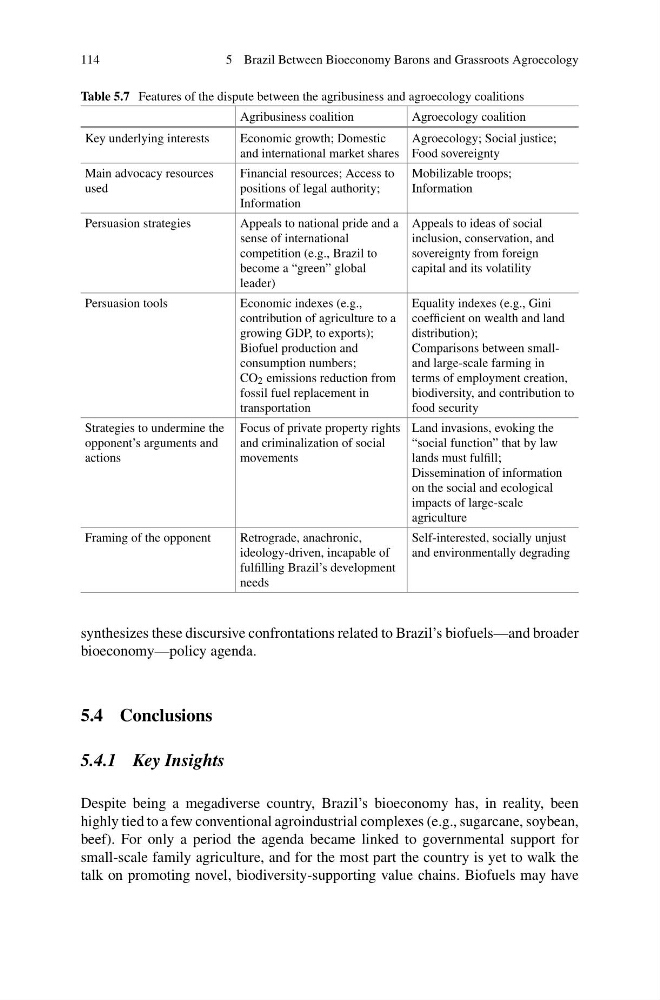
synthesizes these discursive confrontations related to Brazil’s biofuels—and broader
bioeconomy—policy agenda.
5.4 Conclusions
5.4.1 Key Insights
Despite being a megadiverse country, Brazil’s bioeconomy has, in reality, been
highly tied to a few conventional agroindustrial complexes (e.g., sugarcane, soybean,
beef). For only a period the agenda became linked to governmental support for
small-scale family agriculture, and for the most part the country is yet to walk the
talk on promoting novel, biodiversity-supporting value chains. Biofuels may have
5 Brazil Between Bioeconomy Barons and Grassroots Agroecology
Table 5.7 Features of the dispute between the agribusiness and agroecology coalitions
Agribusiness coalition
Agroecology coalition
Key underlying interests
Economic growth; Domestic
and international market shares
Agroecology; Social justice;
Food sovereignty
Main advocacy resources
used
Financial resources; Access to
positions of legal authority;
Information
Mobilizable troops;
Information
Persuasion strategies
Appeals to national pride and a
sense of international
competition (e.g., Brazil to
become a “green” global
leader)
Appeals to ideas of social
inclusion, conservation, and
sovereignty from foreign
capital and its volatility
Persuasion tools
Economic indexes (e.g.,
contribution of agriculture to a
growing GDP, to exports);
Biofuel production and
consumption numbers;
CO 2 emissions reduction from
fossil fuel replacement in
transportation
Equality indexes (e.g., Gini
coefficient on wealth and land
distribution);
Comparisons between smalland large-scale farming in
terms of employment creation,
biodiversity, and contribution to
food security
Strategies to undermine the
opponent’s arguments and
actions
Focus of private property rights
and criminalization of social
movements
Land invasions, evoking the
“social function” that by law
lands must fulfill;
Dissemination of information
on the social and ecological
impacts of large-scale
agriculture
Framing of the opponent
Retrograde, anachronic,
ideology-driven, incapable of
fulfilling Brazil’s development
needs
Self-interested, socially unjust
and environmentally degrading
synthesizes these discursive confrontations related to Brazil’s biofuels—and broader
bioeconomy—policy agenda.
5.4 Conclusions
5.4.1 Key Insights
Despite being a megadiverse country, Brazil’s bioeconomy has, in reality, been
highly tied to a few conventional agroindustrial complexes (e.g., sugarcane, soybean,
beef). For only a period the agenda became linked to governmental support for
small-scale family agriculture, and for the most part the country is yet to walk the
talk on promoting novel, biodiversity-supporting value chains. Biofuels may have