

5.1 Biofuels in Brazil: How and Why
103
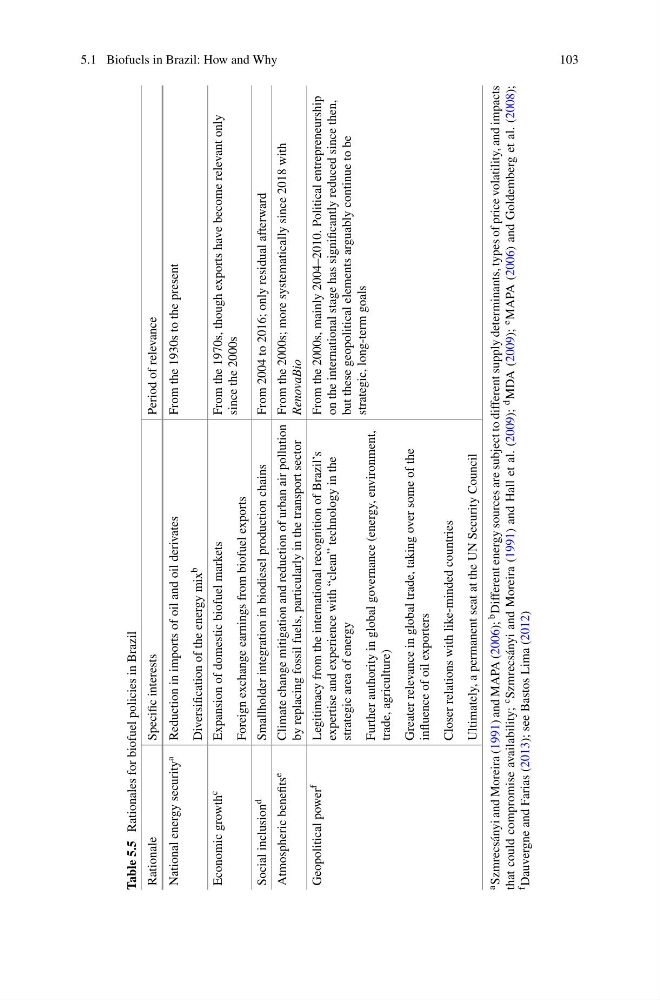
Table 5.5
Rationales for biofuel policies in Brazil
Rationale
Specific interests
Period of relevance
National energy security a
Reduction in imports of oil and oil derivates
Diversification of the energy mix b
From the 1930s to the present
Economic growth c
Expansion of domestic biofuel markets
Foreign exchange earnings from biofuel exports
From the 1970s, though exports have become relevant only
since the 2000s
Social inclusion d
Smallholder integration in biodiesel production chains
From 2004 to 2016; only residual afterward
Atmospheric benefits e
Climate change mitigation and reduction of urban air pollution
by replacing fossil fuels, particularly in the transport sector
From the 2000s; more systematically since 2018 with
RenovaBio
Geopolitical power f
Legitimacy from the international recognition of Brazil’s
expertise and experience with “clean” technology in the
strategic area of energy
Further authority in global governance (energy, environment,
trade, agriculture)
Greater relevance in global trade, taking over some of the
influence of oil exporters
Closer relations with like-minded countries
Ultimately, a permanent seat at the UN Security Council
From the 2000s, mainly 2004–2010. Political entrepreneurship
on the international stage has significantly reduced since then,
but these geopolitical elements arguably continue to be
strategic, long-term goals
a
Szmrecsányi and Moreira (1991) and MAPA (2006); b
Different energy sources are subject to different supply determinants, types of price volatility, and impacts
that could compromise availability; c
Szmrecsányi and Moreira (1991) and Hall et al. (2009); d
MDA (2009); e
MAPA (2006) and Goldemberg et al. (2008);
f
Dauvergne and Farias (2013); see Bastos Lima (2012)
103
Table 5.5
Rationales for biofuel policies in Brazil
Rationale
Specific interests
Period of relevance
National energy security a
Reduction in imports of oil and oil derivates
Diversification of the energy mix b
From the 1930s to the present
Economic growth c
Expansion of domestic biofuel markets
Foreign exchange earnings from biofuel exports
From the 1970s, though exports have become relevant only
since the 2000s
Social inclusion d
Smallholder integration in biodiesel production chains
From 2004 to 2016; only residual afterward
Atmospheric benefits e
Climate change mitigation and reduction of urban air pollution
by replacing fossil fuels, particularly in the transport sector
From the 2000s; more systematically since 2018 with
RenovaBio
Geopolitical power f
Legitimacy from the international recognition of Brazil’s
expertise and experience with “clean” technology in the
strategic area of energy
Further authority in global governance (energy, environment,
trade, agriculture)
Greater relevance in global trade, taking over some of the
influence of oil exporters
Closer relations with like-minded countries
Ultimately, a permanent seat at the UN Security Council
From the 2000s, mainly 2004–2010. Political entrepreneurship
on the international stage has significantly reduced since then,
but these geopolitical elements arguably continue to be
strategic, long-term goals
a
Szmrecsányi and Moreira (1991) and MAPA (2006); b
Different energy sources are subject to different supply determinants, types of price volatility, and impacts
that could compromise availability; c
Szmrecsányi and Moreira (1991) and Hall et al. (2009); d
MDA (2009); e
MAPA (2006) and Goldemberg et al. (2008);
f
Dauvergne and Farias (2013); see Bastos Lima (2012)