

102
5 Brazil Between Bioeconomy Barons and Grassroots Agroecology
Table 5.4
Sustainable development phase of biofuel promotion in Brazil: biodiesel
Year
Policy
Policy instrument type(s) and target(s)
Effect
2004
National Program of Biodiesel Production and Use
(PNPB)
Blending mandate (fuel distributors);
Conditional
public credit, procurement, and fiscal incentives
(biodiesel industry)
Biodiesel blending allowed and phased in, aiming
initially at mandatory B5 by 2013. Creates the Social
Fuel Seal, providing preferential procurement and
additional fiscal and credit benefits to biodiesel
industries which purchase feedstock from smallholders a
2006
National Agroenergy Plan (2006–2011)
Public investment (R&D on biofuel value-chains)
Orchestrates the rationales, means, and goals for biofuel
expansion in Brazil; announces funding for biofuel
R&D b
2008
B2 mandate
Blending mandate (fuel distributors)
Mandatory 2% biodiesel blending (B2) comes into force
2009
New rules for biodiesel’s Social Fuel Seal
Conditional public credit, procurement, and fiscal
incentives (biodiesel industry)
Biodiesel industries must provide contracted
smallholders with specified technical assistance; a labor
union or social movement representing smallholders’
interests must validate the contracts c
B3 mandate
Blending mandate (fuel distributors)
Mandatory B3 comes into force
2010
B5 mandate
Blending mandate (fuel distributors)
Mandatory B5 comes into force, anticipated from 2013
2014
A second round of blending mandates
Blending mandate (fuel distributors)
New blending targets: B7 (2014), B8 (2017), B10
(2018) d
2018
A third round of blending mandates
Blending mandate (fuel distributors)
B11 (2019), B12 (2020), B13 (2021), B14 (2022), and
B15 (2023)
2019
New rules for the Social Fuel Seal
Conditional public credit, procurement, and fiscal
incentives (biodiesel industry)
Eliminates the need for a representative organization to
ratify supply contracts; makes larger commercial
cooperatives eligible as “family farmer” suppliers d
2020
B12 mandate
Blending mandate (fuel distributors)
Mandatory B12 comes into force.
a
Law 11.097/2005; b
MAPA (2006); c
MDA (2009); d
Magossi (2012); e
Ordinance N.144, of 22nd July 2019
5 Brazil Between Bioeconomy Barons and Grassroots Agroecology
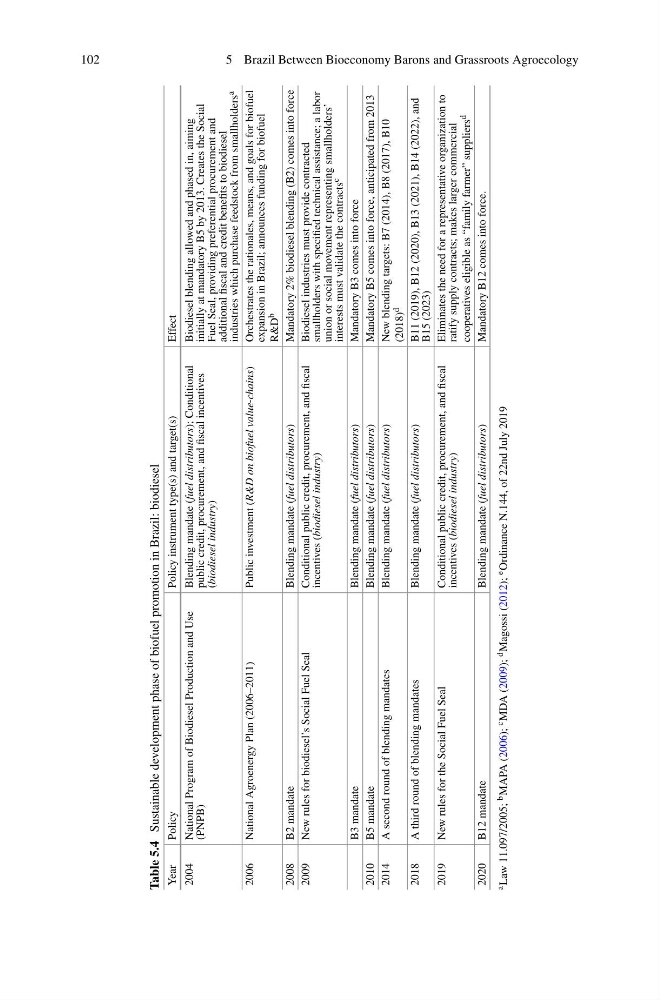
Table 5.4
Sustainable development phase of biofuel promotion in Brazil: biodiesel
Year
Policy
Policy instrument type(s) and target(s)
Effect
2004
National Program of Biodiesel Production and Use
(PNPB)
Blending mandate (fuel distributors);
Conditional
public credit, procurement, and fiscal incentives
(biodiesel industry)
Biodiesel blending allowed and phased in, aiming
initially at mandatory B5 by 2013. Creates the Social
Fuel Seal, providing preferential procurement and
additional fiscal and credit benefits to biodiesel
industries which purchase feedstock from smallholders a
2006
National Agroenergy Plan (2006–2011)
Public investment (R&D on biofuel value-chains)
Orchestrates the rationales, means, and goals for biofuel
expansion in Brazil; announces funding for biofuel
R&D b
2008
B2 mandate
Blending mandate (fuel distributors)
Mandatory 2% biodiesel blending (B2) comes into force
2009
New rules for biodiesel’s Social Fuel Seal
Conditional public credit, procurement, and fiscal
incentives (biodiesel industry)
Biodiesel industries must provide contracted
smallholders with specified technical assistance; a labor
union or social movement representing smallholders’
interests must validate the contracts c
B3 mandate
Blending mandate (fuel distributors)
Mandatory B3 comes into force
2010
B5 mandate
Blending mandate (fuel distributors)
Mandatory B5 comes into force, anticipated from 2013
2014
A second round of blending mandates
Blending mandate (fuel distributors)
New blending targets: B7 (2014), B8 (2017), B10
(2018) d
2018
A third round of blending mandates
Blending mandate (fuel distributors)
B11 (2019), B12 (2020), B13 (2021), B14 (2022), and
B15 (2023)
2019
New rules for the Social Fuel Seal
Conditional public credit, procurement, and fiscal
incentives (biodiesel industry)
Eliminates the need for a representative organization to
ratify supply contracts; makes larger commercial
cooperatives eligible as “family farmer” suppliers d
2020
B12 mandate
Blending mandate (fuel distributors)
Mandatory B12 comes into force.
a
Law 11.097/2005; b
MAPA (2006); c
MDA (2009); d
Magossi (2012); e
Ordinance N.144, of 22nd July 2019