

5.1 Biofuels in Brazil: How and Why
97
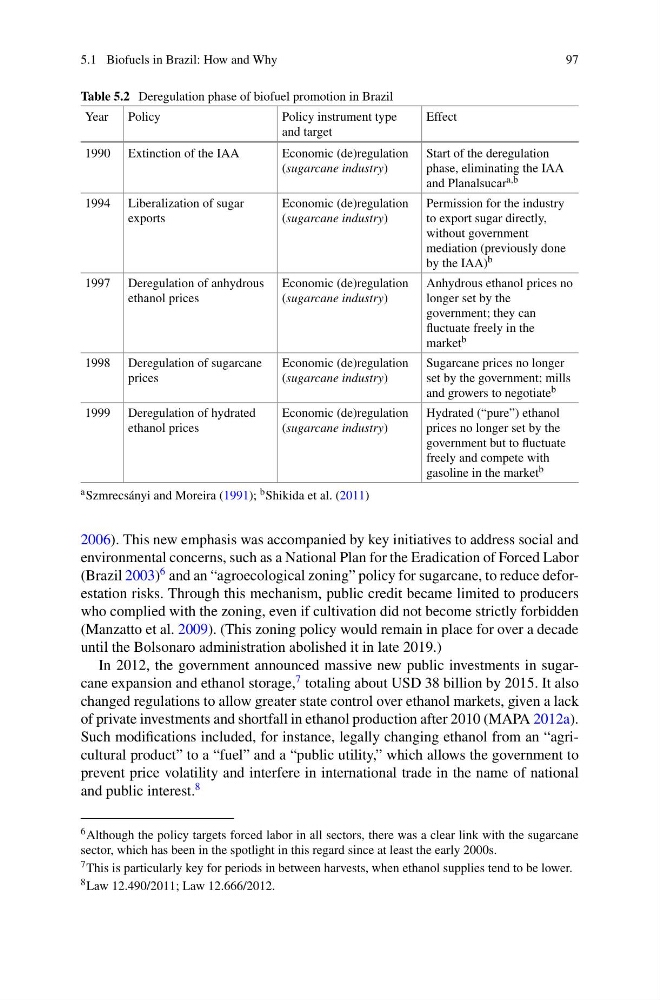
Table 5.2 Deregulation phase of biofuel promotion in Brazil
Year
Policy
Policy instrument type
and target
Effect
1990 Extinction of the IAA
Economic (de)regulation
(sugarcane industry)
Start of the deregulation
phase, eliminating the IAA
and Planalsucar a,b
1994 Liberalization of sugar
exports
Economic (de)regulation
(sugarcane industry)
Permission for the industry
to export sugar directly,
without government
mediation (previously done
by the IAA) b
1997 Deregulation of anhydrous
ethanol prices
Economic (de)regulation
(sugarcane industry)
Anhydrous ethanol prices no
longer set by the
government; they can
fluctuate freely in the
market b
1998 Deregulation of sugarcane
prices
Economic (de)regulation
(sugarcane industry)
Sugarcane prices no longer
set by the government; mills
and growers to negotiate b
1999 Deregulation of hydrated
ethanol prices
Economic (de)regulation
(sugarcane industry)
Hydrated (“pure”) ethanol
prices no longer set by the
government but to fluctuate
freely and compete with
gasoline in the market b
a Szmrecsányi and Moreira (1991); b Shikida et al. (2011)
2006). This new emphasis was accompanied by key initiatives to address social and
environmental concerns, such as a National Plan for the Eradication of Forced Labor
(Brazil 2003)
6 and an “agroecological zoning” policy for sugarcane, to reduce deforestation risks. Through this mechanism, public credit became limited to producers
who complied with the zoning, even if cultivation did not become strictly forbidden
(Manzatto et al. 2009). (This zoning policy would remain in place for over a decade
until the Bolsonaro administration abolished it in late 2019.)
In 2012, the government announced massive new public investments in sugarcane expansion and ethanol storage,
7 totaling about USD 38 billion by 2015. It also
changed regulations to allow greater state control over ethanol markets, given a lack
of private investments and shortfall in ethanol production after 2010 (MAPA 2012a).
Such modifications included, for instance, legally changing ethanol from an “agricultural product” to a “fuel” and a “public utility,” which allows the government to
prevent price volatility and interfere in international trade in the name of national
and public interest.
8
6 Although the policy targets forced labor in all sectors, there was a clear link with the sugarcane
sector, which has been in the spotlight in this regard since at least the early 2000s.
7 This is particularly key for periods in between harvests, when ethanol supplies tend to be lower.
8 Law 12.490/2011; Law 12.666/2012.
97
Table 5.2 Deregulation phase of biofuel promotion in Brazil
Year
Policy
Policy instrument type
and target
Effect
1990 Extinction of the IAA
Economic (de)regulation
(sugarcane industry)
Start of the deregulation
phase, eliminating the IAA
and Planalsucar a,b
1994 Liberalization of sugar
exports
Economic (de)regulation
(sugarcane industry)
Permission for the industry
to export sugar directly,
without government
mediation (previously done
by the IAA) b
1997 Deregulation of anhydrous
ethanol prices
Economic (de)regulation
(sugarcane industry)
Anhydrous ethanol prices no
longer set by the
government; they can
fluctuate freely in the
market b
1998 Deregulation of sugarcane
prices
Economic (de)regulation
(sugarcane industry)
Sugarcane prices no longer
set by the government; mills
and growers to negotiate b
1999 Deregulation of hydrated
ethanol prices
Economic (de)regulation
(sugarcane industry)
Hydrated (“pure”) ethanol
prices no longer set by the
government but to fluctuate
freely and compete with
gasoline in the market b
a Szmrecsányi and Moreira (1991); b Shikida et al. (2011)
2006). This new emphasis was accompanied by key initiatives to address social and
environmental concerns, such as a National Plan for the Eradication of Forced Labor
(Brazil 2003)
6 and an “agroecological zoning” policy for sugarcane, to reduce deforestation risks. Through this mechanism, public credit became limited to producers
who complied with the zoning, even if cultivation did not become strictly forbidden
(Manzatto et al. 2009). (This zoning policy would remain in place for over a decade
until the Bolsonaro administration abolished it in late 2019.)
In 2012, the government announced massive new public investments in sugarcane expansion and ethanol storage,
7 totaling about USD 38 billion by 2015. It also
changed regulations to allow greater state control over ethanol markets, given a lack
of private investments and shortfall in ethanol production after 2010 (MAPA 2012a).
Such modifications included, for instance, legally changing ethanol from an “agricultural product” to a “fuel” and a “public utility,” which allows the government to
prevent price volatility and interfere in international trade in the name of national
and public interest.
8
6 Although the policy targets forced labor in all sectors, there was a clear link with the sugarcane
sector, which has been in the spotlight in this regard since at least the early 2000s.
7 This is particularly key for periods in between harvests, when ethanol supplies tend to be lower.
8 Law 12.490/2011; Law 12.666/2012.