

96
5 Brazil Between Bioeconomy Barons and Grassroots Agroecology
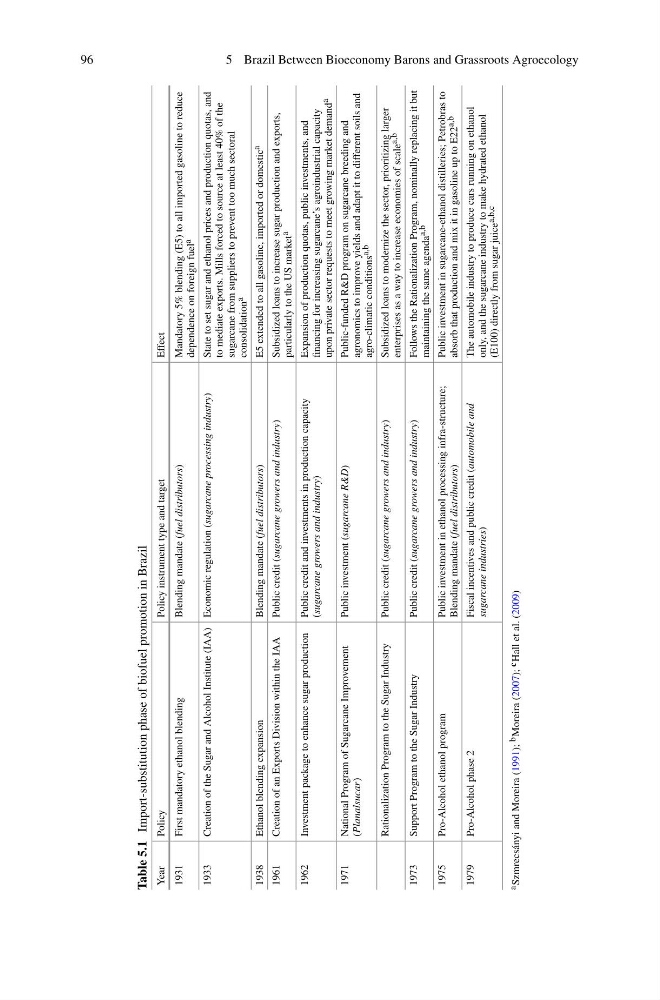
Table 5.1
Import-substitution phase of biofuel promotion in Brazil
Year
Policy
Policy instrument type and target
Effect
1931
First mandatory ethanol blending
Blending mandate (fuel distributors)
Mandatory 5% blending (E5) to all imported gasoline to reduce
dependence on foreign fuel a
1933
Creation of the Sugar and Alcohol Institute (IAA) Economic regulation (sugarcane processing industry)
State to set sugar and ethanol prices and production quotas, and
to mediate exports. Mills forced to source at least 40% of the
sugarcane from suppliers to prevent too much sectoral
consolidation a
1938
Ethanol blending expansion
Blending mandate (fuel distributors)
E5 extended to all gasoline, imported or domestic a
1961
Creation of an Exports Division within the IAA
Public credit (sugarcane growers and industry)
Subsidized loans to increase sugar production and exports,
particularly to the US market a
1962
Investment package to enhance sugar production Public credit and investments in production capacity
(sugarcane growers and industry)
Expansion of production quotas, public investments, and
financing for increasing sugarcane’s agroindustrial capacity
upon private sector requests to meet growing market demand a
1971
National Program of Sugarcane Improvement
(Planalsucar)
Public investment (sugarcane R&D)
Public-funded R&D program on sugarcane breeding and
agronomics to improve yields and adapt it to different soils and
agro-climatic conditions a,b
Rationalization Program to the Sugar Industry
Public credit (sugarcane growers and industry)
Subsidized loans to modernize the sector, prioritizing larger
enterprises as a way to increase economies of scale a,b
1973
Support Program to the Sugar Industry
Public credit (sugarcane growers and industry)
Follows the Rationalization Program, nominally replacing it but
maintaining the same agenda a,b
1975
Pro-Alcohol ethanol program
Public investment in ethanol processing infra-structure;
Blending mandate (fuel distributors)
Public investment in sugarcane-ethanol distilleries; Petrobras to
absorb that production and mix it in gasoline up to E22 a,b
1979
Pro-Alcohol phase 2
Fiscal incentives and public credit (automobile and
sugarcane industries)
The automobile industry to produce cars running on ethanol
only, and the sugarcane industry to make hydrated ethanol
(E100) directly from sugar juice a,b,c
a
Szmrecsányi and Moreira (1991); b
Moreira (2007); c
Hall et al. (2009)
5 Brazil Between Bioeconomy Barons and Grassroots Agroecology
Table 5.1
Import-substitution phase of biofuel promotion in Brazil
Year
Policy
Policy instrument type and target
Effect
1931
First mandatory ethanol blending
Blending mandate (fuel distributors)
Mandatory 5% blending (E5) to all imported gasoline to reduce
dependence on foreign fuel a
1933
Creation of the Sugar and Alcohol Institute (IAA) Economic regulation (sugarcane processing industry)
State to set sugar and ethanol prices and production quotas, and
to mediate exports. Mills forced to source at least 40% of the
sugarcane from suppliers to prevent too much sectoral
consolidation a
1938
Ethanol blending expansion
Blending mandate (fuel distributors)
E5 extended to all gasoline, imported or domestic a
1961
Creation of an Exports Division within the IAA
Public credit (sugarcane growers and industry)
Subsidized loans to increase sugar production and exports,
particularly to the US market a
1962
Investment package to enhance sugar production Public credit and investments in production capacity
(sugarcane growers and industry)
Expansion of production quotas, public investments, and
financing for increasing sugarcane’s agroindustrial capacity
upon private sector requests to meet growing market demand a
1971
National Program of Sugarcane Improvement
(Planalsucar)
Public investment (sugarcane R&D)
Public-funded R&D program on sugarcane breeding and
agronomics to improve yields and adapt it to different soils and
agro-climatic conditions a,b
Rationalization Program to the Sugar Industry
Public credit (sugarcane growers and industry)
Subsidized loans to modernize the sector, prioritizing larger
enterprises as a way to increase economies of scale a,b
1973
Support Program to the Sugar Industry
Public credit (sugarcane growers and industry)
Follows the Rationalization Program, nominally replacing it but
maintaining the same agenda a,b
1975
Pro-Alcohol ethanol program
Public investment in ethanol processing infra-structure;
Blending mandate (fuel distributors)
Public investment in sugarcane-ethanol distilleries; Petrobras to
absorb that production and mix it in gasoline up to E22 a,b
1979
Pro-Alcohol phase 2
Fiscal incentives and public credit (automobile and
sugarcane industries)
The automobile industry to produce cars running on ethanol
only, and the sugarcane industry to make hydrated ethanol
(E100) directly from sugar juice a,b,c
a
Szmrecsányi and Moreira (1991); b
Moreira (2007); c
Hall et al. (2009)