

led researchers to manipulate microorganisms instead to uptake the designated
carbon sources, and this has set a new dimension in PHA biosynthesis. In this
subtopic, naturally occurring PHA biosynthetic pathways and engineered pathways
will be summarized.
3.2.3.1 Naturally Occurring PHA Biosynthetic Pathways
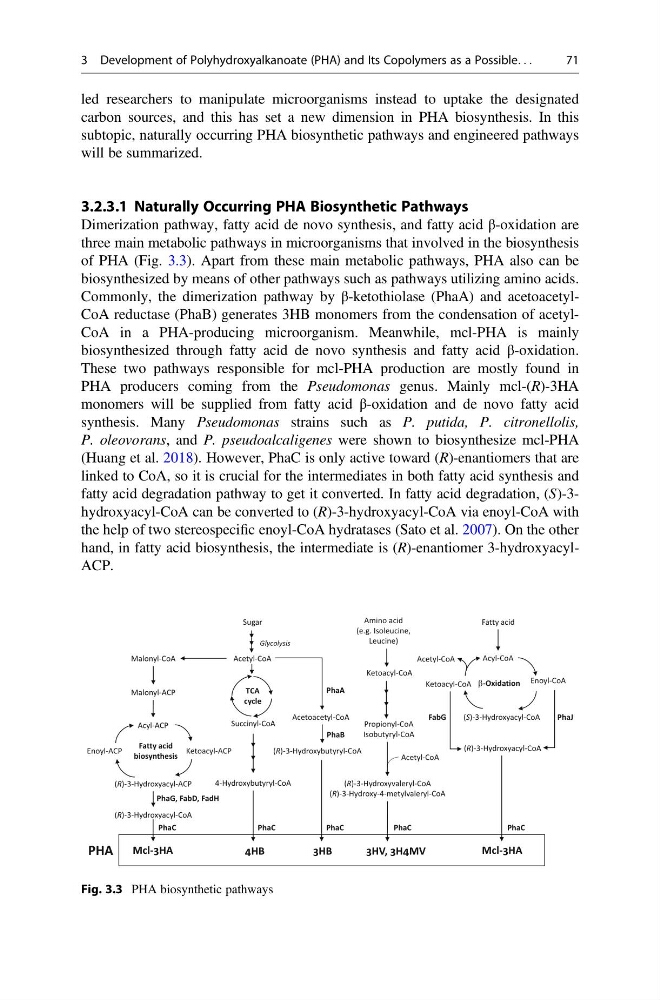
Dimerization pathway, fatty acid de novo synthesis, and fatty acid β-oxidation are
three main metabolic pathways in microorganisms that involved in the biosynthesis
of PHA (Fig. 3.3). Apart from these main metabolic pathways, PHA also can be
biosynthesized by means of other pathways such as pathways utilizing amino acids.
Commonly, the dimerization pathway by β-ketothiolase (PhaA) and acetoacetylCoA reductase (PhaB) generates 3HB monomers from the condensation of acetylCoA in a PHA-producing microorganism. Meanwhile, mcl-PHA is mainly
biosynthesized through fatty acid de novo synthesis and fatty acid β-oxidation.
These two pathways responsible for mcl-PHA production are mostly found in
PHA producers coming from the Pseudomonas genus. Mainly mcl-(R)-3HA
monomers will be supplied from fatty acid β-oxidation and de novo fatty acid
synthesis. Many Pseudomonas strains such as P. putida, P. citronellolis,
P. oleovorans, and P. pseudoalcaligenes were shown to biosynthesize mcl-PHA
(Huang et al. 2018). However, PhaC is only active toward (R)-enantiomers that are
linked to CoA, so it is crucial for the intermediates in both fatty acid synthesis and
fatty acid degradation pathway to get it converted. In fatty acid degradation, (S)-3hydroxyacyl-CoA can be converted to (R)-3-hydroxyacyl-CoA via enoyl-CoA with
the help of two stereospecific enoyl-CoA hydratases (Sato et al. 2007). On the other
hand, in fatty acid biosynthesis, the intermediate is (R)-enantiomer 3-hydroxyacylACP.
Fatty acid
biosynthesis
Amino acid
(e.g. Isoleucine,
Leucine)
Sugar
Acetyl-CoA
4-Hydroxybutyryl-CoA
Propionyl-CoA
Isobutyryl-CoA
Acetyl-CoA
(R)-3-Hydroxyvaleryl-CoA
(R)-3-Hydroxy-4-metylvaleryl-CoA
Enoyl-ACP
Malonyl-CoA
Malonyl-ACP
Acyl-ACP
(R)-3-Hydroxyacyl-ACP
Ketoacyl-ACP
PhaG, FabD, FadH
(R)-3-Hydroxyacyl-CoA
PhaC
Glycolysis
TCA
cycle
Succinyl-CoA
Mcl-3HA
Fatty acid
Acyl-CoA
β-Oxidation
Ketoacyl-CoA
Enoyl-CoA
(S)-3-Hydroxyacyl-CoA
(R)-3-Hydroxyacyl-CoA
PhaJ
FabG
Acetyl-CoA
PhaA
PhaB
Acetoacetyl-CoA
(R)-3-Hydroxybutyryl-CoA
Ketoacyl-CoA
3HB
4HB
3HV, 3H4MV
Mcl-3HA
PhaC
PhaC
PhaC
PhaC
PHA
Fig. 3.3 PHA biosynthetic pathways
3 Development of Polyhydroxyalkanoate (PHA) and Its Copolymers as a Possible. . .
71
carbon sources, and this has set a new dimension in PHA biosynthesis. In this
subtopic, naturally occurring PHA biosynthetic pathways and engineered pathways
will be summarized.
3.2.3.1 Naturally Occurring PHA Biosynthetic Pathways
Dimerization pathway, fatty acid de novo synthesis, and fatty acid β-oxidation are
three main metabolic pathways in microorganisms that involved in the biosynthesis
of PHA (Fig. 3.3). Apart from these main metabolic pathways, PHA also can be
biosynthesized by means of other pathways such as pathways utilizing amino acids.
Commonly, the dimerization pathway by β-ketothiolase (PhaA) and acetoacetylCoA reductase (PhaB) generates 3HB monomers from the condensation of acetylCoA in a PHA-producing microorganism. Meanwhile, mcl-PHA is mainly
biosynthesized through fatty acid de novo synthesis and fatty acid β-oxidation.
These two pathways responsible for mcl-PHA production are mostly found in
PHA producers coming from the Pseudomonas genus. Mainly mcl-(R)-3HA
monomers will be supplied from fatty acid β-oxidation and de novo fatty acid
synthesis. Many Pseudomonas strains such as P. putida, P. citronellolis,
P. oleovorans, and P. pseudoalcaligenes were shown to biosynthesize mcl-PHA
(Huang et al. 2018). However, PhaC is only active toward (R)-enantiomers that are
linked to CoA, so it is crucial for the intermediates in both fatty acid synthesis and
fatty acid degradation pathway to get it converted. In fatty acid degradation, (S)-3hydroxyacyl-CoA can be converted to (R)-3-hydroxyacyl-CoA via enoyl-CoA with
the help of two stereospecific enoyl-CoA hydratases (Sato et al. 2007). On the other
hand, in fatty acid biosynthesis, the intermediate is (R)-enantiomer 3-hydroxyacylACP.
Fatty acid
biosynthesis
Amino acid
(e.g. Isoleucine,
Leucine)
Sugar
Acetyl-CoA
4-Hydroxybutyryl-CoA
Propionyl-CoA
Isobutyryl-CoA
Acetyl-CoA
(R)-3-Hydroxyvaleryl-CoA
(R)-3-Hydroxy-4-metylvaleryl-CoA
Enoyl-ACP
Malonyl-CoA
Malonyl-ACP
Acyl-ACP
(R)-3-Hydroxyacyl-ACP
Ketoacyl-ACP
PhaG, FabD, FadH
(R)-3-Hydroxyacyl-CoA
PhaC
Glycolysis
TCA
cycle
Succinyl-CoA
Mcl-3HA
Fatty acid
Acyl-CoA
β-Oxidation
Ketoacyl-CoA
Enoyl-CoA
(S)-3-Hydroxyacyl-CoA
(R)-3-Hydroxyacyl-CoA
PhaJ
FabG
Acetyl-CoA
PhaA
PhaB
Acetoacetyl-CoA
(R)-3-Hydroxybutyryl-CoA
Ketoacyl-CoA
3HB
4HB
3HV, 3H4MV
Mcl-3HA
PhaC
PhaC
PhaC
PhaC
PHA
Fig. 3.3 PHA biosynthetic pathways
3 Development of Polyhydroxyalkanoate (PHA) and Its Copolymers as a Possible. . .
71