

with the hydrolysate of rice husk (Heng et al. 2017). Domestic waste such as waste
cooking oil was also shown to have some potential to be a carbon source for PHA
production. An approximate of 1.2 g/L of P(3HB) obtained from waste frying oil was
1.2 g/L, which is almost similar to a concentration that can be obtained from glucose
(Verlinden et al. 2011). In parallel to the growing research interest on PHA production,
many other novel carbon sources will be added to the list.
3.2.3 Metabolic Pathways for PHA Biosynthesis
Metabolic pathways operating in a microorganism is also an essential deciding factor
in PHA biosynthesis because it gives rise to the relevant precursors for desired PHA
production. Earlier attempts at producing interesting PHAs include basic fermentation technology using naturally occurring PHA-producing bacteria with different
types of carbon sources. However, recent advancement in biotechnology studies has
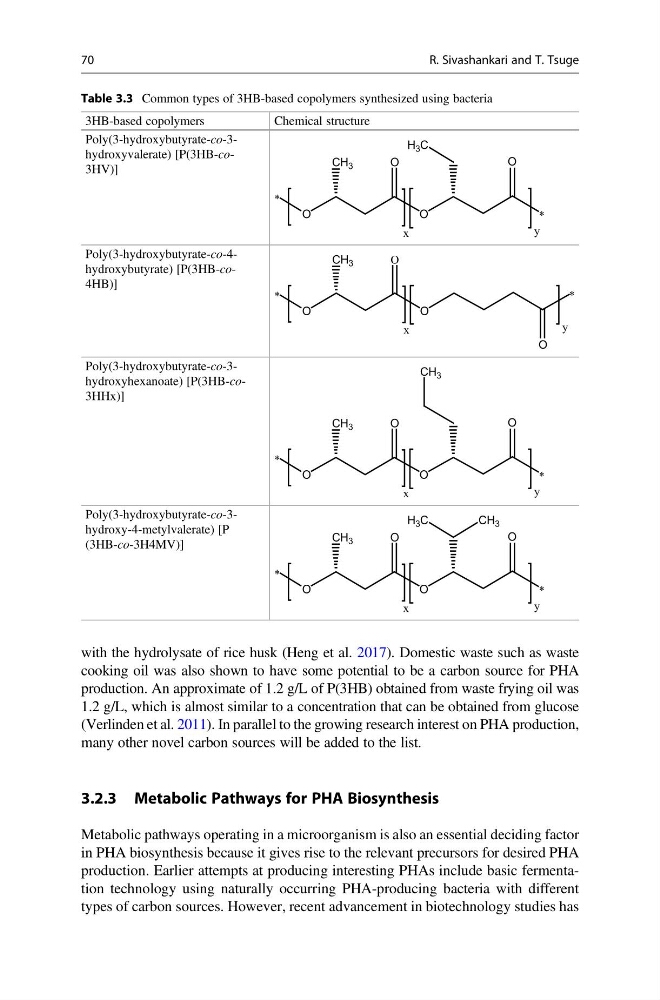
Table 3.3 Common types of 3HB-based copolymers synthesized using bacteria
3HB-based copolymers
Chemical structure
Poly(3-hydroxybutyrate-co-3hydroxyvalerate) [P(3HB-co3HV)]
O
O
O
x
y
H 3 C
O
CH 3
∗
∗
Poly(3-hydroxybutyrate-co-4hydroxybutyrate) [P(3HB-co4HB)]
O
O
x
y
O
CH 3
O
∗
∗
Poly(3-hydroxybutyrate-co-3hydroxyhexanoate) [P(3HB-co3HHx)]
O
O
O
x
y
O
CH 3
CH 3
∗
∗
Poly(3-hydroxybutyrate-co-3hydroxy-4-metylvalerate) [P
(3HB-co-3H4MV)]
O
O
O
x
y
H 3 C
O
CH 3
CH 3
∗
∗
70
R. Sivashankari and T. Tsuge
cooking oil was also shown to have some potential to be a carbon source for PHA
production. An approximate of 1.2 g/L of P(3HB) obtained from waste frying oil was
1.2 g/L, which is almost similar to a concentration that can be obtained from glucose
(Verlinden et al. 2011). In parallel to the growing research interest on PHA production,
many other novel carbon sources will be added to the list.
3.2.3 Metabolic Pathways for PHA Biosynthesis
Metabolic pathways operating in a microorganism is also an essential deciding factor
in PHA biosynthesis because it gives rise to the relevant precursors for desired PHA
production. Earlier attempts at producing interesting PHAs include basic fermentation technology using naturally occurring PHA-producing bacteria with different
types of carbon sources. However, recent advancement in biotechnology studies has
Table 3.3 Common types of 3HB-based copolymers synthesized using bacteria
3HB-based copolymers
Chemical structure
Poly(3-hydroxybutyrate-co-3hydroxyvalerate) [P(3HB-co3HV)]
O
O
O
x
y
H 3 C
O
CH 3
∗
∗
Poly(3-hydroxybutyrate-co-4hydroxybutyrate) [P(3HB-co4HB)]
O
O
x
y
O
CH 3
O
∗
∗
Poly(3-hydroxybutyrate-co-3hydroxyhexanoate) [P(3HB-co3HHx)]
O
O
O
x
y
O
CH 3
CH 3
∗
∗
Poly(3-hydroxybutyrate-co-3hydroxy-4-metylvalerate) [P
(3HB-co-3H4MV)]
O
O
O
x
y
H 3 C
O
CH 3
CH 3
∗
∗
70
R. Sivashankari and T. Tsuge