

et al. 2016), Jharkhand (Alam et al. 2016), Punjab (Sharma et al. 2016), Manipur
(Chandrashekhar et al. 2016), Uttar Pradesh (Olea et al. 2018) and West Bengal
(Bhowmick et al. 2018a) are reported to have arsenic in groundwater with the
concentration exceeding the permissible limit set for drinking water (Prasad et al.
2013).
Most reported arsenic problems (As
III species) have been found in groundwater
supply systems and are caused primarily by natural processes, such as mineral
weathering and dissolution resulting from a change in the geochemical environment
to a reductive condition. Millions of people in West Bengal and Bangladesh had
been drinking groundwater from wells contained arsenic concentration ranging from
100 to 3900 μg L
À1 , with many of them succumbing to diseases caused by it
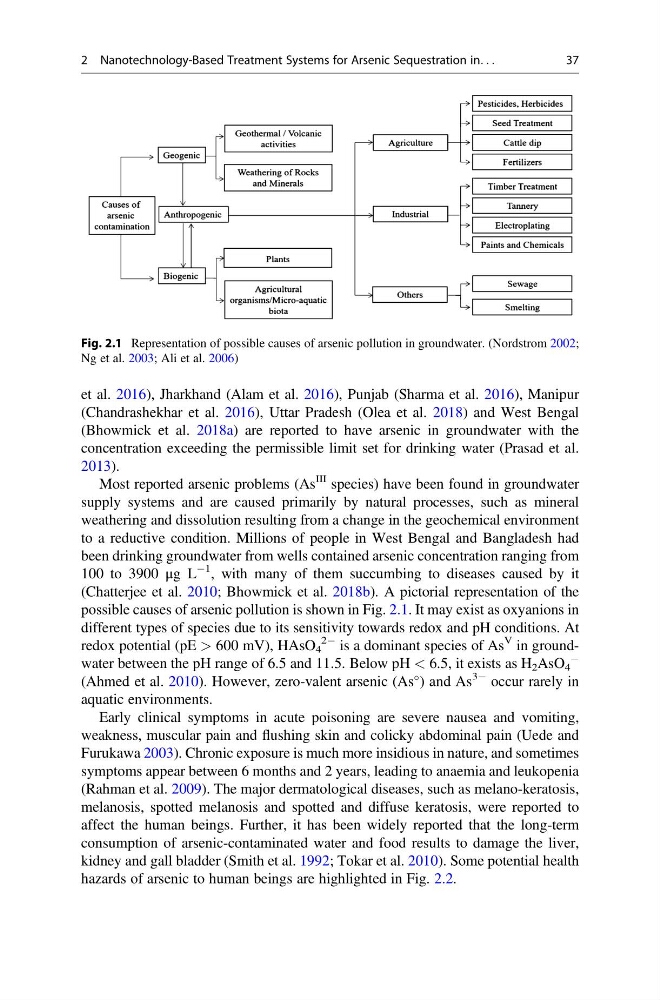
(Chatterjee et al. 2010; Bhowmick et al. 2018b). A pictorial representation of the
possible causes of arsenic pollution is shown in Fig. 2.1. It may exist as oxyanions in
different types of species due to its sensitivity towards redox and pH conditions. At
redox potential (pE > 600 mV), HAsO 4
2À is a dominant species of As
V in groundwater between the pH range of 6.5 and 11.5. Below pH < 6.5, it exists as H 2 AsO 4
À
(Ahmed et al. 2010). However, zero-valent arsenic (As
) and As
3À occur rarely in
aquatic environments.
Early clinical symptoms in acute poisoning are severe nausea and vomiting,
weakness, muscular pain and flushing skin and colicky abdominal pain (Uede and
Furukawa 2003). Chronic exposure is much more insidious in nature, and sometimes
symptoms appear between 6 months and 2 years, leading to anaemia and leukopenia
(Rahman et al. 2009). The major dermatological diseases, such as melano-keratosis,
melanosis, spotted melanosis and spotted and diffuse keratosis, were reported to
affect the human beings. Further, it has been widely reported that the long-term
consumption of arsenic-contaminated water and food results to damage the liver,
kidney and gall bladder (Smith et al. 1992; Tokar et al. 2010). Some potential health
hazards of arsenic to human beings are highlighted in Fig. 2.2.
Fig. 2.1 Representation of possible causes of arsenic pollution in groundwater. (Nordstrom 2002;
Ng et al. 2003; Ali et al. 2006)
2 Nanotechnology-Based Treatment Systems for Arsenic Sequestration in. . .
37
(Chandrashekhar et al. 2016), Uttar Pradesh (Olea et al. 2018) and West Bengal
(Bhowmick et al. 2018a) are reported to have arsenic in groundwater with the
concentration exceeding the permissible limit set for drinking water (Prasad et al.
2013).
Most reported arsenic problems (As
III species) have been found in groundwater
supply systems and are caused primarily by natural processes, such as mineral
weathering and dissolution resulting from a change in the geochemical environment
to a reductive condition. Millions of people in West Bengal and Bangladesh had
been drinking groundwater from wells contained arsenic concentration ranging from
100 to 3900 μg L
À1 , with many of them succumbing to diseases caused by it
(Chatterjee et al. 2010; Bhowmick et al. 2018b). A pictorial representation of the
possible causes of arsenic pollution is shown in Fig. 2.1. It may exist as oxyanions in
different types of species due to its sensitivity towards redox and pH conditions. At
redox potential (pE > 600 mV), HAsO 4
2À is a dominant species of As
V in groundwater between the pH range of 6.5 and 11.5. Below pH < 6.5, it exists as H 2 AsO 4
À
(Ahmed et al. 2010). However, zero-valent arsenic (As
) and As
3À occur rarely in
aquatic environments.
Early clinical symptoms in acute poisoning are severe nausea and vomiting,
weakness, muscular pain and flushing skin and colicky abdominal pain (Uede and
Furukawa 2003). Chronic exposure is much more insidious in nature, and sometimes
symptoms appear between 6 months and 2 years, leading to anaemia and leukopenia
(Rahman et al. 2009). The major dermatological diseases, such as melano-keratosis,
melanosis, spotted melanosis and spotted and diffuse keratosis, were reported to
affect the human beings. Further, it has been widely reported that the long-term
consumption of arsenic-contaminated water and food results to damage the liver,
kidney and gall bladder (Smith et al. 1992; Tokar et al. 2010). Some potential health
hazards of arsenic to human beings are highlighted in Fig. 2.2.
Fig. 2.1 Representation of possible causes of arsenic pollution in groundwater. (Nordstrom 2002;
Ng et al. 2003; Ali et al. 2006)
2 Nanotechnology-Based Treatment Systems for Arsenic Sequestration in. . .
37