

transformation and dilution of pollutants takes place via air-soil-water systems
before being transferred to soil (FAO and ITPS 2015).
16.2 Sources of Soil Pollution
16.2.1 Natural Sources
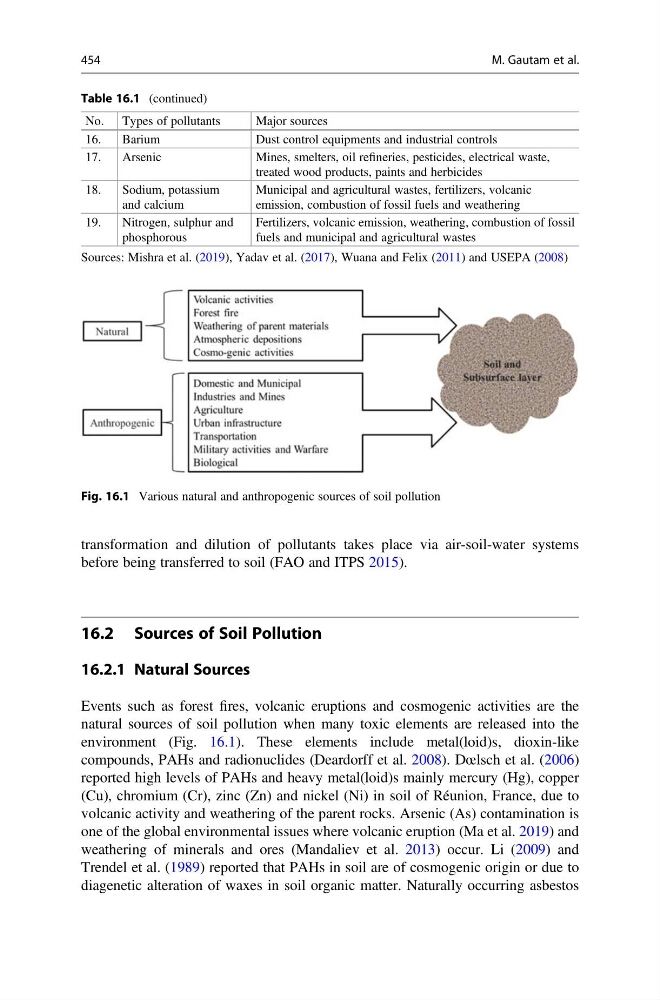
Events such as forest fires, volcanic eruptions and cosmogenic activities are the
natural sources of soil pollution when many toxic elements are released into the
environment (Fig. 16.1). These elements include metal(loid)s, dioxin-like
compounds, PAHs and radionuclides (Deardorff et al. 2008). Dœlsch et al. (2006)
reported high levels of PAHs and heavy metal(loid)s mainly mercury (Hg), copper
(Cu), chromium (Cr), zinc (Zn) and nickel (Ni) in soil of Réunion, France, due to
volcanic activity and weathering of the parent rocks. Arsenic (As) contamination is
one of the global environmental issues where volcanic eruption (Ma et al. 2019) and
weathering of minerals and ores (Mandaliev et al. 2013) occur. Li (2009) and
Trendel et al. (1989) reported that PAHs in soil are of cosmogenic origin or due to
diagenetic alteration of waxes in soil organic matter. Naturally occurring asbestos
Table 16.1 (continued)
No. Types of pollutants
Major sources
16.
Barium
Dust control equipments and industrial controls
17.
Arsenic
Mines, smelters, oil refineries, pesticides, electrical waste,
treated wood products, paints and herbicides
18.
Sodium, potassium
and calcium
Municipal and agricultural wastes, fertilizers, volcanic
emission, combustion of fossil fuels and weathering
19.
Nitrogen, sulphur and
phosphorous
Fertilizers, volcanic emission, weathering, combustion of fossil
fuels and municipal and agricultural wastes
Sources: Mishra et al. (2019), Yadav et al. (2017), Wuana and Felix (2011) and USEPA (2008)
Fig. 16.1 Various natural and anthropogenic sources of soil pollution
454
M. Gautam et al.
before being transferred to soil (FAO and ITPS 2015).
16.2 Sources of Soil Pollution
16.2.1 Natural Sources
Events such as forest fires, volcanic eruptions and cosmogenic activities are the
natural sources of soil pollution when many toxic elements are released into the
environment (Fig. 16.1). These elements include metal(loid)s, dioxin-like
compounds, PAHs and radionuclides (Deardorff et al. 2008). Dœlsch et al. (2006)
reported high levels of PAHs and heavy metal(loid)s mainly mercury (Hg), copper
(Cu), chromium (Cr), zinc (Zn) and nickel (Ni) in soil of Réunion, France, due to
volcanic activity and weathering of the parent rocks. Arsenic (As) contamination is
one of the global environmental issues where volcanic eruption (Ma et al. 2019) and
weathering of minerals and ores (Mandaliev et al. 2013) occur. Li (2009) and
Trendel et al. (1989) reported that PAHs in soil are of cosmogenic origin or due to
diagenetic alteration of waxes in soil organic matter. Naturally occurring asbestos
Table 16.1 (continued)
No. Types of pollutants
Major sources
16.
Barium
Dust control equipments and industrial controls
17.
Arsenic
Mines, smelters, oil refineries, pesticides, electrical waste,
treated wood products, paints and herbicides
18.
Sodium, potassium
and calcium
Municipal and agricultural wastes, fertilizers, volcanic
emission, combustion of fossil fuels and weathering
19.
Nitrogen, sulphur and
phosphorous
Fertilizers, volcanic emission, weathering, combustion of fossil
fuels and municipal and agricultural wastes
Sources: Mishra et al. (2019), Yadav et al. (2017), Wuana and Felix (2011) and USEPA (2008)
Fig. 16.1 Various natural and anthropogenic sources of soil pollution
454
M. Gautam et al.