

that throw out harmful species of cellular cytoplasm such as ATPases type P1B (Nies
1999; Ramírez et al. 2008). Besides, the most relevant resistance mechanism in
bacteria is related to the P1B-type ATPases and chemiosmotic systems. Metallomic
specific researches have showed the interrelationships of metal-induced proteome
and metabolome changes (Lara-Chavero et al. 2018; Metallomics 2012).
The increase in genomic sequencing opens the knowledge of the genes that are
related to the mechanisms of metallic resistance. Furthermore, the influence of metal
ions on gene expression is of great interest in understanding metal resistance in
bacteria. Some genes as cadA encode for such resistance mechanisms, which are
200
150
100
50
0
0
5
10
15
• Cr in Liquid phase
o Cr in Biofilm
)
L
/
g
m
(
r
C
Time (h)
a)
0%
10%
20%
30%
40%
50%
60%
70%
80%
90%
100%
0
1 0
2 0
3 0
4 0
5 0
y
c
n
e
i
c
i
f
f
e
l
a
v
o
m
o
R
%
Time (h)
b)
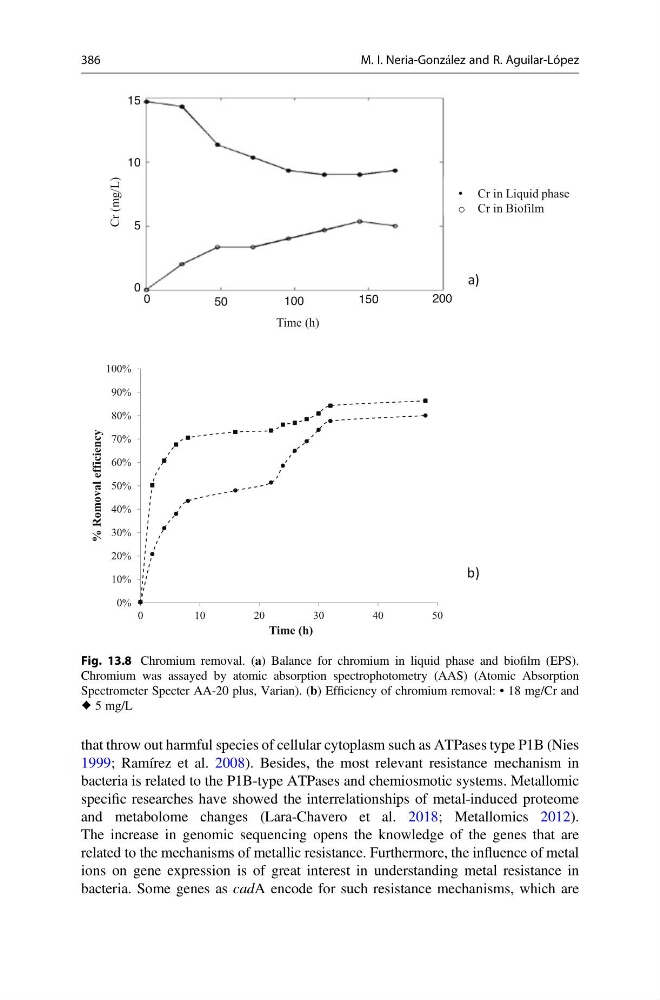
Fig. 13.8 Chromium removal. (a) Balance for chromium in liquid phase and biofilm (EPS).
Chromium was assayed by atomic absorption spectrophotometry (AAS) (Atomic Absorption
Spectrometer Specter AA-20 plus, Varian). (b) Efficiency of chromium removal: • 18 mg/Cr and
♦ 5 mg/L
386
M. I. Neria-González and R. Aguilar-López
1999; Ramírez et al. 2008). Besides, the most relevant resistance mechanism in
bacteria is related to the P1B-type ATPases and chemiosmotic systems. Metallomic
specific researches have showed the interrelationships of metal-induced proteome
and metabolome changes (Lara-Chavero et al. 2018; Metallomics 2012).
The increase in genomic sequencing opens the knowledge of the genes that are
related to the mechanisms of metallic resistance. Furthermore, the influence of metal
ions on gene expression is of great interest in understanding metal resistance in
bacteria. Some genes as cadA encode for such resistance mechanisms, which are
200
150
100
50
0
0
5
10
15
• Cr in Liquid phase
o Cr in Biofilm
)
L
/
g
m
(
r
C
Time (h)
a)
0%
10%
20%
30%
40%
50%
60%
70%
80%
90%
100%
0
1 0
2 0
3 0
4 0
5 0
y
c
n
e
i
c
i
f
f
e
l
a
v
o
m
o
R
%
Time (h)
b)
Fig. 13.8 Chromium removal. (a) Balance for chromium in liquid phase and biofilm (EPS).
Chromium was assayed by atomic absorption spectrophotometry (AAS) (Atomic Absorption
Spectrometer Specter AA-20 plus, Varian). (b) Efficiency of chromium removal: • 18 mg/Cr and
♦ 5 mg/L
386
M. I. Neria-González and R. Aguilar-López