

ligand–receptor recognition moieties such as antibody–antigen has been exploited in
SPR sensors for monitoring the binding reactions among biological substrates
(Couture et al. 2013). Sensing of metal ions in aqueous media is challenging. It is
significant to note that SPR sensors are usually designed with a gold surface fixed
and a monolayer of polymer fixed with molecular receptors that specifically bind
the target (Jung et al. 2013). Similarly, electrodes with gold coatings are in use for
the electrochemical detection of mercury (Martín-Yerga et al. 2013). In both cases,
the detectors’ efficiency is rather limited due to slow diffusion/restricted accessibility
of analytes to the recognition sites. Other issues include low chemical stability, film
adhesion, and high film resistivity. In this aspect, self-assembled monolayers
(SAMs) of specific molecular receptors/biomolecules is emerging as an alternative
(Sánchez et al. 2014). The lower chemical stability of self-assembled monolayers
(SAMs), for example, thiol group oxidation and the nonspecific binding with
impurities of the surface leading to defects/pinholes in the SAMs (Vericat et al.
2010). Apart from SAMs, Langmuir–Blodgett (LB) films containing large or
branched amphiphilic chelators are used, which are found to have lower stability
as they get leached out from the gold surface during the course of analysis
(Prabhakaran et al. 2007). It was demonstrated that the combination of the
Langmuir–Blodgett and self-assembled monolayers techniques (Turygin et al.
2006) resulted in sensitive and selective metal-sensing SPR chips with increased
stability and homogenous orientation of the binding moieties toward the solution.
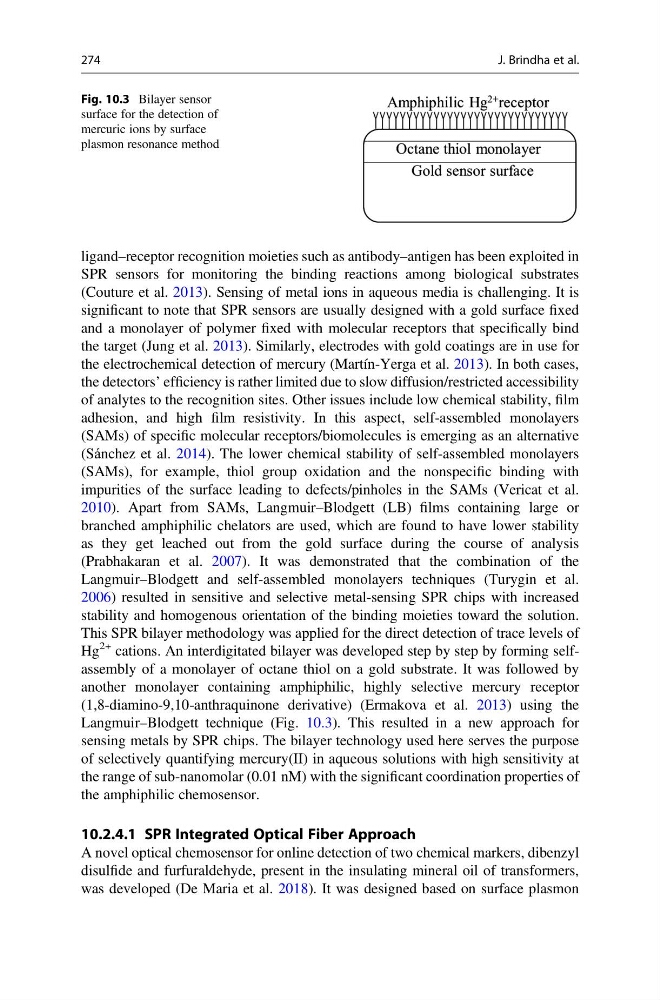
This SPR bilayer methodology was applied for the direct detection of trace levels of
Hg
2+ cations. An interdigitated bilayer was developed step by step by forming selfassembly of a monolayer of octane thiol on a gold substrate. It was followed by
another monolayer containing amphiphilic, highly selective mercury receptor
(1,8-diamino-9,10-anthraquinone derivative) (Ermakova et al. 2013) using the
Langmuir–Blodgett technique (Fig. 10.3). This resulted in a new approach for
sensing metals by SPR chips. The bilayer technology used here serves the purpose
of selectively quantifying mercury(II) in aqueous solutions with high sensitivity at
the range of sub-nanomolar (0.01 nM) with the significant coordination properties of
the amphiphilic chemosensor.
10.2.4.1 SPR Integrated Optical Fiber Approach
A novel optical chemosensor for online detection of two chemical markers, dibenzyl
disulfide and furfuraldehyde, present in the insulating mineral oil of transformers,
was developed (De Maria et al. 2018). It was designed based on surface plasmon
Fig. 10.3 Bilayer sensor
surface for the detection of
mercuric ions by surface
plasmon resonance method
274
J. Brindha et al.
SPR sensors for monitoring the binding reactions among biological substrates
(Couture et al. 2013). Sensing of metal ions in aqueous media is challenging. It is
significant to note that SPR sensors are usually designed with a gold surface fixed
and a monolayer of polymer fixed with molecular receptors that specifically bind
the target (Jung et al. 2013). Similarly, electrodes with gold coatings are in use for
the electrochemical detection of mercury (Martín-Yerga et al. 2013). In both cases,
the detectors’ efficiency is rather limited due to slow diffusion/restricted accessibility
of analytes to the recognition sites. Other issues include low chemical stability, film
adhesion, and high film resistivity. In this aspect, self-assembled monolayers
(SAMs) of specific molecular receptors/biomolecules is emerging as an alternative
(Sánchez et al. 2014). The lower chemical stability of self-assembled monolayers
(SAMs), for example, thiol group oxidation and the nonspecific binding with
impurities of the surface leading to defects/pinholes in the SAMs (Vericat et al.
2010). Apart from SAMs, Langmuir–Blodgett (LB) films containing large or
branched amphiphilic chelators are used, which are found to have lower stability
as they get leached out from the gold surface during the course of analysis
(Prabhakaran et al. 2007). It was demonstrated that the combination of the
Langmuir–Blodgett and self-assembled monolayers techniques (Turygin et al.
2006) resulted in sensitive and selective metal-sensing SPR chips with increased
stability and homogenous orientation of the binding moieties toward the solution.
This SPR bilayer methodology was applied for the direct detection of trace levels of
Hg
2+ cations. An interdigitated bilayer was developed step by step by forming selfassembly of a monolayer of octane thiol on a gold substrate. It was followed by
another monolayer containing amphiphilic, highly selective mercury receptor
(1,8-diamino-9,10-anthraquinone derivative) (Ermakova et al. 2013) using the
Langmuir–Blodgett technique (Fig. 10.3). This resulted in a new approach for
sensing metals by SPR chips. The bilayer technology used here serves the purpose
of selectively quantifying mercury(II) in aqueous solutions with high sensitivity at
the range of sub-nanomolar (0.01 nM) with the significant coordination properties of
the amphiphilic chemosensor.
10.2.4.1 SPR Integrated Optical Fiber Approach
A novel optical chemosensor for online detection of two chemical markers, dibenzyl
disulfide and furfuraldehyde, present in the insulating mineral oil of transformers,
was developed (De Maria et al. 2018). It was designed based on surface plasmon
Fig. 10.3 Bilayer sensor
surface for the detection of
mercuric ions by surface
plasmon resonance method
274
J. Brindha et al.