

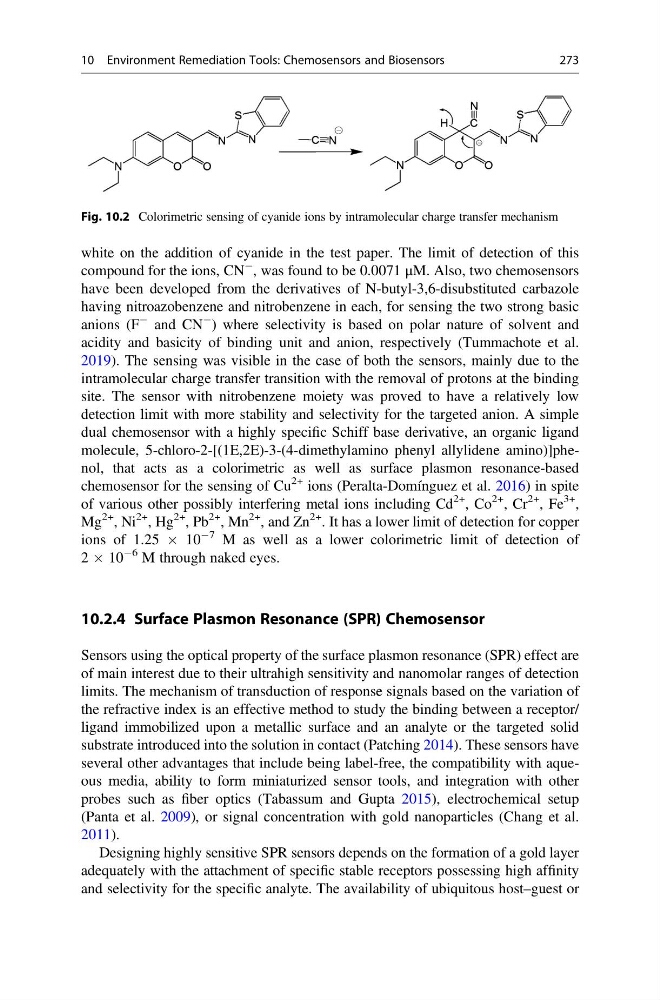
white on the addition of cyanide in the test paper. The limit of detection of this
compound for the ions, CN
À
, was found to be 0.0071 μM. Also, two chemosensors
have been developed from the derivatives of N-butyl-3,6-disubstituted carbazole
having nitroazobenzene and nitrobenzene in each, for sensing the two strong basic
anions (F
À and CN
À
) where selectivity is based on polar nature of solvent and
acidity and basicity of binding unit and anion, respectively (Tummachote et al.
2019). The sensing was visible in the case of both the sensors, mainly due to the
intramolecular charge transfer transition with the removal of protons at the binding
site. The sensor with nitrobenzene moiety was proved to have a relatively low
detection limit with more stability and selectivity for the targeted anion. A simple
dual chemosensor with a highly specific Schiff base derivative, an organic ligand
molecule, 5-chloro-2-[(1E,2E)-3-(4-dimethylamino phenyl allylidene amino)]phenol, that acts as a colorimetric as well as surface plasmon resonance-based
chemosensor for the sensing of Cu
2+ ions (Peralta-Domínguez et al. 2016) in spite
of various other possibly interfering metal ions including Cd
2+ , Co
2+ , Cr
2+ , Fe
3+ ,
Mg
2+ , Ni
2+ , Hg
2+ , Pb
2+ , Mn
2+ , and Zn
2+ . It has a lower limit of detection for copper
ions of 1.25 Â 10
À7 M as well as a lower colorimetric limit of detection of
2 Â 10
À6 M through naked eyes.
10.2.4 Surface Plasmon Resonance (SPR) Chemosensor
Sensors using the optical property of the surface plasmon resonance (SPR) effect are
of main interest due to their ultrahigh sensitivity and nanomolar ranges of detection
limits. The mechanism of transduction of response signals based on the variation of
the refractive index is an effective method to study the binding between a receptor/
ligand immobilized upon a metallic surface and an analyte or the targeted solid
substrate introduced into the solution in contact (Patching 2014). These sensors have
several other advantages that include being label-free, the compatibility with aqueous media, ability to form miniaturized sensor tools, and integration with other
probes such as fiber optics (Tabassum and Gupta 2015), electrochemical setup
(Panta et al. 2009), or signal concentration with gold nanoparticles (Chang et al.
2011).
Designing highly sensitive SPR sensors depends on the formation of a gold layer
adequately with the attachment of specific stable receptors possessing high affinity
and selectivity for the specific analyte. The availability of ubiquitous host–guest or
Fig. 10.2 Colorimetric sensing of cyanide ions by intramolecular charge transfer mechanism
10 Environment Remediation Tools: Chemosensors and Biosensors
273
compound for the ions, CN
À
, was found to be 0.0071 μM. Also, two chemosensors
have been developed from the derivatives of N-butyl-3,6-disubstituted carbazole
having nitroazobenzene and nitrobenzene in each, for sensing the two strong basic
anions (F
À and CN
À
) where selectivity is based on polar nature of solvent and
acidity and basicity of binding unit and anion, respectively (Tummachote et al.
2019). The sensing was visible in the case of both the sensors, mainly due to the
intramolecular charge transfer transition with the removal of protons at the binding
site. The sensor with nitrobenzene moiety was proved to have a relatively low
detection limit with more stability and selectivity for the targeted anion. A simple
dual chemosensor with a highly specific Schiff base derivative, an organic ligand
molecule, 5-chloro-2-[(1E,2E)-3-(4-dimethylamino phenyl allylidene amino)]phenol, that acts as a colorimetric as well as surface plasmon resonance-based
chemosensor for the sensing of Cu
2+ ions (Peralta-Domínguez et al. 2016) in spite
of various other possibly interfering metal ions including Cd
2+ , Co
2+ , Cr
2+ , Fe
3+ ,
Mg
2+ , Ni
2+ , Hg
2+ , Pb
2+ , Mn
2+ , and Zn
2+ . It has a lower limit of detection for copper
ions of 1.25 Â 10
À7 M as well as a lower colorimetric limit of detection of
2 Â 10
À6 M through naked eyes.
10.2.4 Surface Plasmon Resonance (SPR) Chemosensor
Sensors using the optical property of the surface plasmon resonance (SPR) effect are
of main interest due to their ultrahigh sensitivity and nanomolar ranges of detection
limits. The mechanism of transduction of response signals based on the variation of
the refractive index is an effective method to study the binding between a receptor/
ligand immobilized upon a metallic surface and an analyte or the targeted solid
substrate introduced into the solution in contact (Patching 2014). These sensors have
several other advantages that include being label-free, the compatibility with aqueous media, ability to form miniaturized sensor tools, and integration with other
probes such as fiber optics (Tabassum and Gupta 2015), electrochemical setup
(Panta et al. 2009), or signal concentration with gold nanoparticles (Chang et al.
2011).
Designing highly sensitive SPR sensors depends on the formation of a gold layer
adequately with the attachment of specific stable receptors possessing high affinity
and selectivity for the specific analyte. The availability of ubiquitous host–guest or
Fig. 10.2 Colorimetric sensing of cyanide ions by intramolecular charge transfer mechanism
10 Environment Remediation Tools: Chemosensors and Biosensors
273