

with toxicity, carcinogenicity, and mutagenicity may expose humans (Revel et al.
2018). Airborne textile microfibers are generally very large to be inhaled, but smaller
particles can be inhaled easily (Dris et al. 2017). Airborne tiny textile fibers released
along with dust are likely to be inhaled, and recently, plastic micro-sized fibers have
been reported in human pulmonary tissues, signifying that some tiny fibers may
enter through the respiratory tract (Gasperi et al. 2018). Harmful effects of this MF
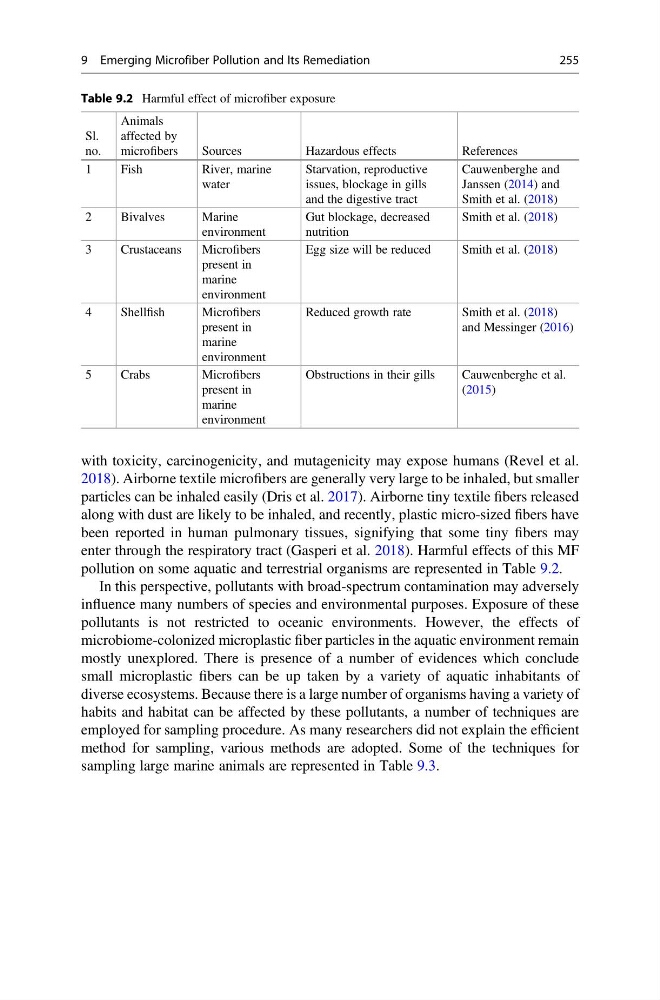
pollution on some aquatic and terrestrial organisms are represented in Table 9.2.
In this perspective, pollutants with broad-spectrum contamination may adversely
influence many numbers of species and environmental purposes. Exposure of these
pollutants is not restricted to oceanic environments. However, the effects of
microbiome-colonized microplastic fiber particles in the aquatic environment remain
mostly unexplored. There is presence of a number of evidences which conclude
small microplastic fibers can be up taken by a variety of aquatic inhabitants of
diverse ecosystems. Because there is a large number of organisms having a variety of
habits and habitat can be affected by these pollutants, a number of techniques are
employed for sampling procedure. As many researchers did not explain the efficient
method for sampling, various methods are adopted. Some of the techniques for
sampling large marine animals are represented in Table 9.3.
Table 9.2 Harmful effect of microfiber exposure
Sl.
no.
Animals
affected by
microfibers
Sources
Hazardous effects
References
1
Fish
River, marine
water
Starvation, reproductive
issues, blockage in gills
and the digestive tract
Cauwenberghe and
Janssen (2014) and
Smith et al. (2018)
2
Bivalves
Marine
environment
Gut blockage, decreased
nutrition
Smith et al. (2018)
3
Crustaceans
Microfibers
present in
marine
environment
Egg size will be reduced
Smith et al. (2018)
4
Shellfish
Microfibers
present in
marine
environment
Reduced growth rate
Smith et al. (2018)
and Messinger (2016)
5
Crabs
Microfibers
present in
marine
environment
Obstructions in their gills
Cauwenberghe et al.
(2015)
9 Emerging Microfiber Pollution and Its Remediation
255
2018). Airborne textile microfibers are generally very large to be inhaled, but smaller
particles can be inhaled easily (Dris et al. 2017). Airborne tiny textile fibers released
along with dust are likely to be inhaled, and recently, plastic micro-sized fibers have
been reported in human pulmonary tissues, signifying that some tiny fibers may
enter through the respiratory tract (Gasperi et al. 2018). Harmful effects of this MF
pollution on some aquatic and terrestrial organisms are represented in Table 9.2.
In this perspective, pollutants with broad-spectrum contamination may adversely
influence many numbers of species and environmental purposes. Exposure of these
pollutants is not restricted to oceanic environments. However, the effects of
microbiome-colonized microplastic fiber particles in the aquatic environment remain
mostly unexplored. There is presence of a number of evidences which conclude
small microplastic fibers can be up taken by a variety of aquatic inhabitants of
diverse ecosystems. Because there is a large number of organisms having a variety of
habits and habitat can be affected by these pollutants, a number of techniques are
employed for sampling procedure. As many researchers did not explain the efficient
method for sampling, various methods are adopted. Some of the techniques for
sampling large marine animals are represented in Table 9.3.
Table 9.2 Harmful effect of microfiber exposure
Sl.
no.
Animals
affected by
microfibers
Sources
Hazardous effects
References
1
Fish
River, marine
water
Starvation, reproductive
issues, blockage in gills
and the digestive tract
Cauwenberghe and
Janssen (2014) and
Smith et al. (2018)
2
Bivalves
Marine
environment
Gut blockage, decreased
nutrition
Smith et al. (2018)
3
Crustaceans
Microfibers
present in
marine
environment
Egg size will be reduced
Smith et al. (2018)
4
Shellfish
Microfibers
present in
marine
environment
Reduced growth rate
Smith et al. (2018)
and Messinger (2016)
5
Crabs
Microfibers
present in
marine
environment
Obstructions in their gills
Cauwenberghe et al.
(2015)
9 Emerging Microfiber Pollution and Its Remediation
255