

sediment composition, soil pH, cation exchange capacity, particle size, permeability
and the presence of other contaminants.
A modified sequential extraction procedure (SEP), originally proposed by the
Commission of the European Communities Bureau of Reference (BCR) (Rauret
et al. 1999), applied to the same sediment samples (Vojteková et al. 2008; Blašková
et al. 2013) allowed to distinguish different fractions (water-soluble and extractable
fraction, metals bound to carbonates easily extractable by a weak acid and metals
bound to Mn and Fe oxides) of the heavy metals studied. If we compare recovery
values for Cu, Ni and Zn given by the two extraction techniques, a percentage
computed as a sum of the amounts determined in steps one and two of SEP was
Table 5.4 Removal of Cu, Pb, Ni and Zn from contaminated soils and sediments by different
agents
Sample
2% Triton X-100
2% Triton X-114
Metabolites of A. niger
Cu
Pb
Ni
Zn
Cu
Pb
Ni
Zn
Cu
Pb
Ni
Zn
%
%
%
%
%
%
%
%
%
%
%
%
Soil Šobov
5.8 0.4 5.6 1.8 5.6 0.5 1.3 3.3 4.9 0.4 4.8 1.2
Soil Pezinok
0.9 0.1 4.8 2.7 0.8 0.2 2.5 3.8 1.3 0.5 2.5 2.5
Sediment
Richňava
1.8 0.2 4.4 4.1 1.9 0.3 1.8 4.6 4.0 0.2 4.7 2.8
Sediment
Jaklovce
1.1 0.1 5.2 3.8 1.0 0.2 2.8 5.4 4.7 0.3 3.3 4.4
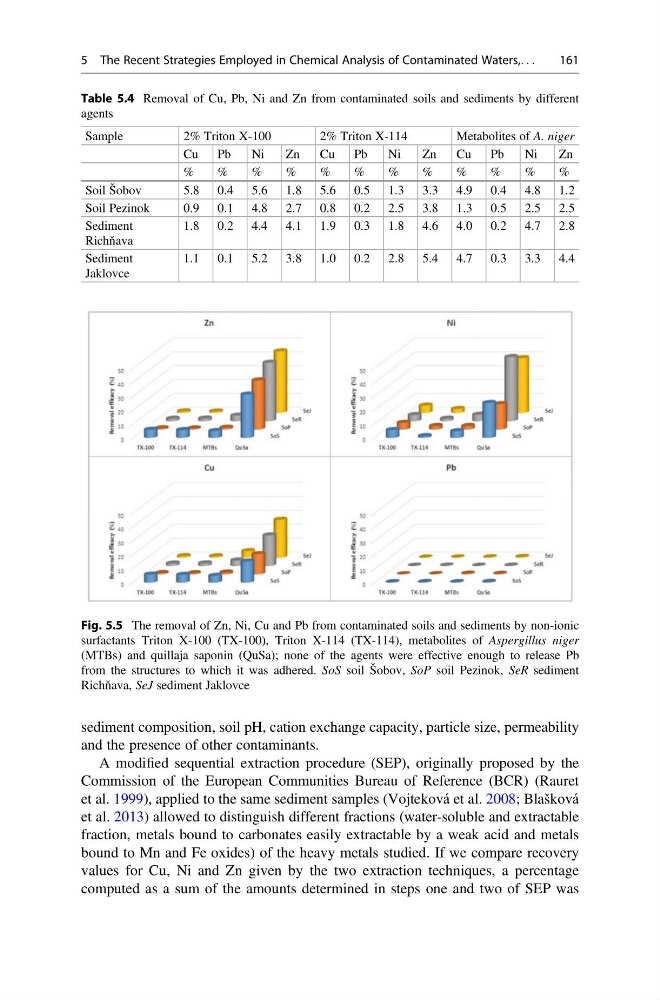
Fig. 5.5 The removal of Zn, Ni, Cu and Pb from contaminated soils and sediments by non-ionic
surfactants Triton X-100 (TX-100), Triton X-114 (TX-114), metabolites of Aspergillus niger
(MTBs) and quillaja saponin (QuSa); none of the agents were effective enough to release Pb
from the structures to which it was adhered. SoS soil Šobov, SoP soil Pezinok, SeR sediment
Richňava, SeJ sediment Jaklovce
5 The Recent Strategies Employed in Chemical Analysis of Contaminated Waters,. . .
161
and the presence of other contaminants.
A modified sequential extraction procedure (SEP), originally proposed by the
Commission of the European Communities Bureau of Reference (BCR) (Rauret
et al. 1999), applied to the same sediment samples (Vojteková et al. 2008; Blašková
et al. 2013) allowed to distinguish different fractions (water-soluble and extractable
fraction, metals bound to carbonates easily extractable by a weak acid and metals
bound to Mn and Fe oxides) of the heavy metals studied. If we compare recovery
values for Cu, Ni and Zn given by the two extraction techniques, a percentage
computed as a sum of the amounts determined in steps one and two of SEP was
Table 5.4 Removal of Cu, Pb, Ni and Zn from contaminated soils and sediments by different
agents
Sample
2% Triton X-100
2% Triton X-114
Metabolites of A. niger
Cu
Pb
Ni
Zn
Cu
Pb
Ni
Zn
Cu
Pb
Ni
Zn
%
%
%
%
%
%
%
%
%
%
%
%
Soil Šobov
5.8 0.4 5.6 1.8 5.6 0.5 1.3 3.3 4.9 0.4 4.8 1.2
Soil Pezinok
0.9 0.1 4.8 2.7 0.8 0.2 2.5 3.8 1.3 0.5 2.5 2.5
Sediment
Richňava
1.8 0.2 4.4 4.1 1.9 0.3 1.8 4.6 4.0 0.2 4.7 2.8
Sediment
Jaklovce
1.1 0.1 5.2 3.8 1.0 0.2 2.8 5.4 4.7 0.3 3.3 4.4
Fig. 5.5 The removal of Zn, Ni, Cu and Pb from contaminated soils and sediments by non-ionic
surfactants Triton X-100 (TX-100), Triton X-114 (TX-114), metabolites of Aspergillus niger
(MTBs) and quillaja saponin (QuSa); none of the agents were effective enough to release Pb
from the structures to which it was adhered. SoS soil Šobov, SoP soil Pezinok, SeR sediment
Richňava, SeJ sediment Jaklovce
5 The Recent Strategies Employed in Chemical Analysis of Contaminated Waters,. . .
161