

reduce energy consumption, maximize atom economy, prevent waste, avoid chemical derivatization and minimize potential for accidents (Anastas and Warner 1998;
Azmir et al. 2013).
5.4.4.1 Quillaja Saponins
The soap bark tree or soapbark (Quillaja saponaria) is one of the major commercial
sources of saponins (Cheeke 2000); saponin extracted from the bark of this tree can
be used as a natural low molecular weight biosurfactant (Bai and McClements 2016),
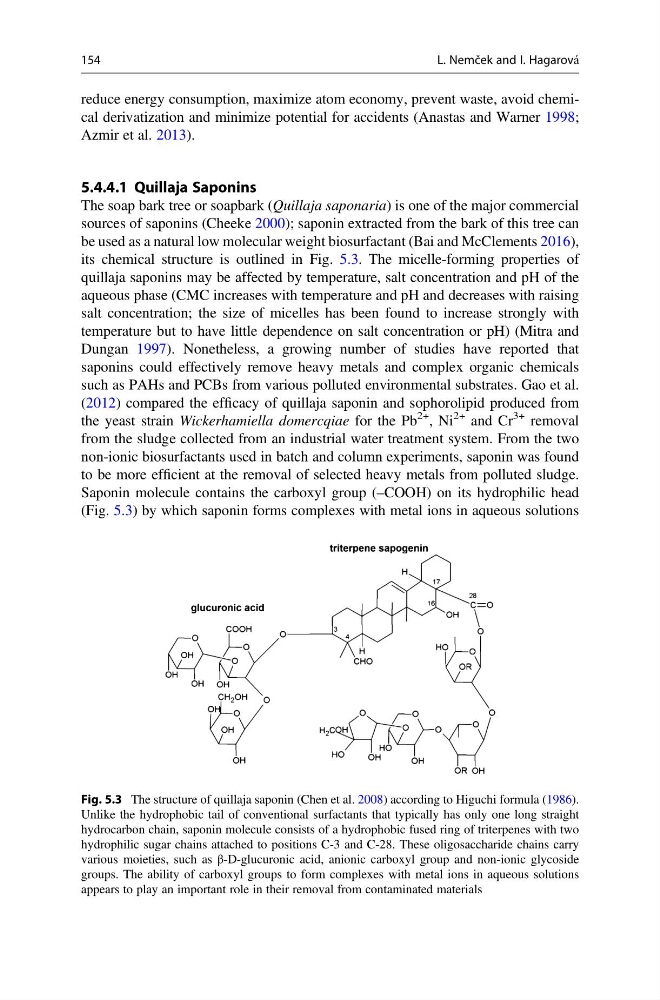
its chemical structure is outlined in Fig. 5.3. The micelle-forming properties of
quillaja saponins may be affected by temperature, salt concentration and pH of the
aqueous phase (CMC increases with temperature and pH and decreases with raising
salt concentration; the size of micelles has been found to increase strongly with
temperature but to have little dependence on salt concentration or pH) (Mitra and
Dungan 1997). Nonetheless, a growing number of studies have reported that
saponins could effectively remove heavy metals and complex organic chemicals
such as PAHs and PCBs from various polluted environmental substrates. Gao et al.
(2012) compared the efficacy of quillaja saponin and sophorolipid produced from
the yeast strain Wickerhamiella domercqiae for the Pb
2+ , Ni
2+ and Cr
3+ removal
from the sludge collected from an industrial water treatment system. From the two
non-ionic biosurfactants used in batch and column experiments, saponin was found
to be more efficient at the removal of selected heavy metals from polluted sludge.
Saponin molecule contains the carboxyl group (–COOH) on its hydrophilic head
(Fig. 5.3) by which saponin forms complexes with metal ions in aqueous solutions
Fig. 5.3 The structure of quillaja saponin (Chen et al. 2008) according to Higuchi formula (1986).
Unlike the hydrophobic tail of conventional surfactants that typically has only one long straight
hydrocarbon chain, saponin molecule consists of a hydrophobic fused ring of triterpenes with two
hydrophilic sugar chains attached to positions C-3 and C-28. These oligosaccharide chains carry
various moieties, such as β-D-glucuronic acid, anionic carboxyl group and non-ionic glycoside
groups. The ability of carboxyl groups to form complexes with metal ions in aqueous solutions
appears to play an important role in their removal from contaminated materials
154
L. Nemček and I. Hagarová
Azmir et al. 2013).
5.4.4.1 Quillaja Saponins
The soap bark tree or soapbark (Quillaja saponaria) is one of the major commercial
sources of saponins (Cheeke 2000); saponin extracted from the bark of this tree can
be used as a natural low molecular weight biosurfactant (Bai and McClements 2016),
its chemical structure is outlined in Fig. 5.3. The micelle-forming properties of
quillaja saponins may be affected by temperature, salt concentration and pH of the
aqueous phase (CMC increases with temperature and pH and decreases with raising
salt concentration; the size of micelles has been found to increase strongly with
temperature but to have little dependence on salt concentration or pH) (Mitra and
Dungan 1997). Nonetheless, a growing number of studies have reported that
saponins could effectively remove heavy metals and complex organic chemicals
such as PAHs and PCBs from various polluted environmental substrates. Gao et al.
(2012) compared the efficacy of quillaja saponin and sophorolipid produced from
the yeast strain Wickerhamiella domercqiae for the Pb
2+ , Ni
2+ and Cr
3+ removal
from the sludge collected from an industrial water treatment system. From the two
non-ionic biosurfactants used in batch and column experiments, saponin was found
to be more efficient at the removal of selected heavy metals from polluted sludge.
Saponin molecule contains the carboxyl group (–COOH) on its hydrophilic head
(Fig. 5.3) by which saponin forms complexes with metal ions in aqueous solutions
Fig. 5.3 The structure of quillaja saponin (Chen et al. 2008) according to Higuchi formula (1986).
Unlike the hydrophobic tail of conventional surfactants that typically has only one long straight
hydrocarbon chain, saponin molecule consists of a hydrophobic fused ring of triterpenes with two
hydrophilic sugar chains attached to positions C-3 and C-28. These oligosaccharide chains carry
various moieties, such as β-D-glucuronic acid, anionic carboxyl group and non-ionic glycoside
groups. The ability of carboxyl groups to form complexes with metal ions in aqueous solutions
appears to play an important role in their removal from contaminated materials
154
L. Nemček and I. Hagarová