

be rich in saponins are ginseng, licorice root, asparagus, soybeans, sugar beet,
chickpea, green pea, horse chestnut, quinoa, etc. (Price et al. 1987; Fenwick et al.
1991; Shidhaye et al. 2008; Cheok et al. 2014; Shin et al. 2015). Saponins are
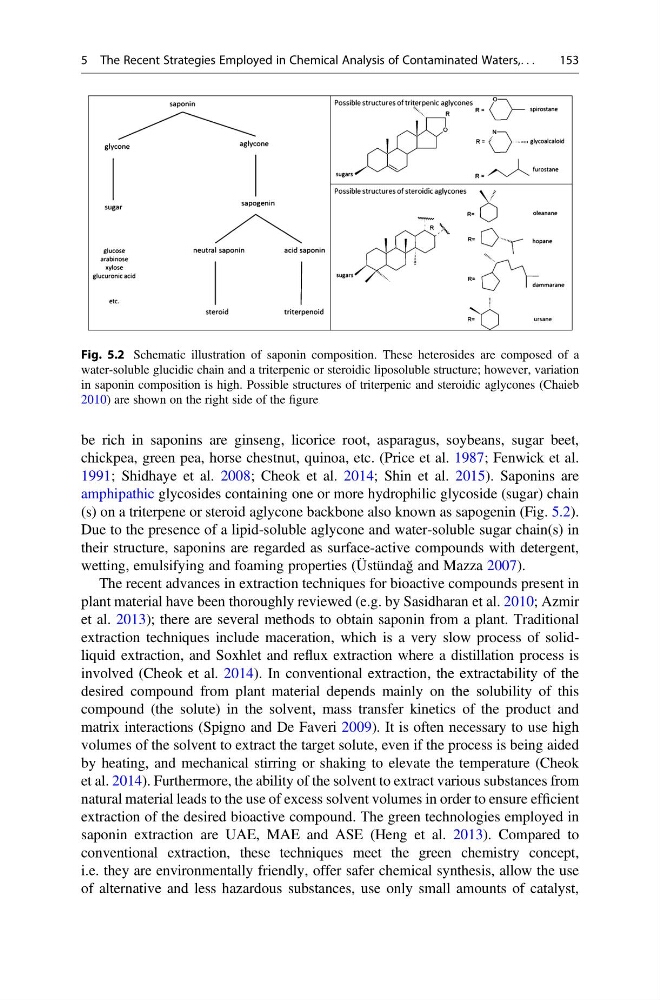
amphipathic glycosides containing one or more hydrophilic glycoside (sugar) chain
(s) on a triterpene or steroid aglycone backbone also known as sapogenin (Fig. 5.2).
Due to the presence of a lipid-soluble aglycone and water-soluble sugar chain(s) in
their structure, saponins are regarded as surface-active compounds with detergent,
wetting, emulsifying and foaming properties (Üstündağ and Mazza 2007).
The recent advances in extraction techniques for bioactive compounds present in
plant material have been thoroughly reviewed (e.g. by Sasidharan et al. 2010; Azmir
et al. 2013); there are several methods to obtain saponin from a plant. Traditional
extraction techniques include maceration, which is a very slow process of solidliquid extraction, and Soxhlet and reflux extraction where a distillation process is
involved (Cheok et al. 2014). In conventional extraction, the extractability of the
desired compound from plant material depends mainly on the solubility of this
compound (the solute) in the solvent, mass transfer kinetics of the product and
matrix interactions (Spigno and De Faveri 2009). It is often necessary to use high
volumes of the solvent to extract the target solute, even if the process is being aided
by heating, and mechanical stirring or shaking to elevate the temperature (Cheok
et al. 2014). Furthermore, the ability of the solvent to extract various substances from
natural material leads to the use of excess solvent volumes in order to ensure efficient
extraction of the desired bioactive compound. The green technologies employed in
saponin extraction are UAE, MAE and ASE (Heng et al. 2013). Compared to
conventional extraction, these techniques meet the green chemistry concept,
i.e. they are environmentally friendly, offer safer chemical synthesis, allow the use
of alternative and less hazardous substances, use only small amounts of catalyst,
Fig. 5.2 Schematic illustration of saponin composition. These heterosides are composed of a
water-soluble glucidic chain and a triterpenic or steroidic liposoluble structure; however, variation
in saponin composition is high. Possible structures of triterpenic and steroidic aglycones (Chaieb
2010) are shown on the right side of the figure
5 The Recent Strategies Employed in Chemical Analysis of Contaminated Waters,. . .
153
chickpea, green pea, horse chestnut, quinoa, etc. (Price et al. 1987; Fenwick et al.
1991; Shidhaye et al. 2008; Cheok et al. 2014; Shin et al. 2015). Saponins are
amphipathic glycosides containing one or more hydrophilic glycoside (sugar) chain
(s) on a triterpene or steroid aglycone backbone also known as sapogenin (Fig. 5.2).
Due to the presence of a lipid-soluble aglycone and water-soluble sugar chain(s) in
their structure, saponins are regarded as surface-active compounds with detergent,
wetting, emulsifying and foaming properties (Üstündağ and Mazza 2007).
The recent advances in extraction techniques for bioactive compounds present in
plant material have been thoroughly reviewed (e.g. by Sasidharan et al. 2010; Azmir
et al. 2013); there are several methods to obtain saponin from a plant. Traditional
extraction techniques include maceration, which is a very slow process of solidliquid extraction, and Soxhlet and reflux extraction where a distillation process is
involved (Cheok et al. 2014). In conventional extraction, the extractability of the
desired compound from plant material depends mainly on the solubility of this
compound (the solute) in the solvent, mass transfer kinetics of the product and
matrix interactions (Spigno and De Faveri 2009). It is often necessary to use high
volumes of the solvent to extract the target solute, even if the process is being aided
by heating, and mechanical stirring or shaking to elevate the temperature (Cheok
et al. 2014). Furthermore, the ability of the solvent to extract various substances from
natural material leads to the use of excess solvent volumes in order to ensure efficient
extraction of the desired bioactive compound. The green technologies employed in
saponin extraction are UAE, MAE and ASE (Heng et al. 2013). Compared to
conventional extraction, these techniques meet the green chemistry concept,
i.e. they are environmentally friendly, offer safer chemical synthesis, allow the use
of alternative and less hazardous substances, use only small amounts of catalyst,
Fig. 5.2 Schematic illustration of saponin composition. These heterosides are composed of a
water-soluble glucidic chain and a triterpenic or steroidic liposoluble structure; however, variation
in saponin composition is high. Possible structures of triterpenic and steroidic aglycones (Chaieb
2010) are shown on the right side of the figure
5 The Recent Strategies Employed in Chemical Analysis of Contaminated Waters,. . .
153