

of an extraction disk and subsequently eluted in a selective solvent. It can be used
either as a sample clean-up method or as a preconcentration method. Nowadays, the
large variety of commercially available sorbents makes this technique suitable for
the determination of analytes of divergent chemical structures and polarities
(Escarpa et al. 2012; Chirila and Drăghici 2013). The novel adsorbent materials
being used for solid-phase extraction of pollutants in environmental samples include
carbon nanotubes, TiO 2 nanotubes, graphene, ion imprinting polymers, magnetic
materials (or combination of ion imprinting and magnetic materials), core-shell
materials, mesoporous materials, metal organic frameworks and sorbents of
biological origin derived from bacteria, yeast, algae and fungi (Xiao et al. 2016).
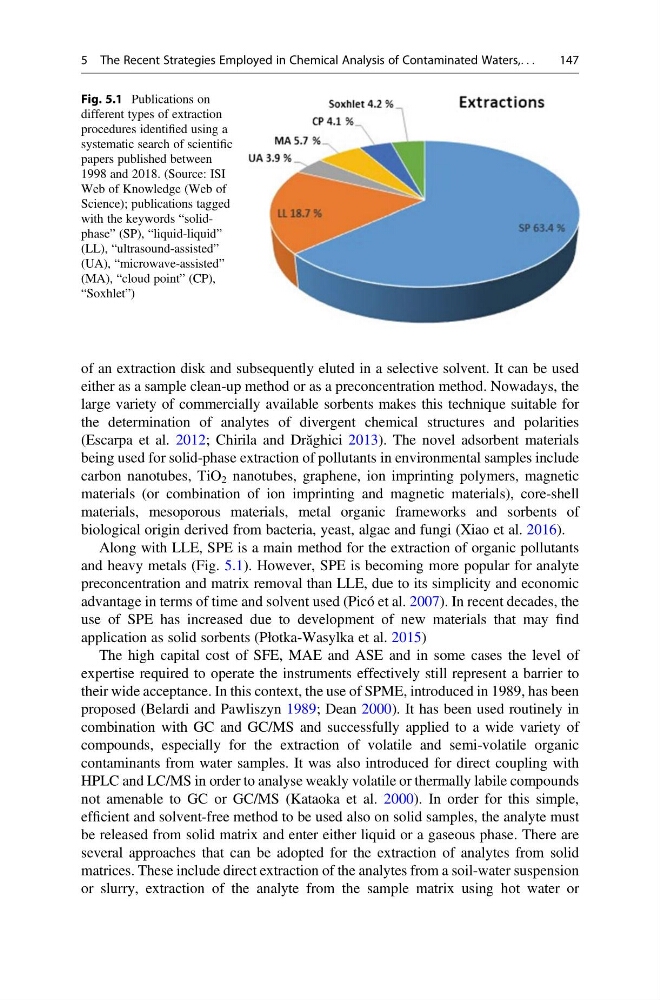
Along with LLE, SPE is a main method for the extraction of organic pollutants
and heavy metals (Fig. 5.1). However, SPE is becoming more popular for analyte
preconcentration and matrix removal than LLE, due to its simplicity and economic
advantage in terms of time and solvent used (Picó et al. 2007). In recent decades, the
use of SPE has increased due to development of new materials that may find
application as solid sorbents (Płotka-Wasylka et al. 2015)
The high capital cost of SFE, MAE and ASE and in some cases the level of
expertise required to operate the instruments effectively still represent a barrier to
their wide acceptance. In this context, the use of SPME, introduced in 1989, has been
proposed (Belardi and Pawliszyn 1989; Dean 2000). It has been used routinely in
combination with GC and GC/MS and successfully applied to a wide variety of
compounds, especially for the extraction of volatile and semi-volatile organic
contaminants from water samples. It was also introduced for direct coupling with
HPLC and LC/MS in order to analyse weakly volatile or thermally labile compounds
not amenable to GC or GC/MS (Kataoka et al. 2000). In order for this simple,
efficient and solvent-free method to be used also on solid samples, the analyte must
be released from solid matrix and enter either liquid or a gaseous phase. There are
several approaches that can be adopted for the extraction of analytes from solid
matrices. These include direct extraction of the analytes from a soil-water suspension
or slurry, extraction of the analyte from the sample matrix using hot water or
Fig. 5.1 Publications on
different types of extraction
procedures identified using a
systematic search of scientific
papers published between
1998 and 2018. (Source: ISI
Web of Knowledge (Web of
Science); publications tagged
with the keywords “solidphase” (SP), “liquid-liquid”
(LL), “ultrasound-assisted”
(UA), “microwave-assisted”
(MA), “cloud point” (CP),
“Soxhlet”)
5 The Recent Strategies Employed in Chemical Analysis of Contaminated Waters,. . .
147
either as a sample clean-up method or as a preconcentration method. Nowadays, the
large variety of commercially available sorbents makes this technique suitable for
the determination of analytes of divergent chemical structures and polarities
(Escarpa et al. 2012; Chirila and Drăghici 2013). The novel adsorbent materials
being used for solid-phase extraction of pollutants in environmental samples include
carbon nanotubes, TiO 2 nanotubes, graphene, ion imprinting polymers, magnetic
materials (or combination of ion imprinting and magnetic materials), core-shell
materials, mesoporous materials, metal organic frameworks and sorbents of
biological origin derived from bacteria, yeast, algae and fungi (Xiao et al. 2016).
Along with LLE, SPE is a main method for the extraction of organic pollutants
and heavy metals (Fig. 5.1). However, SPE is becoming more popular for analyte
preconcentration and matrix removal than LLE, due to its simplicity and economic
advantage in terms of time and solvent used (Picó et al. 2007). In recent decades, the
use of SPE has increased due to development of new materials that may find
application as solid sorbents (Płotka-Wasylka et al. 2015)
The high capital cost of SFE, MAE and ASE and in some cases the level of
expertise required to operate the instruments effectively still represent a barrier to
their wide acceptance. In this context, the use of SPME, introduced in 1989, has been
proposed (Belardi and Pawliszyn 1989; Dean 2000). It has been used routinely in
combination with GC and GC/MS and successfully applied to a wide variety of
compounds, especially for the extraction of volatile and semi-volatile organic
contaminants from water samples. It was also introduced for direct coupling with
HPLC and LC/MS in order to analyse weakly volatile or thermally labile compounds
not amenable to GC or GC/MS (Kataoka et al. 2000). In order for this simple,
efficient and solvent-free method to be used also on solid samples, the analyte must
be released from solid matrix and enter either liquid or a gaseous phase. There are
several approaches that can be adopted for the extraction of analytes from solid
matrices. These include direct extraction of the analytes from a soil-water suspension
or slurry, extraction of the analyte from the sample matrix using hot water or
Fig. 5.1 Publications on
different types of extraction
procedures identified using a
systematic search of scientific
papers published between
1998 and 2018. (Source: ISI
Web of Knowledge (Web of
Science); publications tagged
with the keywords “solidphase” (SP), “liquid-liquid”
(LL), “ultrasound-assisted”
(UA), “microwave-assisted”
(MA), “cloud point” (CP),
“Soxhlet”)
5 The Recent Strategies Employed in Chemical Analysis of Contaminated Waters,. . .
147