

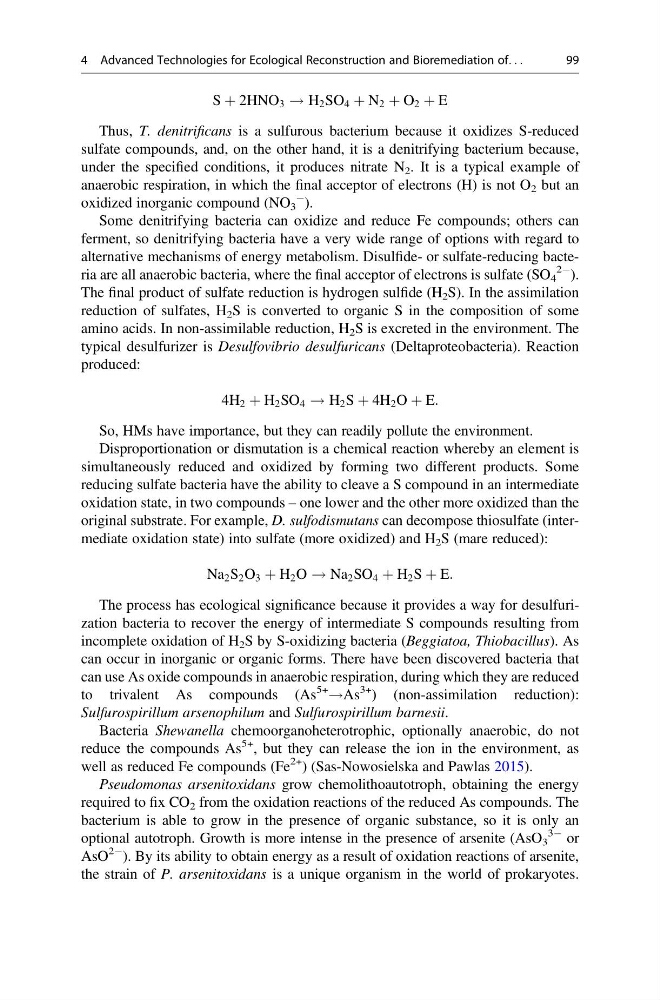
S þ 2HNO 3 ! H 2 SO 4 þ N 2 þ O 2 þ E
Thus, T. denitrificans is a sulfurous bacterium because it oxidizes S-reduced
sulfate compounds, and, on the other hand, it is a denitrifying bacterium because,
under the specified conditions, it produces nitrate N 2 . It is a typical example of
anaerobic respiration, in which the final acceptor of electrons (H) is not O 2 but an
oxidized inorganic compound (NO 3
À ).
Some denitrifying bacteria can oxidize and reduce Fe compounds; others can
ferment, so denitrifying bacteria have a very wide range of options with regard to
alternative mechanisms of energy metabolism. Disulfide- or sulfate-reducing bacteria are all anaerobic bacteria, where the final acceptor of electrons is sulfate (SO 4
2À ).
The final product of sulfate reduction is hydrogen sulfide (H 2 S). In the assimilation
reduction of sulfates, H 2 S is converted to organic S in the composition of some
amino acids. In non-assimilable reduction, H 2 S is excreted in the environment. The
typical desulfurizer is Desulfovibrio desulfuricans (Deltaproteobacteria). Reaction
produced:
4H 2 þ H 2 SO 4 ! H 2 S þ 4H 2 O þ E:
So, HMs have importance, but they can readily pollute the environment.
Disproportionation or dismutation is a chemical reaction whereby an element is
simultaneously reduced and oxidized by forming two different products. Some
reducing sulfate bacteria have the ability to cleave a S compound in an intermediate
oxidation state, in two compounds – one lower and the other more oxidized than the
original substrate. For example, D. sulfodismutans can decompose thiosulfate (intermediate oxidation state) into sulfate (more oxidized) and H 2 S (mare reduced):
Na 2 S 2 O 3 þ H 2 O ! Na 2 SO 4 þ H 2 S þ E:
The process has ecological significance because it provides a way for desulfurization bacteria to recover the energy of intermediate S compounds resulting from
incomplete oxidation of H 2 S by S-oxidizing bacteria (Beggiatoa, Thiobacillus). As
can occur in inorganic or organic forms. There have been discovered bacteria that
can use As oxide compounds in anaerobic respiration, during which they are reduced
to trivalent As compounds (As
5+
!As
3+ ) (non-assimilation reduction):
Sulfurospirillum arsenophilum and Sulfurospirillum barnesii.
Bacteria Shewanella chemoorganoheterotrophic, optionally anaerobic, do not
reduce the compounds As
5+ , but they can release the ion in the environment, as
well as reduced Fe compounds (Fe
2+ ) (Sas-Nowosielska and Pawlas 2015).
Pseudomonas arsenitoxidans grow chemolithoautotroph, obtaining the energy
required to fix CO 2 from the oxidation reactions of the reduced As compounds. The
bacterium is able to grow in the presence of organic substance, so it is only an
optional autotroph. Growth is more intense in the presence of arsenite (AsO 3
3À or
AsO
2À ). By its ability to obtain energy as a result of oxidation reactions of arsenite,
the strain of P. arsenitoxidans is a unique organism in the world of prokaryotes.
4 Advanced Technologies for Ecological Reconstruction and Bioremediation of. . .
99
Thus, T. denitrificans is a sulfurous bacterium because it oxidizes S-reduced
sulfate compounds, and, on the other hand, it is a denitrifying bacterium because,
under the specified conditions, it produces nitrate N 2 . It is a typical example of
anaerobic respiration, in which the final acceptor of electrons (H) is not O 2 but an
oxidized inorganic compound (NO 3
À ).
Some denitrifying bacteria can oxidize and reduce Fe compounds; others can
ferment, so denitrifying bacteria have a very wide range of options with regard to
alternative mechanisms of energy metabolism. Disulfide- or sulfate-reducing bacteria are all anaerobic bacteria, where the final acceptor of electrons is sulfate (SO 4
2À ).
The final product of sulfate reduction is hydrogen sulfide (H 2 S). In the assimilation
reduction of sulfates, H 2 S is converted to organic S in the composition of some
amino acids. In non-assimilable reduction, H 2 S is excreted in the environment. The
typical desulfurizer is Desulfovibrio desulfuricans (Deltaproteobacteria). Reaction
produced:
4H 2 þ H 2 SO 4 ! H 2 S þ 4H 2 O þ E:
So, HMs have importance, but they can readily pollute the environment.
Disproportionation or dismutation is a chemical reaction whereby an element is
simultaneously reduced and oxidized by forming two different products. Some
reducing sulfate bacteria have the ability to cleave a S compound in an intermediate
oxidation state, in two compounds – one lower and the other more oxidized than the
original substrate. For example, D. sulfodismutans can decompose thiosulfate (intermediate oxidation state) into sulfate (more oxidized) and H 2 S (mare reduced):
Na 2 S 2 O 3 þ H 2 O ! Na 2 SO 4 þ H 2 S þ E:
The process has ecological significance because it provides a way for desulfurization bacteria to recover the energy of intermediate S compounds resulting from
incomplete oxidation of H 2 S by S-oxidizing bacteria (Beggiatoa, Thiobacillus). As
can occur in inorganic or organic forms. There have been discovered bacteria that
can use As oxide compounds in anaerobic respiration, during which they are reduced
to trivalent As compounds (As
5+
!As
3+ ) (non-assimilation reduction):
Sulfurospirillum arsenophilum and Sulfurospirillum barnesii.
Bacteria Shewanella chemoorganoheterotrophic, optionally anaerobic, do not
reduce the compounds As
5+ , but they can release the ion in the environment, as
well as reduced Fe compounds (Fe
2+ ) (Sas-Nowosielska and Pawlas 2015).
Pseudomonas arsenitoxidans grow chemolithoautotroph, obtaining the energy
required to fix CO 2 from the oxidation reactions of the reduced As compounds. The
bacterium is able to grow in the presence of organic substance, so it is only an
optional autotroph. Growth is more intense in the presence of arsenite (AsO 3
3À or
AsO
2À ). By its ability to obtain energy as a result of oxidation reactions of arsenite,
the strain of P. arsenitoxidans is a unique organism in the world of prokaryotes.
4 Advanced Technologies for Ecological Reconstruction and Bioremediation of. . .
99