

expressed by the oxidoreduction potential (redox) ¼ Eh. In their life environments,
including soils, different 54 ecophysiological groups of bacteria perform
oxidoreduction reactions according to potential redox.
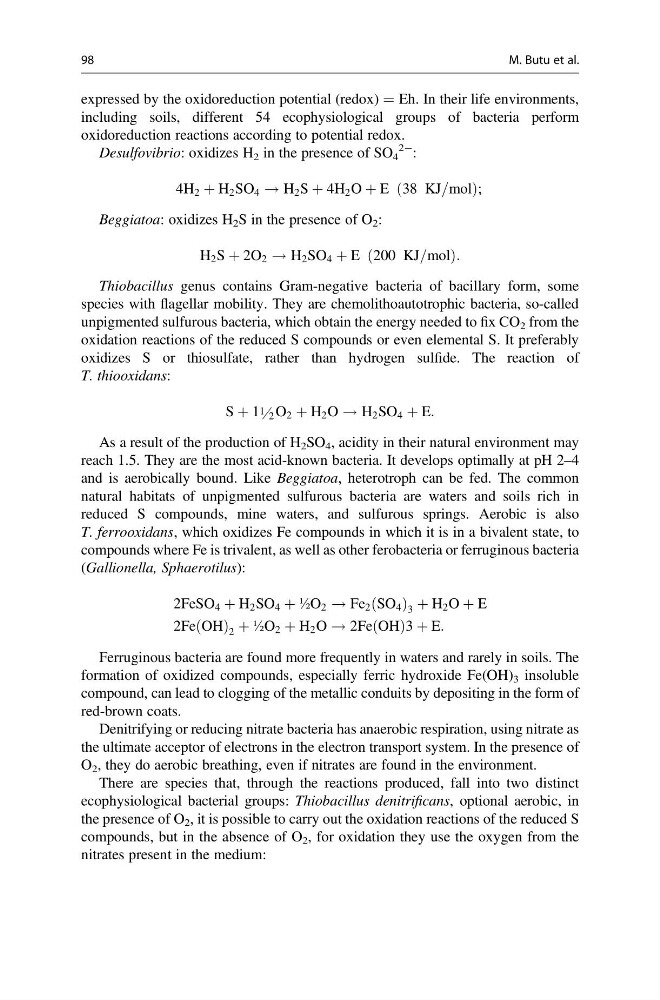
Desulfovibrio: oxidizes H 2 in the presence of SO 4
2À :
4H 2 þ H 2 SO 4 ! H 2 S þ 4H 2 O þ E 38 KJ=mol
ð
Þ ;
Beggiatoa: oxidizes H 2 S in the presence of O 2 :
H 2 S þ 2O 2 ! H 2 SO 4 þ E 200 KJ=mol
ð
Þ :
Thiobacillus genus contains Gram-negative bacteria of bacillary form, some
species with flagellar mobility. They are chemolithoautotrophic bacteria, so-called
unpigmented sulfurous bacteria, which obtain the energy needed to fix CO 2 from the
oxidation reactions of the reduced S compounds or even elemental S. It preferably
oxidizes S or thiosulfate, rather than hydrogen sulfide. The reaction of
T. thiooxidans:
S þ 1 1 = 2 O 2 þ H 2 O ! H 2 SO 4 þ E:
As a result of the production of H 2 SO 4 , acidity in their natural environment may
reach 1.5. They are the most acid-known bacteria. It develops optimally at pH 2–4
and is aerobically bound. Like Beggiatoa, heterotroph can be fed. The common
natural habitats of unpigmented sulfurous bacteria are waters and soils rich in
reduced S compounds, mine waters, and sulfurous springs. Aerobic is also
T. ferrooxidans, which oxidizes Fe compounds in which it is in a bivalent state, to
compounds where Fe is trivalent, as well as other ferobacteria or ferruginous bacteria
(Gallionella, Sphaerotilus):
2FeSO 4 þ H 2 SO 4 þ ½O 2 ! Fe 2 SO 4
ð
Þ 3 þ H 2 O þ E
2Fe OH
ð Þ 2 þ ½O 2 þ H 2 O ! 2Fe OH
ð Þ3 þ E:
Ferruginous bacteria are found more frequently in waters and rarely in soils. The
formation of oxidized compounds, especially ferric hydroxide Fe(OH) 3 insoluble
compound, can lead to clogging of the metallic conduits by depositing in the form of
red-brown coats.
Denitrifying or reducing nitrate bacteria has anaerobic respiration, using nitrate as
the ultimate acceptor of electrons in the electron transport system. In the presence of
O 2 , they do aerobic breathing, even if nitrates are found in the environment.
There are species that, through the reactions produced, fall into two distinct
ecophysiological bacterial groups: Thiobacillus denitrificans, optional aerobic, in
the presence of O 2 , it is possible to carry out the oxidation reactions of the reduced S
compounds, but in the absence of O 2 , for oxidation they use the oxygen from the
nitrates present in the medium:
98
M. Butu et al.
including soils, different 54 ecophysiological groups of bacteria perform
oxidoreduction reactions according to potential redox.
Desulfovibrio: oxidizes H 2 in the presence of SO 4
2À :
4H 2 þ H 2 SO 4 ! H 2 S þ 4H 2 O þ E 38 KJ=mol
ð
Þ ;
Beggiatoa: oxidizes H 2 S in the presence of O 2 :
H 2 S þ 2O 2 ! H 2 SO 4 þ E 200 KJ=mol
ð
Þ :
Thiobacillus genus contains Gram-negative bacteria of bacillary form, some
species with flagellar mobility. They are chemolithoautotrophic bacteria, so-called
unpigmented sulfurous bacteria, which obtain the energy needed to fix CO 2 from the
oxidation reactions of the reduced S compounds or even elemental S. It preferably
oxidizes S or thiosulfate, rather than hydrogen sulfide. The reaction of
T. thiooxidans:
S þ 1 1 = 2 O 2 þ H 2 O ! H 2 SO 4 þ E:
As a result of the production of H 2 SO 4 , acidity in their natural environment may
reach 1.5. They are the most acid-known bacteria. It develops optimally at pH 2–4
and is aerobically bound. Like Beggiatoa, heterotroph can be fed. The common
natural habitats of unpigmented sulfurous bacteria are waters and soils rich in
reduced S compounds, mine waters, and sulfurous springs. Aerobic is also
T. ferrooxidans, which oxidizes Fe compounds in which it is in a bivalent state, to
compounds where Fe is trivalent, as well as other ferobacteria or ferruginous bacteria
(Gallionella, Sphaerotilus):
2FeSO 4 þ H 2 SO 4 þ ½O 2 ! Fe 2 SO 4
ð
Þ 3 þ H 2 O þ E
2Fe OH
ð Þ 2 þ ½O 2 þ H 2 O ! 2Fe OH
ð Þ3 þ E:
Ferruginous bacteria are found more frequently in waters and rarely in soils. The
formation of oxidized compounds, especially ferric hydroxide Fe(OH) 3 insoluble
compound, can lead to clogging of the metallic conduits by depositing in the form of
red-brown coats.
Denitrifying or reducing nitrate bacteria has anaerobic respiration, using nitrate as
the ultimate acceptor of electrons in the electron transport system. In the presence of
O 2 , they do aerobic breathing, even if nitrates are found in the environment.
There are species that, through the reactions produced, fall into two distinct
ecophysiological bacterial groups: Thiobacillus denitrificans, optional aerobic, in
the presence of O 2 , it is possible to carry out the oxidation reactions of the reduced S
compounds, but in the absence of O 2 , for oxidation they use the oxygen from the
nitrates present in the medium:
98
M. Butu et al.