

The microplastics have been found in the scats of the seal Arctocephalus
tropicalis as well as in Arctocephalus gazella which are eating the pelagic fish
Electrona subaspera that has ingested the microplastic (Eriksson and Burton
2003; Van Cauwenberghe and Janssen 2014).
The aquatic animals eaten up by humans without removing the digestive
track, may also inadvertently ingest the microplastic as in the case of eating
Nephrops norvegicus, a crustacean from the Glyde Sea (Alomar and Deudero
2017; Murray and Cowie 2011; Wang et al. 2019).
2.4 Remediation
2.4.1 Primary Recycling
For recycling and reprocessing of plastic litter, the four main techniques are mechanical reprocessing (primary and secondary), thermal recuperation, and chemical
depolymerization. It is actually difficult to recycle plastic technically and economically due to the poor waste separation, high cost of energy, lack of fiscal incentives,
contamination by several other materials, and unstable market outlook (Hahladakis
et al. 2018). For industrial-scale production of recycled industrial plastic, the thermoplastic waste is recycled through mechanical recycling process. This method
gives reliable quality control, and consistent source of feedstocks. The propylene
wastes have been mechanically recycled into propylene granules as shown in
Fig. 2.18. Melt spinning process is another production process to recycle the
industrial plastic wastes as illustrated in Fig. 2.19. The recycled plastic pellets are
melted in a special compartment called extruder where the temperature ranges from
218 to 235
C (Tuladhar and Yin 2019). Molten filaments from the extruder are then
cooled and solidified using cold-water bath. At 120–150
C, these fibers are
converted into tiny cross-sectional parts through an oven. These monofilament fibers
are further processed by passing through the rollers, and their surfaces are further processed using the special indent roller. These indents improve the characteristics of the fibers such as the compatibility (bonding ability) with the concrete
matrix. When the indentation process is completed, the fibers are then sliced into
appropriate length of 50 mm. Through the melt spinning process, the polypropylene
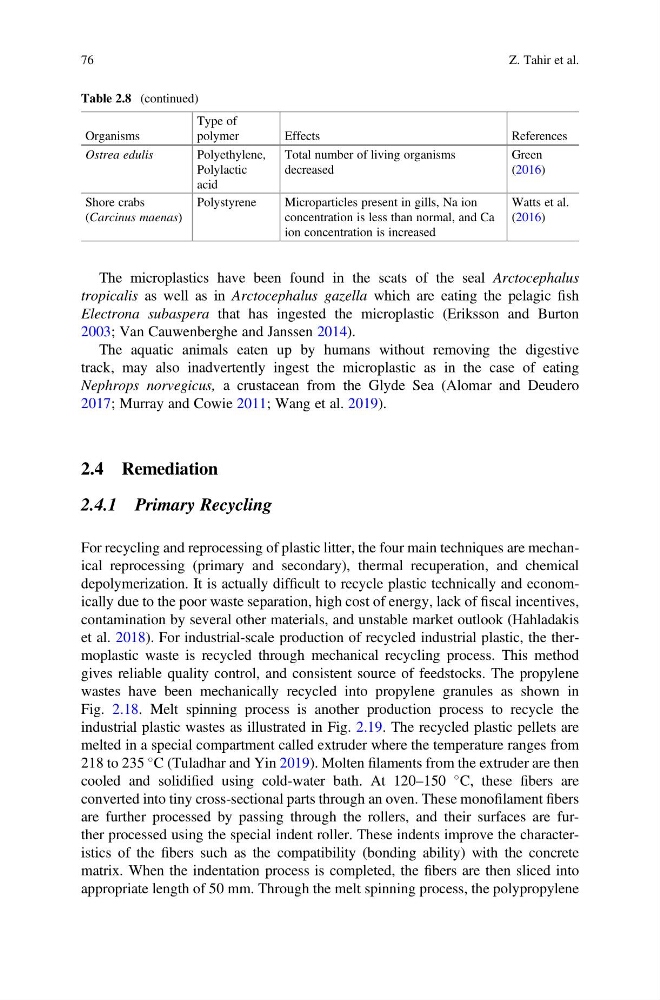
Table 2.8 (continued)
Organisms
Type of
polymer
Effects
References
Ostrea edulis
Polyethylene,
Polylactic
acid
Total number of living organisms
decreased
Green
(2016)
Shore crabs
(Carcinus maenas)
Polystyrene
Microparticles present in gills, Na ion
concentration is less than normal, and Ca
ion concentration is increased
Watts et al.
(2016)
76
Z. Tahir et al.
tropicalis as well as in Arctocephalus gazella which are eating the pelagic fish
Electrona subaspera that has ingested the microplastic (Eriksson and Burton
2003; Van Cauwenberghe and Janssen 2014).
The aquatic animals eaten up by humans without removing the digestive
track, may also inadvertently ingest the microplastic as in the case of eating
Nephrops norvegicus, a crustacean from the Glyde Sea (Alomar and Deudero
2017; Murray and Cowie 2011; Wang et al. 2019).
2.4 Remediation
2.4.1 Primary Recycling
For recycling and reprocessing of plastic litter, the four main techniques are mechanical reprocessing (primary and secondary), thermal recuperation, and chemical
depolymerization. It is actually difficult to recycle plastic technically and economically due to the poor waste separation, high cost of energy, lack of fiscal incentives,
contamination by several other materials, and unstable market outlook (Hahladakis
et al. 2018). For industrial-scale production of recycled industrial plastic, the thermoplastic waste is recycled through mechanical recycling process. This method
gives reliable quality control, and consistent source of feedstocks. The propylene
wastes have been mechanically recycled into propylene granules as shown in
Fig. 2.18. Melt spinning process is another production process to recycle the
industrial plastic wastes as illustrated in Fig. 2.19. The recycled plastic pellets are
melted in a special compartment called extruder where the temperature ranges from
218 to 235
C (Tuladhar and Yin 2019). Molten filaments from the extruder are then
cooled and solidified using cold-water bath. At 120–150
C, these fibers are
converted into tiny cross-sectional parts through an oven. These monofilament fibers
are further processed by passing through the rollers, and their surfaces are further processed using the special indent roller. These indents improve the characteristics of the fibers such as the compatibility (bonding ability) with the concrete
matrix. When the indentation process is completed, the fibers are then sliced into
appropriate length of 50 mm. Through the melt spinning process, the polypropylene
Table 2.8 (continued)
Organisms
Type of
polymer
Effects
References
Ostrea edulis
Polyethylene,
Polylactic
acid
Total number of living organisms
decreased
Green
(2016)
Shore crabs
(Carcinus maenas)
Polystyrene
Microparticles present in gills, Na ion
concentration is less than normal, and Ca
ion concentration is increased
Watts et al.
(2016)
76
Z. Tahir et al.