

79% disposed off by burying in the land or dumped in the landfill. There are no exact
calculations of total marine plastic wastes in comparison to the overall plastic
production. However, it has been calculated that 10% of plastic is annually disposed off into the seas and oceans (Mendenhall 2018). Aquatic pollutants can adsorb
easily onto the surface of small particles, and persistent organic pollutants are concentrated onto the mats of microplastics. These high concentrations can cause
endocrine disorder, and have negative impacts as the combination of the microbial
and chemical carriers increases the risk of fish contamination, which would eventually enter the human and animal food chain.
Atmosphere
Polypropylene particles can be transported by the wind. These may come from the
cloth fibers, abrasive tires, plastic sheets, and can be breathed in by humans or
animals. In urban areas and big cities the air may contain about 200 particles/m
3 /day.
Polypropylene particles are carcinogens and can concentrate in the brain, lungs, and
gastrointestinal track and cause serious problems if present in high amount (Waring
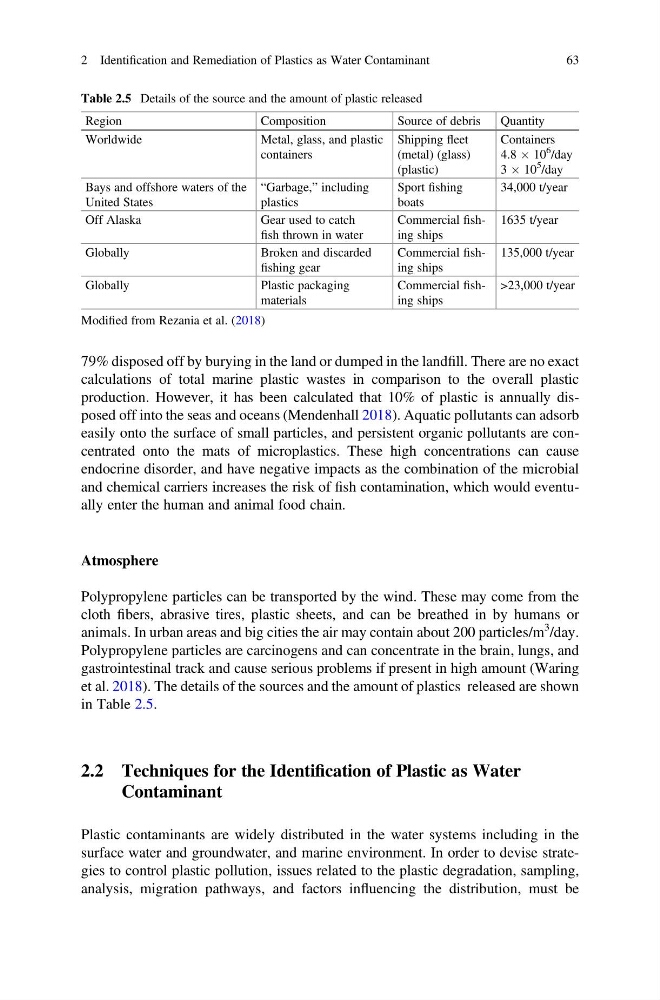
et al. 2018). The details of the sources and the amount of plastics released are shown
in Table 2.5.
2.2 Techniques for the Identification of Plastic as Water
Contaminant
Plastic contaminants are widely distributed in the water systems including in the
surface water and groundwater, and marine environment. In order to devise strategies to control plastic pollution, issues related to the plastic degradation, sampling,
analysis, migration pathways, and factors influencing the distribution, must be
Table 2.5 Details of the source and the amount of plastic released
Region
Composition
Source of debris
Quantity
Worldwide
Metal, glass, and plastic
containers
Shipping fleet
(metal) (glass)
(plastic)
Containers
4.8 Â 10
6
/day
3 Â 10
5
/day
Bays and offshore waters of the
United States
“Garbage,” including
plastics
Sport fishing
boats
34,000 t/year
Off Alaska
Gear used to catch
fish thrown in water
Commercial fishing ships
1635 t/year
Globally
Broken and discarded
fishing gear
Commercial fishing ships
135,000 t/year
Globally
Plastic packaging
materials
Commercial fishing ships
>23,000 t/year
Modified from Rezania et al. (2018)
2 Identification and Remediation of Plastics as Water Contaminant
63
calculations of total marine plastic wastes in comparison to the overall plastic
production. However, it has been calculated that 10% of plastic is annually disposed off into the seas and oceans (Mendenhall 2018). Aquatic pollutants can adsorb
easily onto the surface of small particles, and persistent organic pollutants are concentrated onto the mats of microplastics. These high concentrations can cause
endocrine disorder, and have negative impacts as the combination of the microbial
and chemical carriers increases the risk of fish contamination, which would eventually enter the human and animal food chain.
Atmosphere
Polypropylene particles can be transported by the wind. These may come from the
cloth fibers, abrasive tires, plastic sheets, and can be breathed in by humans or
animals. In urban areas and big cities the air may contain about 200 particles/m
3 /day.
Polypropylene particles are carcinogens and can concentrate in the brain, lungs, and
gastrointestinal track and cause serious problems if present in high amount (Waring
et al. 2018). The details of the sources and the amount of plastics released are shown
in Table 2.5.
2.2 Techniques for the Identification of Plastic as Water
Contaminant
Plastic contaminants are widely distributed in the water systems including in the
surface water and groundwater, and marine environment. In order to devise strategies to control plastic pollution, issues related to the plastic degradation, sampling,
analysis, migration pathways, and factors influencing the distribution, must be
Table 2.5 Details of the source and the amount of plastic released
Region
Composition
Source of debris
Quantity
Worldwide
Metal, glass, and plastic
containers
Shipping fleet
(metal) (glass)
(plastic)
Containers
4.8 Â 10
6
/day
3 Â 10
5
/day
Bays and offshore waters of the
United States
“Garbage,” including
plastics
Sport fishing
boats
34,000 t/year
Off Alaska
Gear used to catch
fish thrown in water
Commercial fishing ships
1635 t/year
Globally
Broken and discarded
fishing gear
Commercial fishing ships
135,000 t/year
Globally
Plastic packaging
materials
Commercial fishing ships
>23,000 t/year
Modified from Rezania et al. (2018)
2 Identification and Remediation of Plastics as Water Contaminant
63