

transportation and activities of the gas and oil, and fishing industries. Samples
obtained from the Ross Sea in the Antarctica is found to have plastic particles of
0.3–22 nm in size.
Plastics constitute 20% of the wastes in the sea contributed by the marine flotsam
and jetsam, and angling activities. The disposed angling items include the thin single
filamentous lines, and the nylon net, which could endanger the aquatic life (Li et al.
2016).
Other marine garbages may originate from the business or military vessels,
recreational watercrafts and ships, and oil tankers. Some of the wastes are unlawfully
released or extracted from the junks to recover nets, ropes, trawl skims, and other
angling-related items (Sheavly and Register 2007).
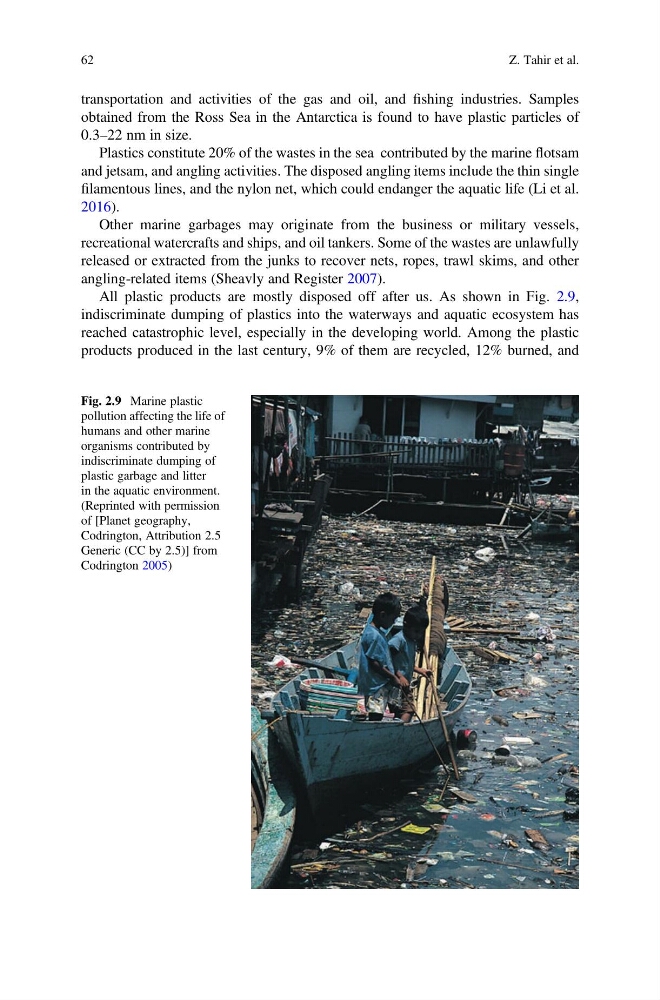
All plastic products are mostly disposed off after us. As shown in Fig. 2.9,
indiscriminate dumping of plastics into the waterways and aquatic ecosystem has
reached catastrophic level, especially in the developing world. Among the plastic
products produced in the last century, 9% of them are recycled, 12% burned, and
Fig. 2.9 Marine plastic
pollution affecting the life of
humans and other marine
organisms contributed by
indiscriminate dumping of
plastic garbage and litter
in the aquatic environment.
(Reprinted with permission
of [Planet geography,
Codrington, Attribution 2.5
Generic (CC by 2.5)] from
Codrington 2005)
62
Z. Tahir et al.
obtained from the Ross Sea in the Antarctica is found to have plastic particles of
0.3–22 nm in size.
Plastics constitute 20% of the wastes in the sea contributed by the marine flotsam
and jetsam, and angling activities. The disposed angling items include the thin single
filamentous lines, and the nylon net, which could endanger the aquatic life (Li et al.
2016).
Other marine garbages may originate from the business or military vessels,
recreational watercrafts and ships, and oil tankers. Some of the wastes are unlawfully
released or extracted from the junks to recover nets, ropes, trawl skims, and other
angling-related items (Sheavly and Register 2007).
All plastic products are mostly disposed off after us. As shown in Fig. 2.9,
indiscriminate dumping of plastics into the waterways and aquatic ecosystem has
reached catastrophic level, especially in the developing world. Among the plastic
products produced in the last century, 9% of them are recycled, 12% burned, and
Fig. 2.9 Marine plastic
pollution affecting the life of
humans and other marine
organisms contributed by
indiscriminate dumping of
plastic garbage and litter
in the aquatic environment.
(Reprinted with permission
of [Planet geography,
Codrington, Attribution 2.5
Generic (CC by 2.5)] from
Codrington 2005)
62
Z. Tahir et al.