

selectivity. Furthermore, it also exhibited outstanding performance in the separation
of oil and water when used as a membrane.
18.3.4 Melamine Foam Composite Materials
Melamine foam possesses an open structure having pores, functioning as an ideal
candidate to be a part of composite nanomaterials for wastewater treatment. Normally, other one-dimensional or two-dimensional materials along with melamine
foam are generally used to make composite in order to retain its porous nature. Yu
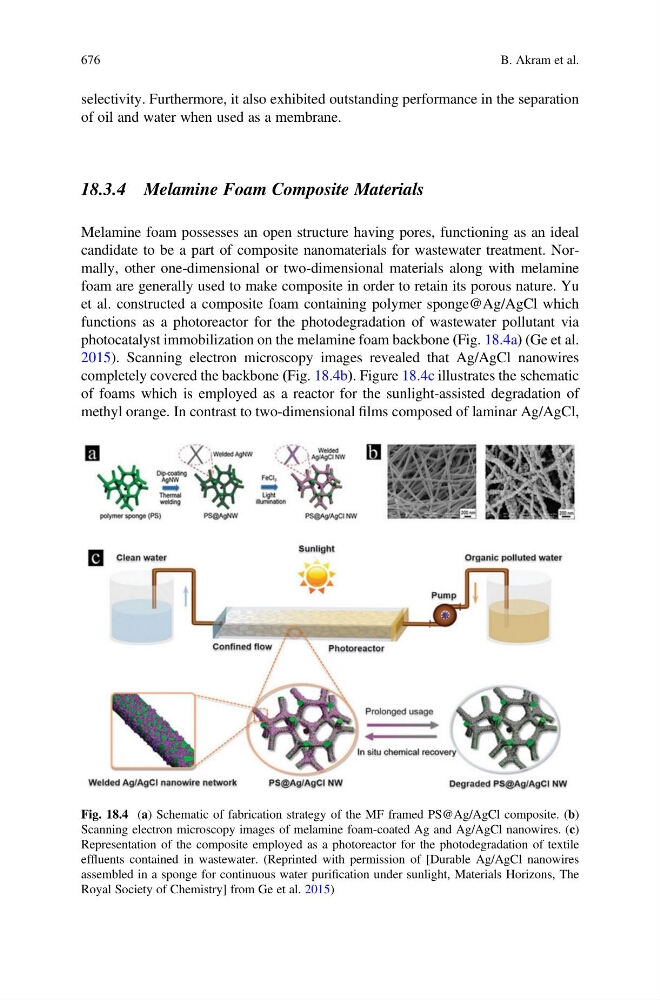
et al. constructed a composite foam containing polymer sponge@Ag/AgCl which
functions as a photoreactor for the photodegradation of wastewater pollutant via
photocatalyst immobilization on the melamine foam backbone (Fig. 18.4a) (Ge et al.
2015). Scanning electron microscopy images revealed that Ag/AgCl nanowires
completely covered the backbone (Fig. 18.4b). Figure 18.4c illustrates the schematic
of foams which is employed as a reactor for the sunlight-assisted degradation of
methyl orange. In contrast to two-dimensional films composed of laminar Ag/AgCl,
Fig. 18.4 (a) Schematic of fabrication strategy of the MF framed PS@Ag/AgCl composite. (b)
Scanning electron microscopy images of melamine foam-coated Ag and Ag/AgCl nanowires. (c)
Representation of the composite employed as a photoreactor for the photodegradation of textile
effluents contained in wastewater. (Reprinted with permission of [Durable Ag/AgCl nanowires
assembled in a sponge for continuous water purification under sunlight, Materials Horizons, The
Royal Society of Chemistry] from Ge et al. 2015)
676
B. Akram et al.
of oil and water when used as a membrane.
18.3.4 Melamine Foam Composite Materials
Melamine foam possesses an open structure having pores, functioning as an ideal
candidate to be a part of composite nanomaterials for wastewater treatment. Normally, other one-dimensional or two-dimensional materials along with melamine
foam are generally used to make composite in order to retain its porous nature. Yu
et al. constructed a composite foam containing polymer sponge@Ag/AgCl which
functions as a photoreactor for the photodegradation of wastewater pollutant via
photocatalyst immobilization on the melamine foam backbone (Fig. 18.4a) (Ge et al.
2015). Scanning electron microscopy images revealed that Ag/AgCl nanowires
completely covered the backbone (Fig. 18.4b). Figure 18.4c illustrates the schematic
of foams which is employed as a reactor for the sunlight-assisted degradation of
methyl orange. In contrast to two-dimensional films composed of laminar Ag/AgCl,
Fig. 18.4 (a) Schematic of fabrication strategy of the MF framed PS@Ag/AgCl composite. (b)
Scanning electron microscopy images of melamine foam-coated Ag and Ag/AgCl nanowires. (c)
Representation of the composite employed as a photoreactor for the photodegradation of textile
effluents contained in wastewater. (Reprinted with permission of [Durable Ag/AgCl nanowires
assembled in a sponge for continuous water purification under sunlight, Materials Horizons, The
Royal Society of Chemistry] from Ge et al. 2015)
676
B. Akram et al.